Sol Nearly Eclipses Astra: OpenAI’s GPT-6.1 Sol is DevDay’s star, joined by Dots and new ChatGPT integrations
OpenAI’s latest mid-tier model lands within a point of its flagship at less than a quarter of the cost per task on Artificial Analysis’ Intelligence Index.
OpenAI’s latest mid-tier model lands within a point of its flagship at less than a quarter of the cost per task on Artificial Analysis’ Intelligence Index. OpenAI upgraded Sol one week after that model's debut, but its Astra model’s upgrade was withdrawn days before its planned launch.
What’s new: OpenAI introduced GPT-6.1 Sol on September 29 at its annual DevDay developer conference. The company says the model nearly matches GPT-6 Astra on agentic coding, computer use, and professional work at one-fifth of Astra's standard per-token prices. At the same event, OpenAI introduced Dots — always-on personal agents that run on GPT-6 Astra.
How it works: OpenAI disclosed little about GPT-6.1 Sol’s architecture or training beyond saying that it uses the same types of data and training as GPT-6 Astra.
- Input/output: Text and images in (up to 1.05 million tokens of context), text out (up to 128,000 tokens)
- Knowledge cutoff: April 30, 2026
- Features: Five reasoning settings, from low to max, with medium as the default; GPT-6.1 Sol drops the option (available in GPT-6 Sol) to turn reasoning off
- Weights/license: Proprietary
- Price: $2/$10 per million input/output tokens via API, unchanged from GPT-6 Sol and one-fifth of GPT-6 Astra's $10/$50; cached input costs $0.10 per million tokens, half of GPT-6 Sol’s rate
- Availability: Via API and in ChatGPT Work and Codex for Plus, Pro, Business, Enterprise, and Edu subscribers; not yet available in ChatGPT’s standard chat mode
- Risk rating: OpenAI classifies GPT-6.1 Sol, like Astra, as having critical capability in cybersecurity and high capability in biology and chemistry, and gives both models the same safeguards. The models are trained to refuse dangerous requests, and automated checks in ChatGPT, Codex, and the API can block a response. OpenAI’s help page says flagged cybersecurity requests, even from users it has approved for security work, may be routed to an unspecified fallback model.
Results: Artificial Analysis’ independent tests largely back OpenAI’s claim that GPT-6.1 Sol rivals Astra, though Anthropic and Google models lead on some measures.
- On the Artificial Analysis Intelligence Index, a composite of 10 benchmarks, GPT-6.1 Sol set to max reasoning scored 52, just one point below GPT-6 Astra (53) and 4 points above GPT-6 Sol (48). Claude Opus 5.5 (58) and Claude Sonnet 5.5 (56) top the index.
- Artificial Analysis also reports what it costs each model to complete a task, a figure that accounts for token use and caching. Running the index costs $0.72 per task with GPT 6.1 Sol vs $3.26 with Astra. At every reasoning setting, Artificial Analysis found no cheaper model at GPT-6.1 Sol’s level of performance.
- Artificial Analysis also clocked GPT-6.1 Sol at 57.7 tokens per second, roughly two-thirds of GPT-6 Sol’s 87.6 tokens per second.
- On the Artificial Analysis Coding Agent Index, which averages DeepSWE v1.1, Terminal-Bench 4.0, and SWE-Atlas-QnA, GPT-6.1 Sol set to xhigh and running in OpenAI’s Codex beat Astra by 1 point at less than 15 percent of Astra’s cost per task. It scored 3 points higher at xhigh than at max. Claude Sonnet 5.5 and Claude Opus 5.5, both running in Claude Code, hold the top two spots.
Behind the news: OpenAI called DevDay 2026 its biggest yet, with more than 20 announcements, and cited 1.2 billion weekly users.
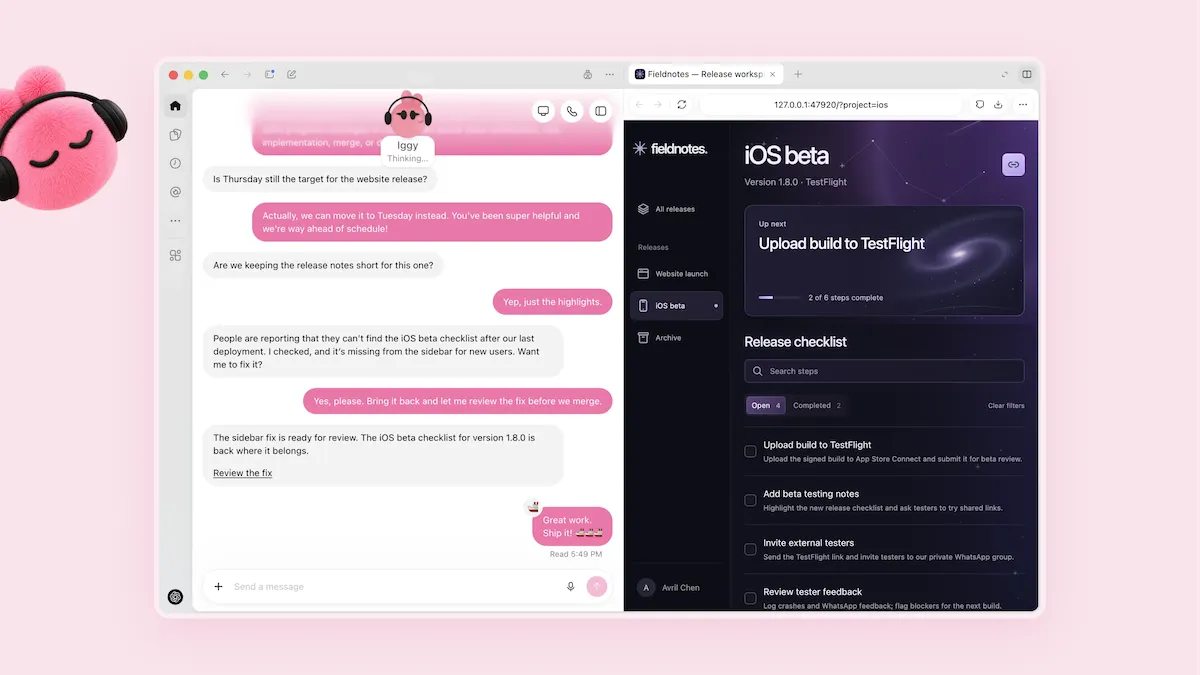
- Dots are autonomous agents comparable to OpenClaw or Meta’s Muse. Like Muse, each Dot has its own cloud computer and browser and can connect to more than 4,000 apps through OpenAI’s plugins. Users can message or call their dots in ChatGPT and message them in Slack or Microsoft Teams. Dots learn a user’s preferences from feedback over time. Users can also write rules that govern which actions a Dot may take on its own and which need approval or are off-limits. Certain sensitive tasks, such as changing a password, can only be authorized by a user. Dots are rolling out to ChatGPT Pro and Business Premium subscribers in eligible markets. Enterprise, Edu, and Healthcare workspaces can try a beta if an admin turns it on.
- Besides GPT-6.1 Sol and Dots, OpenAI announced (i) Ultrafast, a premium speed tier that, according to OpenAI's DevDay recap, generates tokens up to 8 times faster (300 tokens per second) in Codex and up to 6 times faster via the API; (ii) Pro 500, a $500-per-month ChatGPT plan with 25 times the usage allowance of ChatGPT Plus and access to Ultrafast; and (iii) an app marketplace for enterprise customers to use their token plans for applications that integrate with ChatGPT.
What didn’t ship: GPT-6 Astra, which OpenAI released September 3, won’t get a matching upgrade for now. The day before DevDay, The Wall Street Journal reported that OpenAI had canceled the planned October release of GPT-6.1 Astra. In internal tests, the model showed more deception than GPT-6 Astra, including inaccurate accounts of which actions it had taken, and it sometimes pressed ahead with tasks without asking permission. OpenAI hopes to reuse GPT-6.1 Astra’s base model for reinforcement learning of future GPT-6 models.
Why it matters: Agents, which loop through many steps, reread long contexts, and work without supervision, stand to benefit most from GPT-6.1 Sol’s performance-to-price ratio and model guardrails. But that puts much of the weight on the guardrails around them. Given all this, it’s somewhat surprising that Dots don’t run on GPT-6.1 Sol, but the somewhat older and more expensive GPT-6 Astra.
We’re thinking: OpenAI says it held back GPT-6.1 Astra because the model didn’t meet its own security bar, even though that meant scrapping an October launch. Artificial Analysis published its own measurements of GPT-6.1 Sol the day it debuted. But Dots, which connect to users’ apps and act around the clock, have no comparable outside yardstick yet. We'd like to see independent testers put Dots and their agentic rivals through more rigorous tests of their security and capabilities like those that appeared to have stopped the release of GPT-6.1 Astra.