Adaptive Memory Management: Researchers at UCLA, Washington, and Northwestern release MEMCON for agents
Many agents save past experiences as text in an external store, and most search and update such memories using settings the agent’s developer chose by hand, such as the number of memories to retrieve or the schedule for removing them.
Many agents save past experiences as text in an external store, and most search and update such memories using settings the agent’s developer chose by hand, such as the number of memories to retrieve or the schedule for removing them. Researchers developed a method that learns such settings per task and carries what it learns into similar tasks.
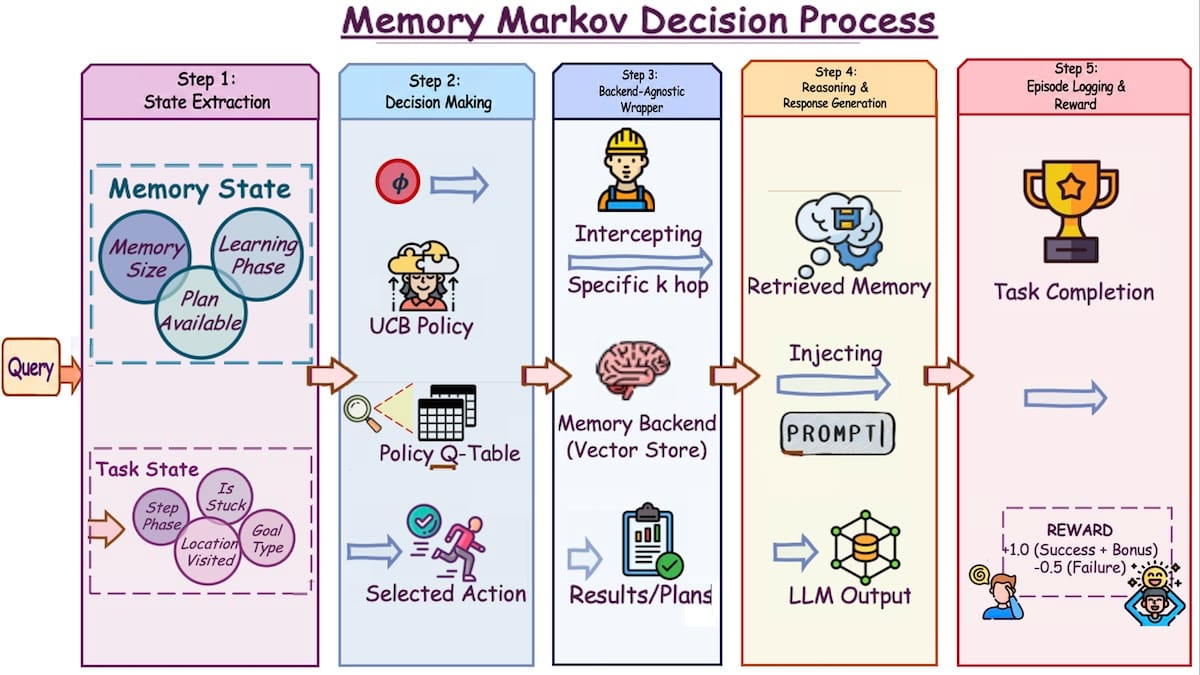
What's new: Eric Hanchen, Zhi Zhang, and colleagues at the University of California Los Angeles, the University of Washington, and Northwestern University developed Memory as a Controlled Process (MEMCON). Their approach wraps around an existing memory backend and calls its existing store, retrieve, and forget functions, learning from experience.
Key insight: The best way to use a memory store changes as an agent gains experience. (a) Early in a stream of tasks, the memory store holds few memories of solved tasks, so the similarities between them may be loose. Searching for memories that are similar to the task at hand may mislead a model more than it helps. Rather than ranking memories for similarity, the agent is better served by searching for memories of how it handled tasks of the same type. (b) Later, a reworded query may reveal something new. (c) As the memory store grows, it’s helpful to remove memories, because they compete for a limited number of retrieval slots. If a task ends with a signal of success or failure, the system that manages the memory can score the decisions involved. The system can sort tasks into types (say, calculating recommendations or comparing stock prices), and the average score per type can tell the system which setting works best for a particular kind of task.
How it works: The authors used three harnesses (implemented in libraries including Lobster) with three models (GPT-4.1-mini, Claude Sonnet-4, and DeepSeek-V3.2) to execute tasks on the web and in simulated environments. They wrapped existing memory backends (such as G-memory) with a small controller that kept a table of scores, one for each pairing of situation and a memory operation (such as retrieve or remove), and updated the scores after every task based on whether the agent had succeeded. Each time the agent was about to fetch from memory, the controller first extracted a compact state representation. It combined what was happening in the task, such as the kind of goal (as specified in the benchmark, like comparing stock prices) and whether the agent was repeating an action, with the state of the memory store, such as roughly how much it held (five possible bins) and whether a successful run from an earlier similar task existed.
- It picked an operation from the choices including searching memory, searching again with a reworded query, retrieving the successful run from a similar task, merging duplicate entries in the memory store, removing an entry, and skipping the search. It favored the one with the best score so far (the authors had hand-picked sensible default numbers for first time pairings) with an increase toward operations it had tried least often.
- The controller ran the chosen operation and added whatever came back to the model’s prompt.
- When a task ended, the controller scored how well it went (based on the outcome and how many steps the agent took to achieve it). It considered the memory choices it had made during that task and updated its table of scores. Choices made near the end, when the outcome was almost settled, resulted in the greatest increases or decreases. Choices made early got less, since later choices had room to correct them.
Results: The authors compared MEMCON to other memory-management approaches using six benchmarks: three in which an agent acts step by step in a simulated environment, such as ALFWorld (household chores), PDDL (planning puzzles based on PlanBench), and ScienceWorld (science experiments); and three in which it browses the web and uses tools to answer a single question, such as TriviaQA (trivia), WebWalkerQA (navigating websites), and GAIA (assistant tasks that call for tools and documents). MEMCON consistently achieved higher success rates while reducing token consumption. For instance:
- On ALFWorld, using a Lobster harness and GPT-4.1-mini, MEMCON (67.9 percent success) outperformed the strongest baseline, G-Memory (59.7 percent success). It reduced average input token consumption from 45,000 to 39,000 tokens per task, a 13 percent saving.
- On GAIA, using a Lobster harness and GPT-4.1-mini, MEMCON (22.4 percent accuracy), outperformed the strongest baseline, G-Memory (21.2 percent accuracy).
Why it matters: An adaptive memory-management layer improves LLM agent performance by giving it the data it needs while reducing computational overhead. The savings and gains came from MEMCON learning to skip or shorten retrieval when retrieval would not help, and to fetch more or retrieve a successful run when retrieval would help, so it spent fewer tokens on irrelevant text while finding more useful memories.
We’re thinking: One common way to optimize agentic behaviors is through training, another is through calls to the underlying model. This work suggests that a lightweight algorithm for adaptive memory management can be simpler and cheaper.