AMD’s World Model Arrives: World Labs' Atlas gives developers 3D video and graphics generation for games, robotics, more
World Labs has opened Atlas, its latest world model, to the public, offering developers a self-serve API that lets them turn text prompts into 3D scenes and camera-controllable video that they can then export.
World Labs has opened Atlas, its latest world model, to the public, offering developers a self-serve API that lets them turn text prompts into 3D scenes and camera-controllable video that they can then export.
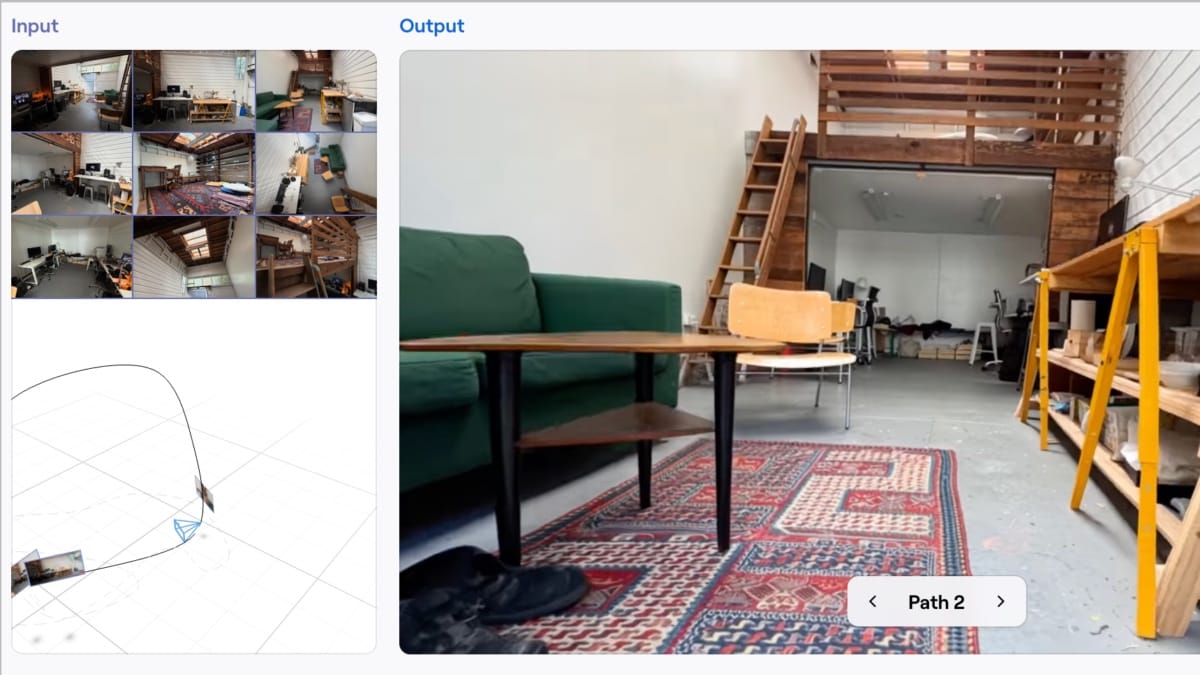
What’s new: After announcing Atlas in September, World Labs released its new model to everyone on November 12. Users can build with its web tools such as Viewfinder, which takes a photo or photos and builds a scene from them, and Chisel, which builds scenes from reference images or written prompts. Atlas also comes with two smaller tools, Relight and Splats to Mesh, that (as the names suggest) relight scenes or convert them to meshes. Devs also get pay-as-you-go API access through prepaid credits, complete with a copy-and-paste prompt that lets an AI coding assistant take them through the setup. Users receive $10 of free API credits and a separate $10 for the web apps to get started.
How it works: World Labs calls Atlas an “omni” world model, but under the hood it’s a multimodal autoregressive diffusion transformer pretrained from scratch to handle text, images, video, and 3D data. It links every image and depth map to a specific camera position that lets it render a scene from various viewpoints consistently.
- Generating a view costs $0.04 for the first frame and $0.008 for each subsequent frame at 720p (the highest resolution that the API offers). Turning views into refined splats is priced at $5.
- Atlas can work from a single image and render whatever lies outside the frame, or it can reconstruct a location using overlapping photos — as many as 64 in Viewfinder. As World Labs puts it, passing through “more input images gives Atlas more context: The more it sees, the less it imagines.”
- Developers chain together API calls to build end-to-end 3D workflows. One estimates camera positions and depth from input photos while another renders novel views or a full video from a single camera path. Then, follow-up calls convert those views into Gaussian splats and the splats into polygon meshes, complete with textures for display or simplified colliders for game engines and simulators.
Performance: On Rapidata’s public leaderboard, Atlas led 19 video and world models at following camera-movement instructions, and human raters favored it in 76.7 percent of head-to-head matchups. In World Labs’ own tests of 3D reconstruction across seven datasets Atlas averaged approximately 12 percent less error than the next-best model, Pi3X, although it didn’t lead on every dataset. There isn’t much independent evidence yet; World Labs hasn’t published a model card or a paper, and no outside group has reproduced its reconstruction results.
Behind the news: World Labs, co-founded by Fei-Fei Li, made its Marble world model public a year ago and later offered it to developers through an API. Atlas builds scenes in the same 3D format as Marble.
- World Labs’ initial Atlas announcement had a significant focus on building simulated environments to train robots. The November launch leads with web apps and 3D pipelines. Its launch page still lists robotics research and simulation as a use, but the new developer docs don’t mention robotics.
- In September 2026, AMD agreed to acquire World Labs in an all-stock deal valued at about $8.2 billion. The deal closed on November 16, officially naming Li AMD’s chief scientist and executive VP. Neither AMD’s initial announcement nor its closing statement mentions Atlas or says what will happen to World Labs’ products.
Why it matters: Atlas supplies 3D output that developers can use in their own projects elsewhere. Its splats and meshes can go into game engines and Blender, whereas other world models that stream pixels produce only video. Setting exact camera positions gives developers way more control than describing a camera move in a prompt. And since the onboarding is written for coding agents, a developer can ask an agent to build a scene in plain language. But there are trade-offs. Free-tier outputs can’t be used commercially, and the accuracy claims rest mostly on World Labs’ own tests.
We’re thinking: Many of this fall’s most impressive world-model demos (Google DeepMind’s Genie 4, Runway’s GWM Worlds 2) were interactive videos that only a limited few can actually get their hands on. Atlas currently has a leg up on both for a pretty simple reason: it comes with a price list and an export button. Developers find out what a model is useful for by building with it. With Atlas, they can try it out for themselves.