Claude Fable Gets a Price Cut: Anthropic releases Claude Fable and Mythos 5.2 shortly before record-breaking IPO
Anthropic updated its most capable public model and removed safeguards for its private twin, opening Claude Mythos to more organizations that apply for access.
Anthropic updated its most capable public model and removed safeguards for its private twin, opening Claude Mythos to more organizations that apply for access. Meanwhile, the company began selling shares to the public for the first time at a market capitalization of $1.5 trillion.
What’s new: Anthropic introduced Claude Fable 5.2, which costs 20 percent less per token than Claude Fable 5.1. Claude Mythos 5.2, a version with fewer biology and cybersecurity safeguards, is available only to organizations that Anthropic approves.
- Undisclosed: Parameter count, architecture, training data and methods
- Weights/license: Proprietary
- Price: Via API 8/0.20/$40 per million input/cached/output tokens with cache writes at 10/16 per million tokens for five-minute/one-hour caches and 50 percent off for batched requests; fast mode 16/80 per million input/output token.
- Availability: Claude Fable 5.2 via Claude apps on eligible paid plans, Claude Code, Claude API, Amazon Bedrock, Claude Platform on AWS, Claude Models on Google Cloud, and Microsoft Foundry, with 30-day data retention required; Claude Mythos 5.2 only to organizations approved through Anthropic’s Cyber Verification Program or Life Sciences Verification Program
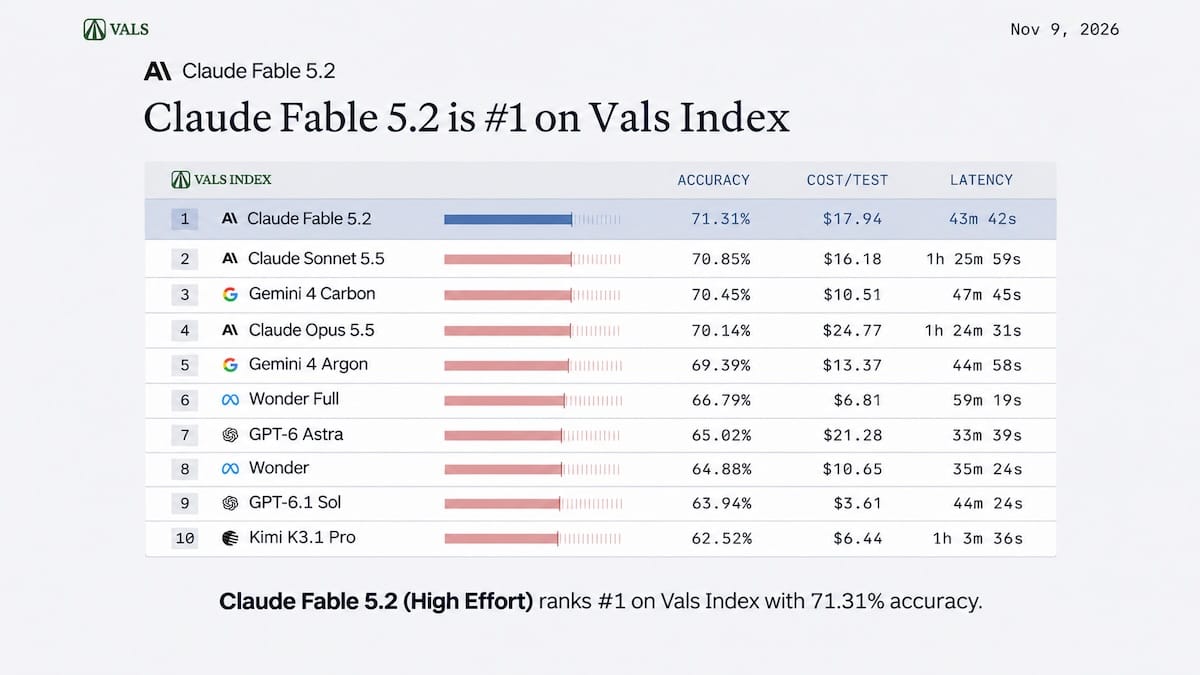
- Performance: First on Artificial Analysis’ Intelligence Index v5.0.1 (65), Vals AI’s Vals Index (71.31 percent), and ARC Prize’s ARC-AGI-3 in its standard harness (81.2 percent)
- Knowledge cutoff: June 2026
- Features: Reasoning always on, with five reasoning levels (low, medium, high, xhigh, max), defaults to high in API and medium in Claude apps and Claude Code; tool use; fast mode, which generates tokens up to 2.5 times faster
- Input/output: Text and images in (up to 1 million tokens), text out (up to 128,000 tokens, 112 tokens per second)
How it works: Claude Fable 5.2 and Claude Mythos 5.2 are one model with different safeguards. Anthropic described one change to how it trained the model and several to how it restricts the model’s use.
- Another anti-distillation measure, which Anthropic calls “preserved thinking” and now applies to all API accounts rather than only new ones, stops anyone from editing earlier turns of a conversation to extract the model’s reasoning.
- To deter distillation (training a model on another model’s outputs), Anthropic added protections, such as showing users only a summary of the model’s reasoning. Claude models now screen requests that try to extract these traces. The company says this cuts the data distillers collect by 90 to 99 percent.
- In Claude Fable 5.2, classifiers block high-risk cybersecurity work such as penetration testing (simulated attacks on a system to find vulnerabilities) and generating exploits. Blocked requests route to older models: Claude Opus 4.8 answers barred cybersecurity requests, and Claude Opus 5 answers barred biology requests and a small set of requests about developing AI models. Anthropic says the cybersecurity and biology classifiers are as robust as Claude Fable 5.1’s but block about 55 percent fewer requests; the company describes these as legitimate requests blocked by mistake.
- During training, Anthropic limited the model’s progress in two skills that can speed development of AI models: optimizing kernels for AI chips and improving large language model architectures. Anthropic says the model performs at about the level of Claude Opus 5.5 in these areas, and that related skills such as agentic coding, hardware development, and “traditional” machine learning research were not limited.
Performance: Claude Fable 5.2 ranks first on independent intelligence leaderboards from Artificial Analysis and Vals AI, but its cost per task is the highest of any model Artificial Analysis has priced. In Anthropic’s tests, Fable 5.2 improved most (relative to its predecessor) on a test of paid freelance projects.
- In Anthropic’s tests on the Remote Labor Index, 240 paid freelance projects in areas such as game development, architecture, and data analysis, Claude Fable 5.2 set to high reasoning produced work that human evaluators judged at least as good as the freelancers’ on 41.3 percent of projects, leading all models with more than twice the success rate of Claude Fable 5.1.
- On Arena AI’s Agent Arena, which ranks models by how they perform in real user sessions based on task success, user satisfaction, and steerability, Claude Fable 5.2 ranks first, ahead of Claude Opus 5.5. It also leads Agent Arena’s coding category (33.17 percent net improvement). On Arena AI’s WebDev leaderboard, which ranks models via blind head-to-head comparisons of websites they build, Claude Fable 5.2 ranks first (1,826 Elo) narrowly ahead of Claude Opus 5.5 (1,816 Elo).
- On Vals AI’s Vals Index, which combines eight tests of finance, coding, legal, and tax work, Claude Fable 5.2 set to max reasoning ranks first (71.31 percent accuracy, $17.94 and 43.7 minutes per test), ahead of Claude Sonnet 5.5 (70.85, $16.18 and 86 minutes per test) and Gemini 4 Carbon (70.45, $10.51 and 47.75 minutes per test). Among individual tests, it ranks first on Finance Agent v2.1, financial analysis tasks (69.47 percent); EMB v1.1, financial modeling in spreadsheets (77.38 percent); Vibe Code Bench v1.1, building apps from plain-language requests (93.77 percent); ProgramBench, rebuilding programs from scratch (19.00 percent); and BioMysteryBench, biology data investigations developed by Anthropic (83.70 percent). It ties Claude Opus 5.5 on Terminal-Bench 4.0, 66 long tasks in a computer terminal (65.15 percent), and matches several models with a perfect score on ProofBench v1.1, formally verified math proofs.
- On Artificial Analysis’ Intelligence Index v5.0.1, a weighted average of nine tests of knowledge work, coding, science, and general knowledge, Claude Fable 5.2 set to max reasoning ranks first (65 points, $26.54 and 40.9 minutes per task), ahead of Gemini 4 Carbon (60 points at $5.48 per task) and Claude Opus 5.5 (59 at $10.04 per task). Claude Fable 5.2 posts the highest score on five of the component tests: HLE-Diamond, a test of reasoning and knowledge, AA-Omniscience v1.1, a test of knowledge versus hallucinations, CritPt v2 (Hard Subset), a test of physics reasoning, Terminal-Bench-Science 0.1, a test of scientific research workflows in a computer terminal, and FrontierCode-AA 2.0, a test of software engineering in open-source code repositories.
Behind the news: Over successive releases, Anthropic has widened access to its top model and cut its price. In April, Anthropic introduced Claude Mythos Preview only for partners in its Project Glasswing cybersecurity program, at $25/125 per million tokens of input/output. In June, it made Claude Fable 5, a version of Mythos Preview’s successor with added safeguards, generally available at $10/50 per million tokens of input/output, while keeping Claude Mythos 5 for selected partners. In September, Claude Fable 5.1 kept those prices and limited Claude Mythos 5.1 to U.S. cybersecurity and life sciences organizations that Anthropic selected. Claude Fable 5.2 cuts prices again, and organizations can now apply for Claude Mythos 5.2. Anthropic introduced its updated models a day before it began marketing its initial public offering to investors. It expects shares to start trading on November 19.
Why it matters: The type of work Anthropic limited in Claude Fable 5.2 is the same type it showcased to investors. In its initial public offering roadshow video, Anthropic said Claude Mythos, writing or porting almost all of the kernels, ran prompt processing (reading input before generating a response) for one Anthropic model on AMD MI355X GPUs in about three days. Anthropic estimated the same work had taken 6 to 12 months with earlier methods. A company that can move its models quickly to another vendor’s chips has more supplier options, which can lower what the company pays for compute. Notably, Anthropic keeps that ability for itself, while Claude Fable 5.2 users receive only Claude Opus 5.5-level help with the same type of tasks.
We’re thinking: Claude Fable 5.2 is more capable than its predecessor Fable 5.1, but Opus 5.5 remains a strong workhorse, especially for monthly subscribers. Bloggers quickly discovered that not only did Fable usage have its own separate weekly meter, but that using Fable depleted total metered usage much more quickly than the corresponding value of API credits. For example, a Claude Ultra plan ($200 per month) might yield approximately $2500 worth of Opus 5.5 usage (as priced via the API) but only $630 of Fable 5.2 usage.