Ox Alpha Revealed as GLM-5.3-Flash: Z.ai’s latest model built viral buzz as Ox Alpha while being served on China-made chips
For over a week, the name and maker of the most-used model on OpenRouter remained unknown.
For over a week, the name and maker of the most-used model on OpenRouter remained unknown. Last week, it was publicly announced to be a new GLM series model — and in a surprise to many, the company says it served the model’s free, high-volume preview exclusively with Chinese-made chips. Now anyone can download its weights.
What’s new: Z.ai released GLM-5.3-Flash, a vision-language model it had previewed under the name “Ox Alpha.” It’s the company’s first vision model since April’s GLM-5V-Turbo, and the first model in the GLM-5 family whose vision capability was built from the start rather than added to a language model afterward.
- Input/output: Text, images, and video in (up to 1,048,576 tokens), text out (up to 128,000 tokens, 44.6 tokens per second)
- Architecture: Hybrid mixture-of-experts transformer that combines linear and sparse attention, 320 billion parameters total, 18 billion active per token
- Features: Adjustable reasoning levels (low, high, and max, the default), reasoning cannot be deactivated, streaming output, tool calling, context caching
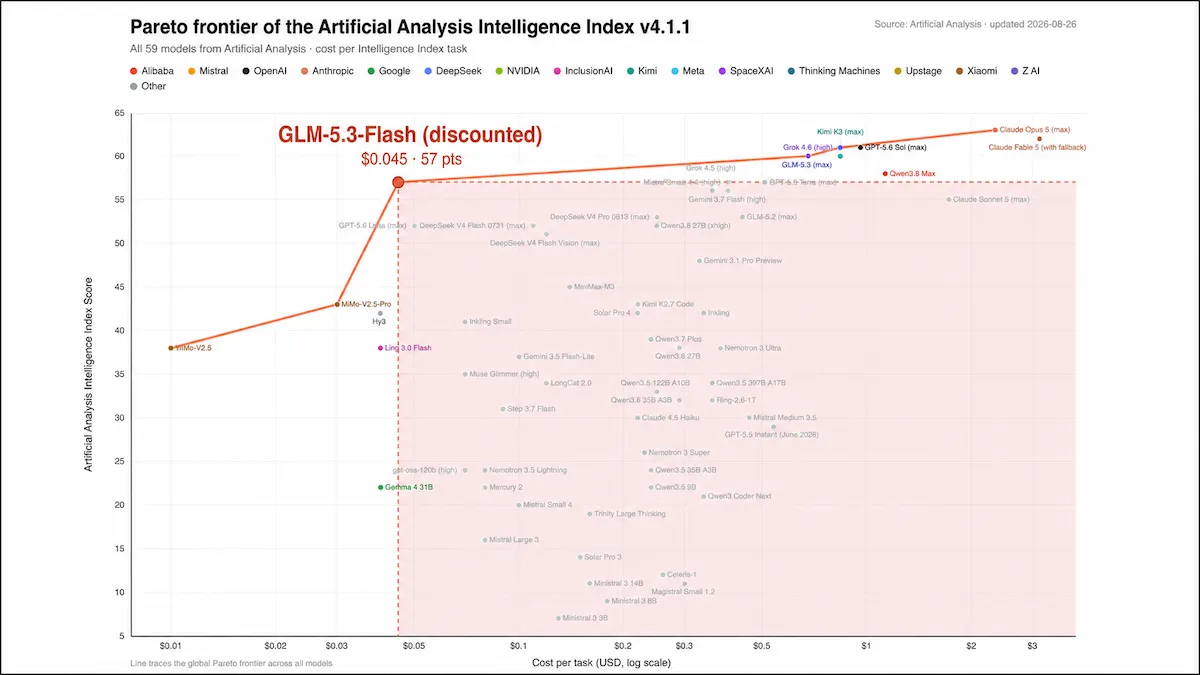
- Performance: Achieved 57 points on Artificial Analysis’ Intelligence Index; third among all models and best among open weights models on Artificial Analysis’ GDPval-AA v2 (real-world knowledge work tasks)
- Availability/price: Via GLM Coding Plan subscriptions ranging from $18 to $168 per month, API at $0.15/0.03/$0.50 per million input/cached/output tokens
- Weights/license: Free to download under the commercially permissive MIT license
- Undisclosed: Knowledge cutoff, pretraining data sources
How it works: Z.ai trained GLM-5.3-Flash on text, images, and video from the start rather than melding vision and text transformers afterward. Unlike the larger GLM-5.3, Z.ai pretrained this model from scratch and redesigned the attention layers to handle long inputs more efficiently.
- A first in the GLM series, the model mixes two kinds of attention. Linear attention, a memory-efficient variant whose cost grows in proportion to input length, attends to nearby context, while sparse attention attends to the full context. The company says the combination cuts attention computation to roughly one-third of GLM-5.3’s, and less than DeepSeek-V4-Flash and Kimi K3.
- A step called IndexPool averages every four of the model’s lookup vectors into a single vector to reduce memory use as context approaches 1 million tokens. This, plus the hybrid attention mechanism, cut GLM-5.3-Flash’s key-value cache to less than a quarter of GLM-5.3’s, but remains higher than DeepSeek or Kimi’s best numbers
- The company pretrained the model on a 30-trillion-token multimodal corpus. It used Manifold-Constrained Hyper-Connections, a technique developed by DeepSeek that splits the typical layer-to-layer connection into several parallel connections and keeps those paths stable as they combine.The company says this helped the model scale efficiently.
- To generate training data, Z.ai had the model work in environments where it could render a frontend, a game, or a 3D scene, see the result, and revise. The company then trained the model on those attempts. For front-end work, Z.ai says it tried reinforcement learning that scored the model on how the rendered page turned out
- At inference, the model sends each token through 8 of 288 experts and uses around half the network layers (45) as GLM-4.5 (92). A multi-token prediction layer, which drafts several tokens ahead for the main model to check, speeds generation.
Performance: Independent evaluations place GLM-5.3-Flash just below the top open weights models, while costing roughly an eighth per task of the open weights models just above it. Leading proprietary models cost between 10 to 35 times per task. GLM-5.3-Flash leads all other open weights models tested on one evaluation of real-world work and completes long-running coding tasks nearly as well as the larger GLM-5.3, which costs 16 times more per task.
- GLM-5.3-Flash achieved 57 on Artificial Analysis’ Intelligence Index, a composite of nine evaluations of economically useful tasks, at an average of just $0.09 per task. At a fraction of the price, it approached the open weights leaders Kimi K3 and GLM-5.3 (both set to max reasoning, tied at 60, $0.84 and $0.68 per task, respectively). It matched Claude Opus 4.8 set to max reasoning ($2.03 per task), and outperformed Gemini 3.7 Flash (56, $0.40 per task).
- GLM-5.3-Flash (1,765 Elo) ranked third on Artificial Analysis’ GDPval-AA v2, a head-to-head ranking of models on tasks in economically useful fields, behind Claude Opus 5 set to max reasoning (1,824 Elo) or xhigh reasoning (1,797) and ahead of Grok GLM-5.3 set to max reasoning (1,758) and Grok 4.6 set to xhigh reasoning (1,755)
- GLM-5.3-Flash was able to one-shot 63 percent of problems posed by DeepSWE v.1.1, a test of software engineering skills whose coding tasks are written from scratch rather than taken from public repositories. On this benchmark it cost $0.24 per task, against 69 percent at $3.99 for GLM-5.3 and 74 percent at $11.84 for Claude Opus 5 set to max reasoning. DeepSeek V4 Flash, a comparably sized model, solved 53 percent at twice the cost.
- The model is verbose and slow, particularly for a model its size. The model used 150 million tokens to complete the Artificial Analysis’ Intelligence Index, more than the median (110 million). On multiple hardware providers, it generates an average of 45 tokens per second, significantly slower than GLM-5.3 (78 tokens per second) and the typical model tested by Artificial Analysis (69 tokens per second).
Behind the news: For a week before the launch, Z.ai introduced its preview of GLM-5.3-Flash anonymously, available free and exclusively on the coding harness OpenCode and on the model marketplace OpenRouter for a week before launch. This way, it was able to collect feedback from developers unaware whose model they were testing. The company says Ox Alpha became the most popular model on those services that week. Users speculated that the mystery model belonged to the GLM family within days based on its tokenizer outputs. On August 26, Z.ai confirmed the model and released its weights under a standard MIT license. Two days later, the company released weights for its flagship GLM-5.3 under a license similar to MIT but added a clause requiring any business whose revenue surpasses $10 billion to pass a security review by Z.ai before using the weights commercially.
Why it matters: While GLM-5.3 still outpaces GLM-5.3 Flash (and virtually all open models) on text benchmarks, Z.ai’s cheap model is also the more advanced and versatile one, for now. GLM-5.3 is merely a highly capable fine-tune, while Flash received a new base, architecture, and vision capability. The company says its next flagship model will inherit this multimodal, hybrid attention architecture, while also training on more data and showing greater capabilities. Months ago, GLM-5V-Turbo outpaced Claude Opus 4.6 on vision-language tasks; the next GLM series model may similarly challenge top proprietary multimodal models.
We’re thinking: Ox Alpha’s anonymous preview created buzz and mystery but also allowed users to judge it on its merits (and deficits). Perhaps the biggest mystery revealed was its reliance on chips from China-based manufacturers. This shows that with the right memory optimization methods, companies can serve a cost-effective, high-performing model at scale on economically-priced hardware — albeit a somewhat smaller and slower model than we've come to expect from the cutting edge.