Anthropic, OpenAI Fight for Compute: Anthropic and OpenAI both spend big to make deals for data center sites and hardware
Data center buildout plans reached a new order of magnitude as new partnerships form and old ones fade away in the search for capacity to train and deliver AI.
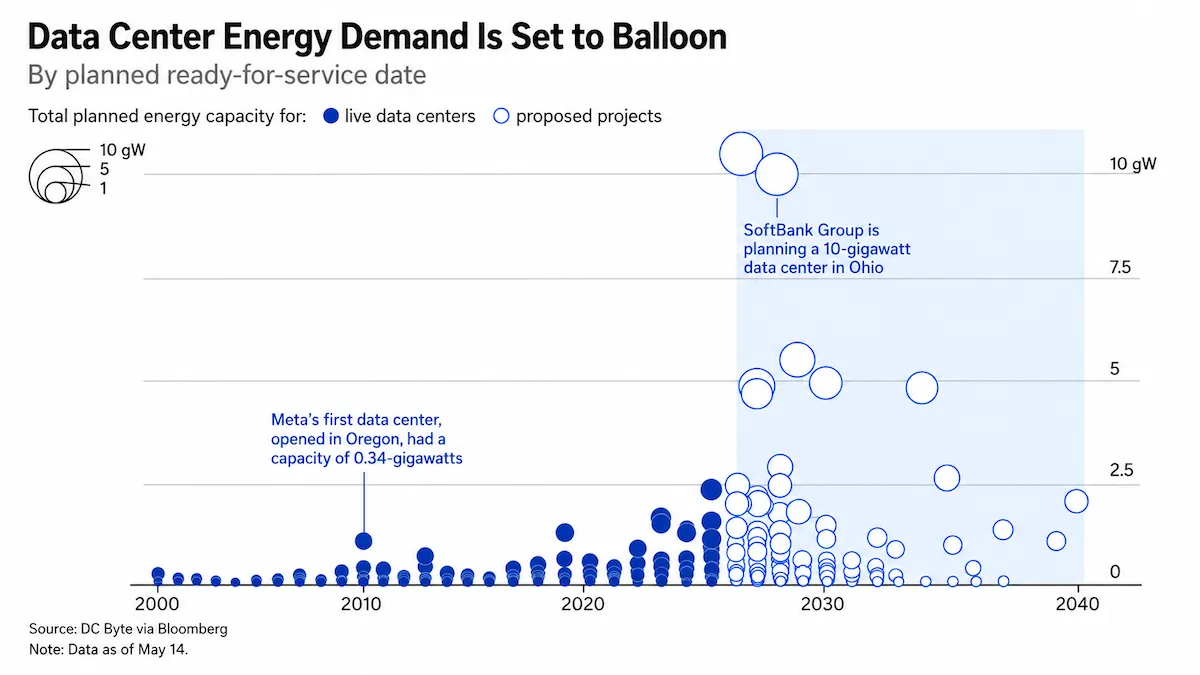
Data center buildout plans reached a new order of magnitude as new partnerships form and old ones fade away in the search for capacity to train and deliver AI.
What’s new: Anthropic and AMD signed a partnership for Anthropic to purchase up to 2 gigawatts of AMD’s most powerful GPUs and AMD to invest up to $5 billion in Anthropic. The two companies plan to have the hardware up and running in as-yet-undetermined data centers in 2027.
How it works: Anthropic wasn’t alone in making new deals for more compute. OpenAI announced a big project in the state of Georgia, and OpenAI and Nvidia are reportedly working out a financial arrangement similar to Anthropic and AMD’s, where Nvidia would guarantee hundreds of billions of dollars in credit to construct an enormous data center in Ohio.
- OpenAI will build a 3.2 gigawatt data center in southeastern Georgia that should come online in 2028. Unlike similar data center projects it’s pursued in the past, OpenAI will take the lead on design and finance, with hopes to speed up construction and reduce total costs. OpenAI is expected to spend at least $20 billion on the project itself in order to qualify for local building incentives, with at least another $10 billion required for construction, not counting the GPUs and other hardware inside.
- OpenAI also hopes to break ground on a 10 gigawatt data center in southern Ohio, which would be the company’s largest. To offset up to $500 billion in debt, OpenAI may turn to Nvidia to guarantee as much as $250 billion, in exchange for OpenAI purchasing Nvidia chips and other considerations. (OpenAI’s last fundraising round valued the company at $852 billion; Nvidia is currently valued at approximately $4.792 trillion.)
- Sachin Katti, OpenAI’s VP of compute strategy, said the company would develop a common, energy- and resource-efficient design for AI data centers and release them as an open source standard, similar to the Open Compute Project, founded by Meta in 2011.
- AMD and Anthropic also may extend their partnership to future data centers, under a similar arrangement to OpenAI and Nvidia. AMD would backstop some debt to offset construction costs, according to the Wall Street Journal.
Behind the news: Many AI companies are in a race for more compute, but also want to keep data center expenses off their balance sheets. Startups like Anthropic and OpenAI want to show IPO investors high future profit and low future debt. Infrastructure suggests future profit potential but also greater liabilities. Higher interest rates make it more expensive to finance data centers and the chips inside them. AI companies also must fight political headwinds, as public sentiment turns against data center construction and expansion, in large part due to rising energy costs.
- This week, Meta sold $12.55 billion in bonds for a new data center project in west Texas at 7.5 percent interest – 2.875 percent higher than a ten-year U.S. treasury note and 0.5 percent higher than a similar recent Meta data center project in Louisiana.
- BloombergNEF forecasts that U.S. electricity demand for data centers will rise to 194 gigawatts by 2035, or about 20 percent of the nation’s electricity, up from 56.1 gigawatts (5.9 percent) today. Even with on-site use of gas generators, BloombergNEF predicts a 19 gigawatt shortfall in total electrical capacity.
- One hope is new energy- and cost-efficient data center designs. Nvidia plans to use a 1 megawatt energy conversion sidecar, directly attached to a server rack. This reduces the many rounds of energy loss that come from gradually reducing and converting high-voltage AC power from the grid to low-voltage DC power flowing through chips, making the power transfer twenty percent more efficient. Instead of gradually reducing 34,500 volts of grid electricity to 415 volts of AC to power a 50kW rack, a server rack with a sidecar can be ten times as powerful (500kW), supplied with 800 volts of DC energy – coincidentally, the voltage and current produced by most renewable energy sources.
Why it matters: Despite this massive buildout, there isn’t enough computational power to go around. Compute, or the lack of it, dictates which models get designed, trained, and served. “Right now we have to make hard decisions on what models we actually train, what products we actually scale,” said OpenAI president Greg Brockman in a roundtable last week, adding that he doubted the current compute crunch would lessen any time soon.
We’re thinking: Technology needs infrastructure, and breakthrough technology like AI needs it on a massive scale. Some of the deals being struck may be part financial engineering, part political compromise, but they also properly reflect that everyone, from chipmakers to model builders to ordinary citizens, has skin in the game. Partnerships offset part of the risk, but the risks still get taken because the rewards are so great.