One Agent Works, Another Directs: Devin Fusion with SWE-2 rivals Claude Fable 5.1 and GPT-6 Astra output at lower costs
Benchmarking a coding agent typically means scoring one model within one harness.
Benchmarking a coding agent typically means scoring one model within one harness. Now a major independent evaluator has scored a harness that uses two models and found it matches top models’ performance at lower cost.
What’s new: Cognition introduced SWE-2, a model built for software engineering work, and made Devin Fusion, a harness that runs two models in one session, available beyond its cloud service. When using Devin Fusion, a more powerful model like Claude Fable 5.1 plans and reviews tasks, and a less costly one like SWE-2 carries out most of the work. All features below are for SWE-2, except where noted.
- Input/output: Text in, text out
- Architecture: Fine-tuned from Kimi K3, a 2.8 trillion-parameter mixture-of-experts model
- Features: Three reasoning levels (medium, high, max);
- Performance: On Artificial Analysis’ Coding Agent Index v1.5, Devin Fusion, with Claude Fable 5.1 as the lead model and SWE-2 as the sidekick model, tied Claude Code with Claude Fable 5.1 (62), at 36 percent lower cost per task
- Availability/price: SWE-2 in Devin Desktop, Devin CLI, Devin Fusion, and Devin Web; SWE-2 free on self-serve plans through October 15, then $3/$0.30/$15 per million input/cached/output tokens. Devin Fusion on paid plans (Pro $20 per month, Teams $80 per month, Max $200 per month) in Devin CLI and Devin Desktop
- Weights/license: Proprietary
- Undisclosed: Context limit, knowledge cutoff, training data, and active parameter count
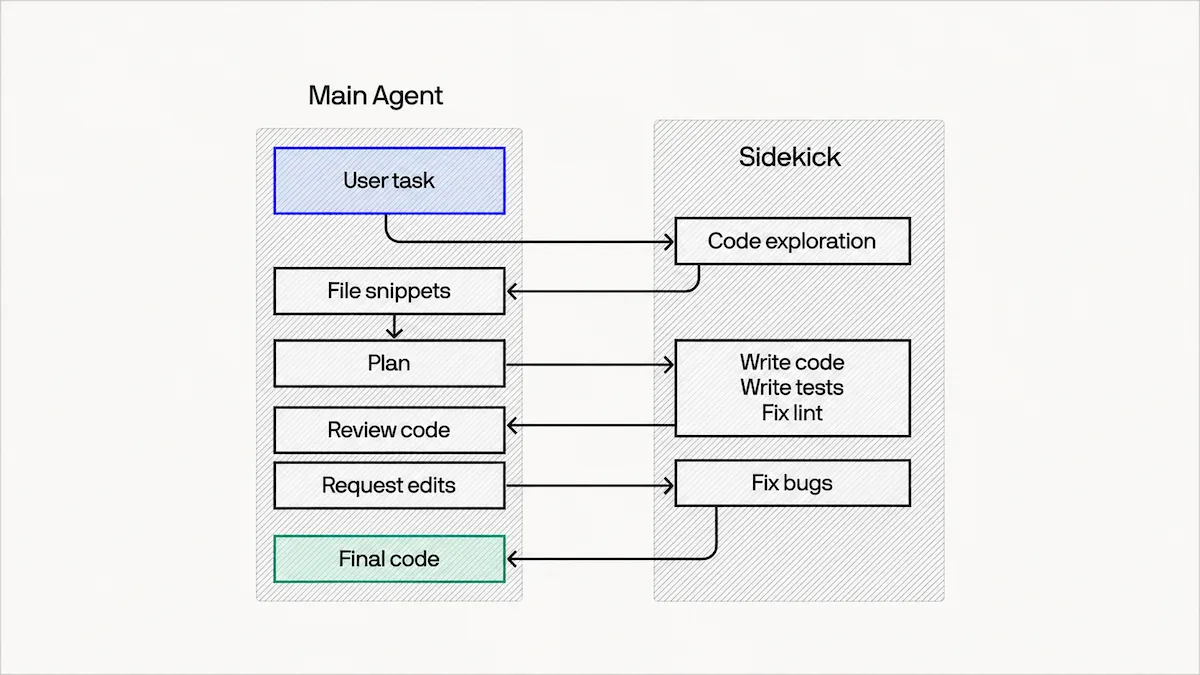
How it works: Instead of handing a task from one model to another in sequence, Devin Fusion runs two agents at once. A lead agent runs a planner model that oversees the session. A sidekick agent runs a cheaper model that completes lower-priority work. Each agent maintains its own tools and context.
- The lead model resolves ambiguities in the user request, writes the plan, and reviews the sidekick’s work. For each task it delegates, it gives the sidekick a brief that sets the task’s constraints and success criteria. The sidekick agent reads, edits, and tests code and communicates with the lead agent. The lead agent reclaims a task when the returned work suggests the sidekick agent is stumbling.
- The two agents pass each other briefs, results, and feedback, rather than entire conversations. This setup lets each agent keep its own context and prompt cache, preserving discounts on repeated inputs. Cognition argues that this step is where ordinary model routing fails. Moving a task to another model mid-session empties the cache, and refilling it at frontier prices reduces savings that routing would otherwise give.
- In the cloud version, Fusion can change models mid-session. Lightweight classifiers run throughout tasks and flag when to give the sidekick’s work back to the lead or assign the sidekick role to a stronger model. These model swaps happen during compaction, when an agent summarizes earlier turns to shrink context. Compaction discards the cache, so the switch adds no cost.
- Cognition trained SWE-2 for the sidekick job by using reinforcement learning to fine-tune Moonshot AI’s 2.8 trillion-parameter Kimi K3. The reward subtracts what an attempt costs, in money and time, from whether it succeeded. That let Cognition train every reasoning level in one run, where Kimi K3’s makers trained a separate expert for each reasoning level and merged them afterward.
Performance: Artificial Analysis independently ran two Devin Fusion pairings through its Coding Agent Index v1.5. Configured with Claude Fable 5.1 as the lead model, Devin Fusion matched Claude Code running the same model alone at a higher reasoning level and cost 36 percent less per task. Configured with GPT-6 Astra, Devin Fusion scored three points lower than Codex running Astra alone, again at a higher reasoning level, but cost 39 percent less.
- On the Coding Agent Index v1.5 — an average of three evaluations of software engineering tasks, command-line tasks, and repository understanding — Devin Fusion with Claude Fable 5.1 set to xhigh reasoning as lead and SWE-2 set to medium reasoning as sidekick achieved a 62, and cost $7.90 and 35.8 minutes per task. This matched the performance of Claude Code running Claude Fable 5.1 set to max reasoning with fallback (62, $12.40 and 34.8 minutes per task).
- Using Devin Fusion with GPT-6 Astra traded accuracy for a slightly steeper discount. Devin Fusion with GPT-6 Astra set to xhigh reasoning as lead and SWE-2 set to medium reasoning as sidekick (59, $4.54 and 24.7 minutes per task) trailed Codex, with GPT-6 Astra set to max reasoning (62, $7.47 and 29.4 minutes per task).
- On Vals AI’s Code Migration test, which asks an agent to rewrite a program in another software language, Devin Fusion had similarly mixed results. With Claude Fable 5.1 as the lead and SWE-2 as the sidekick (57.3 percent at $42.00 per task), it outperformed Claude Fable 5.1 in Claude Code alone (54.6 percent at $70.97 per task). With GPT-6 Astra as the lead and SWE-2 as the sidekick (61.3 percent at $35.51 per task), it trailed GPT-6 Astra in Codex alone (67.7 percent at $44.36 per task).
Behind the news: Devin Fusion is not new, and Cognition is not the only company attempting to match frontier model performance at lower costs by blending multiple models.
- Cognition described Fusion’s lead-and-sidekick design in June and ran it on Devin Cloud through the summer, reporting that the router drove 88 percent of the pull requests a set of its internal users merged. This month’s release added two things the earlier one lacked: a version of the harness that runs on a developer’s own machine rather than only inside Cognition’s cloud service, plus independent evaluation.
- Sakana AI released Fugu Max and Fugu Ultra v2 the same day Fusion left Devin Cloud, extending the orchestrator models it launched this summer. Fugu selects a model from a pool of models for each step or subtask, sometimes several in parallel, rather than fixing a pair of models for a session.
- The two designs disagree about a frontier model’s role. Fusion keeps one in charge of every session, planning, reviewing, and sometimes doing work. Fugu puts a dispatcher in charge instead, a low-cost model trained to split a task into subtasks and hand each to whichever model in its pool fits, so most of its capabilities comes from the collective rather than from a lead model.
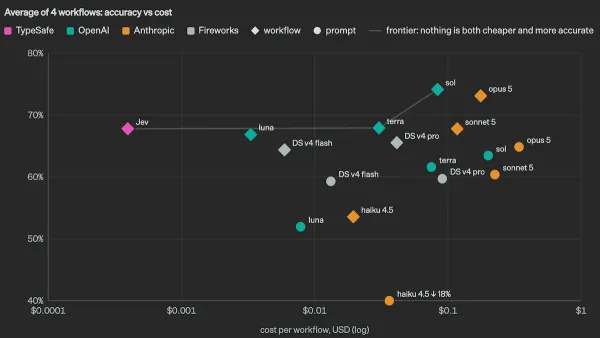
Why it matters: With one model in a harness, token and dollar consumption grow together, so developers can monitor token use as a rough proxy for their bill. Fusion muddies these estimates because it burns lower-cost tokens at a higher rate. Artificial Analysis measured Devin Fusion with Claude Fable 5.1 as the lead, finding it consumed 70 percent more tokens and took nearly three times as many turns than Claude Code using Claude Fable 5.1 alone — but still cost less per task. You might think you could save money by using a sidekick model with a lower per-token cost, but that’s not necessarily true. SWE-2 appears to be the most efficient option for a sidekick model, both outperforming and costing less than models (for example, GPT-5.6 Luna) that are head-to-head more intelligent and cost less per token. In this case, developers really have to pick the right tool for the right job.
We’re thinking: Between Cognition and Sakana, we’ve seen two very different versions of an architect/worker model architecture, but both have succeeded by training companion models that do a specific job well, whether that job is giving instructions or following orders. Model specialization remains a powerful way forward and (as the multi-model Fugu already shows) could be further decomposed to move beyond a simple two-model worker-planner structure.