Models Built to Do One Thing Well: Jev, a classification model, takes the developer world by storm, inspires imitators
While most companies focus on generative and reasoning models, one company is betting on a class of models that isn’t either.
While most companies focus on generative and reasoning models, one company is betting on a class of models that isn’t either. All this new model does is analyze text and return answers to questions about it, but at higher speed and lower cost than a large language model.
What’s new: TypeSafe, founded by OpenAI alumnus Diogo Almeida, released Jev, a general classification model that can answer any question with predefined outputs. It’s designed to be used to give other software tools enough data to make decisions, rather than as a general-purpose language model.
- Input/output: Input: text, up to 64 thousand tokens. Output is defined by the user to be either a choice from a set of options, a score, or a yes/no
- Performance: Similar performance to GPT-5.6 Terra and Claude Sonnet 5 at classifying an internal dataset
- Availability: Currently in early access, $0.042/free per million input/output tokens
- Undisclosed: Architecture, context window, training data, most training methods.
How it works: TypeSafe does not describe the architecture of Jev beyond saying it is not an LLM and not autoregressive, but it is transformer-based. The authors don’t describe their training data beyond saying they make it all themselves. They describe just one of their training methods, which they call “reinforcement learning for calibrated decisions” (RLCD).
- Jev’s input is broken up into two parts: a piece of text (such as a description or a JSON object), and questions about that text. Both pieces are limited to 32 thousand tokens. Within these limits, users can add as many questions as they want. Each question is evaluated in parallel. Users are only charged for the text once as well as for all of the tokens comprising their questions. Output is free.
- Jev’s output can be either a yes/no (true/false), a selection from a list of options, or a score between 0 and 10. The binary yes/no response is defined as the simple probability of whether the answer to the question is yes. The list selection option returns the model’s preferred choice from the list, its confidence in that choice, and a probability for each possible list item. The ten-point rubric score similarly comes with confidence and probabilities for each option, except instead of the final answer being a choice of one of the values, it computes a score based on the probability of each option.
- In training, RLCD encouraged the model to assign probabilities to answers equal to how often they occur. For example, an answer with a 20 percent probability should be the correct answer 20 percent of the time.
- Jev’s structure and pricing encourage users to ask many short, straightforward questions at once. For example, instead of asking Jev to classify an email message as spam or not spam, a developer should decompose the question into multiple criteria for email spam, like a domain mismatch, a request for passwords or other credentials, and so forth. The goal is to create a full classification picture that allows a software system to assess the situation and take action.
Results: The authors only computed results for their models on their internal datasets, citing a number of reasons, including benchmark saturation and companies overly focusing on improving benchmark performance rather than general intelligence.
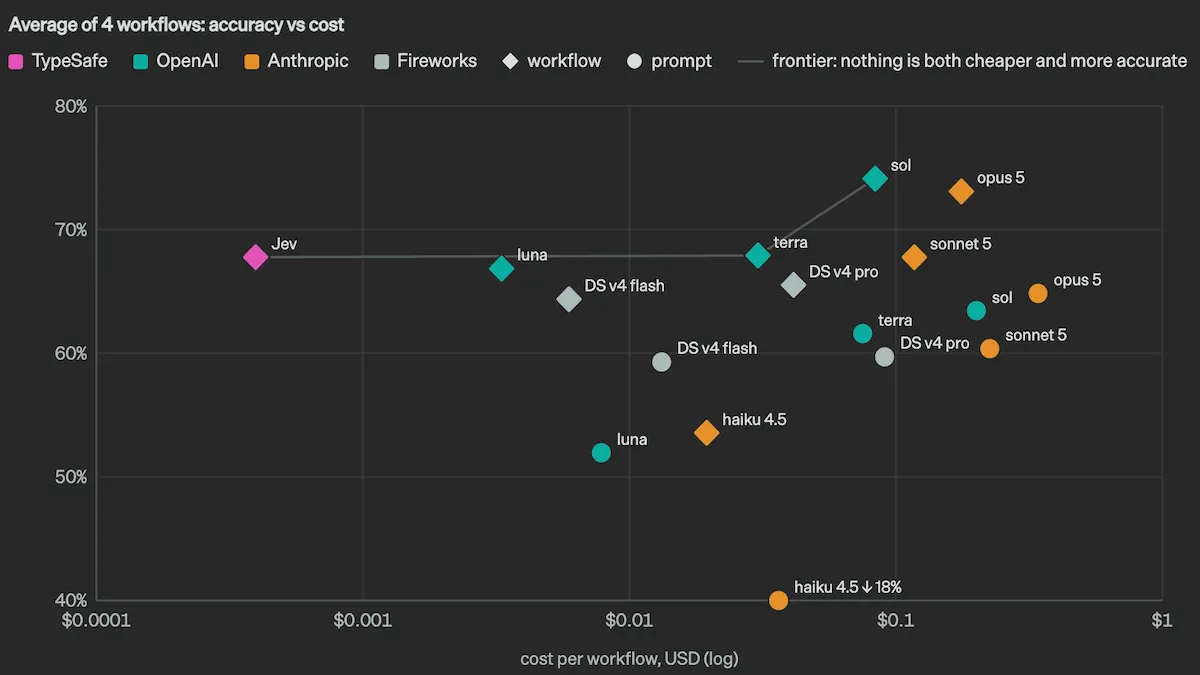
- Across four internal datasets (which used GPT 6 Astra and Claude Fable 5 to determine the correct answers), Jev achieved 67 percent accuracy, about the same performance as GPT-5.6 Terra and Claude Sonnet 5.
- Across the same datasets, Jev cost about $0.0007 per example, Terra cost about $0.06 per example, and Sonnet cost about $0.12 per example.
- Across the same datasets, the authors claim Jev is 193.6 times faster than unspecified LLMs.
Behind the news: Shortly after Jev's release, a host of similar classification models hit the market, some of them open and local rather than proprietary. Laya focuses on multilingual support, but also claims higher accuracy and faster speed than Jev. Bespoke Nimble fine-tunes Qwen-3.5-9B to act as a classification model. Kev likewise uses Qwen 3.5 as a base, but in three different sizes, and attempts to reconstruct Jev's architecture. None of the models claim to have distilled Jev. Without a public benchmark, it's difficult to assess their performance. Meanwhile, platforms like Vercel and Cloudflare quickly added Jev support, replacing costlier LLMs for use cases like tool selection.
Why it matters: Before LLMs became hugely popular, most researchers focused on training one model that can do one or a small set of tasks well. When LLMs became popular, people’s opinions flipped, and the AI community started focusing on building one model that can perform any task well. TypeSafe takes a middle road: let’s build one model that can perform any classification task well. The company wrote a catchphrase to describe its approach to development: “Build prod, not god.”
We're thinking: Jev won’t replace modern LLMs. It can’t generate code, it can’t talk to people, it can’t act as an agent. Instead, it can detect jailbreaks, flag missing details, judge user satisfaction, and more — all situations where turning unstructured input into structured responses can be tremendously valuable for software engineers.