Transcription Battles Heat Up: Google, Meta, and Microsoft all release speech-to-text models suited for agentic input
Speech recognition, a core but sometimes overlooked AI technology in the age of generative models, is having a moment.
Speech recognition, a core but sometimes overlooked AI technology in the age of generative models, is having a moment. Google, Meta, and Microsoft each recently unveiled speech-to-text models, adding to an increasingly-competitive menu of transcription options.
What’s new: Google’s Gemini 3.5 Transcribe, released on August 26, aims to turn speech into a clean transcript that can be used in broader AI workflows. Meta's Muse Voice Transcribe launched on September 1 and is designed as a real-time listening layer that can transcribe speech, distinguish among speakers, and detect when users begin and finish speaking. Microsoft claims that MAI-Transcribe-2, released September 3, is faster and more accurate than any other model on the market.
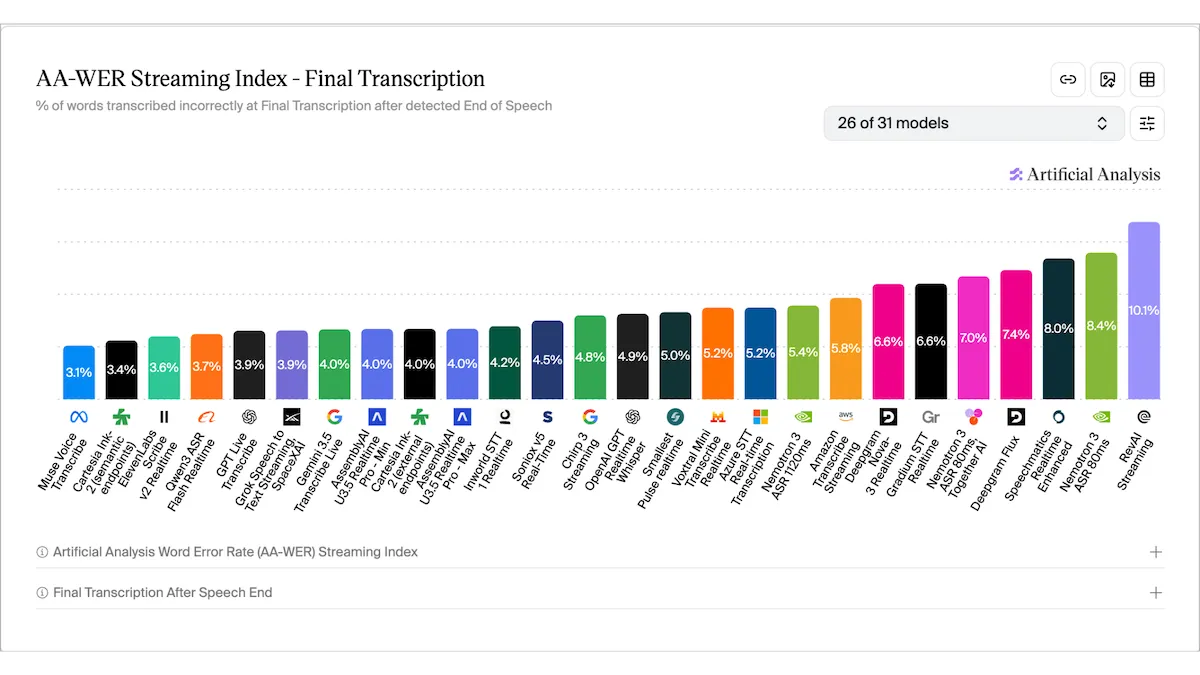
- Performance: On the Artificial Analysis Word Error Rate speech-to-text benchmark, all three models had an error rate less than 4 percent, ranking among the top models on benchmarks for streaming and non-streaming uses. Muse Voice Transcribe has the lowest word error rate among streaming models, and MAI-Transcribe-2 has the lowest among non-streaming models.
- Price: Google bills Gemini 3.5 Transcribe on a per-token basis for audio input and text output, averaging roughly $0.005 per minute (~$0.30/hour) for pre-recorded files and $0.009 per minute (~$0.54/hour) for real-time streaming. Muse Voice Transcribe is $0.18 per hour of audio processed or $3 per 1,000 minutes. MAI-Transcribe-2 is priced at $0.10 per hour of audio through the end of the year.
- Availability: Gemini 3.5 Transcribe is available through the Gemini API. Muse is available through the Meta Model API, Meta AI for Mac, and Muse Code, and MAI-Transcribe-2 is available in public preview through Azure Speech.
- Capabilities: All three models can distinguish different speakers, also known as diarization. Google’s model transcribes over 85 languages, removes filler words, gives word-level time stamps, and can detect up to 8 different speakers. Muse Voice Transcribe supports more than an hour of audio and can distinguish between over 20 speakers. The model trained on over 70 languages, and over 25 languages have been “extensively verified.” Microsoft’s MAI-Transcribe-2 can transcribe over 60 languages. Microsoft states that an hour of audio can be transcribed in 10 seconds, which is five times faster than Google’s model.
- Undisclosed: Model architecture, training data, technical papers
How it works: None of the companies disclosed much information about how their models were built, or how they differ from their predecessors in any terms other than performance.
- Meta revealed that Muse Voice Transcribe is trained to identify context before transcribing a word. The model breaks audio into 80-millisecond chunks — 12.5 per second — each of which is transformed into a single soft token. At each chunk, Muse either emits a text token or predicts a special “next audio” token, allowing it to keep listening to the next chunk. This means the model can gather more audio context when needed before generating text while transcribing easier portions more quickly. Meta calls this process “adaptive delay.” Meta trained Muse Voice Transcribe to learn the tradeoff between accuracy and speed: it is rewarded for transcribing words correctly, but penalized for taking too long to do so.
Performance: Google’s model reported a 4 percent error rate for streaming and 2.6 percent error rate for non-streaming use cases (lower is better). Meta reported a 3.1 percent error rate for streaming. Microsoft’s model was not ranked for streaming, and obtained a 2 percent error rate for non-streaming. It also obtained a 5.2 percent word error rate on the multilingual benchmark FLEURS, making it the top-ranked model for this assessment.
Behind the news: The releases are part of a broader push this year to make speech-to-text faster and more capable, with new real-time models from OpenAI, xAI and NVIDIA competing alongside Meta, Google, and Microsoft.
Why it matters: Speech recognition is a critical component for AI voice agents and voice in, voice out systems. It’s also a particularly unforgiving modality, where any error is judged harshly in real-time and can propagate more errors downstream. Speech recognition is also ruthless when considering costs, since trained human agents can still staff many positions competitively. As companies race to build agents that can talk with people in real time, they are competing to improve transcription accuracy, reduce latency, and make systems more robust to the messy conditions of real-world speech, while keeping their costs low. Rich rewards accrue to the winners; the existing voice agent industry is huge, and nearly any application can benefit from adding voice input.
We’re thinking: We remain excited about voice applications. As we’ve written before, speech-to-text, an LLM, and text-to-speech frequently work together as a pipeline for voice applications. The system transcribes what a user says, processes it, and generates a spoken response. Faster and more accurate text-to-speech makes that final interaction more natural and responsive. Every improvement here brings us closer to voice interfaces that feel less like dictating to a machine and more like having a conversation — the holy grail for automated speech recognition.


