Anthropic’s public filing offers clues to its future: Kimi K3.1 Pro performs among top models overall
RSI’s MoE model has open weights, advances recursion. OpenAI Decisions API opens for general use. Claude Duet agent triages office tasks for paid users. AI radio show gains traction with U.S. Latinos.

In today’s edition of Data Points, you’ll learn about our top headlines, and more:
- RSI’s MoE model has open weights, advances recursion
- OpenAI Decisions API opens for general use
- Claude Duet agent triages office tasks for paid users
- AI radio show gains traction with U.S. Latinos
But first:
Anthropic files to go public, says agents now pay for its compute
Anthropic filed an S-1 to list on Nasdaq under the ticker “ANT,” reporting $16.3 billion in revenue for the first half of 2026, up from $1.2 billion a year earlier. Its proposed governance structure gives a trust and its founders control over the board. Anthropic reports that compute and infrastructure spending fell from about 6.5 times revenue in 2024 to roughly half of revenue in the first half of 2026, which pushed adjusted operating margin to 10 percent; the company’s $80.7 billion net loss comes mostly from non-cash revaluation of convertible notes. Anthropic credits much of its growth to agentic products like Claude Code and Claude Cowork, and says enterprise net revenue retention reached about 900 percent while Opus 5.5 cut cost per task by about 40 percent compared with Opus 5. Anthropic says Claude now helps build its own successors by running experiments, generating training data, and automating evaluations, a process it calls “closing the loop.” It also warns that AI capabilities could outpace its safety work, which may lead it to delay or restrict model releases, as it did with Mythos. (Securities and Exchange Commission)
Kimi K3.1 Pro puts open models a month behind Anthropic and Meta
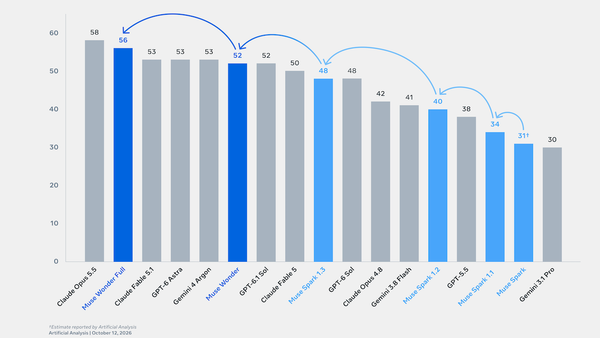
Artificial Analysis reports that Moonshot’s Kimi K3.1 Pro scores 55 on its Intelligence Index, up 11 points from Kimi K3 and behind only Claude Opus 5.5 (58), Claude Sonnet 5.5 (56), and Muse Wonder Full (56). Most of the gain is in agentic tasks: Terminal-Bench 4.0 rises from 13% to 67%, the highest score of any model tested, and GDPval-AA rises 312 Elo to 1,846, third overall. Other evals moved less, such as Humanity’s Last Exam (47% to 52%), though the hallucination rate on AA-Omniscience fell from 53% to 44%. The model has a 1M-token context window and 2.8T total parameters (104B active), accepts text and image input, and costs $2 per million input tokens, $10 per million output tokens, and $0.20 per million cache-hit tokens, 33% below Kimi K3. It uses 14% more output tokens per task, so cost per task stays near $1.98. The weights are not yet published, though Moonshot is expected to release them soon; once they are, the Intelligence Index gap between the best open-weights and proprietary models would shrink from 12 points to 3, which would give developers who self-host a near-frontier option for agentic work. (Artificial Analysis)
RSI debuts open coding model built using automated process
Recursive Superintelligence released Flint, a text-only mixture-of-experts (MoE) coding model with 39.8 billion total parameters and about 2.5 billion active per token, under the Apache 2.0 license. Flint is notable less for its performance than how it was made: Recursive says its Eureka Machine automated research system helped design the architecture, the 4-bit quantization scheme and the low-level kernels. It has 49 layers with 256 routed experts per MoE layer, a 262,144-token context window on the model card (the company blog says up to 512,000), and supports reasoning and OpenAI-compatible tool calls. The 4-bit weights are about 23 GB, and Recursive recommends 48 GB of memory on an Apple Silicon Mac (M4 Pro or newer) or an NVIDIA GPU; it reports over 125 tokens per second on an M4 Pro MacBook Pro. The model also runs in llama.cpp, Ollama, LM Studio, vLLM and SGLang. The following scores are all self-reported: 74.2% on SWE-bench Verified (Qwen3.6 MoE: 73.4%) and 54.9% on Terminal-Bench 2.1 (dense Qwen 3.8: 73.0%). Flint is a candidate for developers who want a locally run coding agent on a single 48 GB machine, but its Terminal-Bench result is well behind the strongest dense model in Recursive’s own chart, so it needs testing on your own tasks. (MarkTechPost)
OpenAI modifies Luna to compete with Jev for fast decisions
OpenAI made its Decisions API generally available last week, giving users a fast, low-cost model to choose among options and return a confidence rating, in competition with TypeSafe’s Jev. OpenAI built it by reconfiguring GPT-6.1 Luna for faster, cheaper inference rather than training a purpose-built model, cutting response times from up to three seconds to under 180 milliseconds, according to API product lead Nikunj Handa. The public version adds voice and visual modalities and routes inference geographically to reduce latency worldwide; model calls through the API cost $0.10 per million input tokens and 0 for output tokens. On the AIM System One Index and Artificial Analysis Decision Index, OpenAI ranks eighth and fourteenth, behind Liquid’s D1 Ultra, Base Lab’s Elephant-1 and the latest Jev, though TypeSafe’s models are the most queried on OpenRouter. Because rankings vary by workload and TypeSafe’s CEO urges testing models on your own tasks, developers replacing LLM calls with a decision model should benchmark OpenAI’s offering against Jev and the others on their own data. (TechCrunch)
Claude chief-of-staff agent in preview for paid subscribers
Anthropic launched Claude Duet, an agent app for professionals and small businesses that automates and manages tasks, competing with Meta’s Muse and OpenAI’s Dots. Built on Claude Opus 5.5, Duet builds daily briefings and dashboards, suggests actions based on user data, and runs tasks in the background on its own virtual machine, returning to the user when it needs approval. It connects to more than 6,000 connectors and plugins in the Claude Marketplace and can make online purchases through Stripe’s Link wallet or Shopify’s Shop Pay, with payments requiring user approval. Anthropic says Duet does not run errands or book tickets, cannot show browser use live, will not trade securities or move money between accounts, and by default refuses requests for credit card numbers or government ID, backed by a new classifier that checks each message for leaks of sensitive information. It is in research preview on iOS, Android, and Claude.ai for Pro and Max customers, with a waitlist. (TechCrunch)
AI talk show host popular with Spanish-language U.S. audiences
Entravision, a Spanish- and English-language broadcaster, put an AI host called Coyotec on LA’s José 97.5 FM, first as a weekend show in September 2025 and now as cohost of the weekday 8-to-10 a.m. program Al Aire y Sin Permiso with human co-host Geraldine “GeeGee” Guzman. Coyotec runs on Claude Haiku for live responses, ElevenLabs for its voice, ChatGPT for initial scripts, and Midjourney for its image; it can answer Guzman in real time but cannot take listener calls yet. Entravision’s Nielsen figures show Los Angeles Hispanic listenership up 21.6 percent from August to September 2026 and listeners 18 to 34 up 84.9 percent, and the show is syndicated in five more markets in California, Nevada, and Texas. The audience gains come from a company-reported rating period of two months, so they do not yet show whether the lift lasts, and earlier AI radio hosts such as Portland’s AI Ashley did not move ratings noticeably. (Wired)
Want to know more about what matters in AI right now?
Read the latest issue of The Batch for in-depth analysis of news and research.
Last week, Andrew talked about how engineering leaders could help their teams become AI-native by focusing on individual development, executing promising projects, investing in AI infrastructure, and redesigning processes around AI's new bottlenecks.
“The cost of building software to a clear spec has fallen dramatically, making everything else seem like a bottleneck in comparison. A skilled team that either knows, or can figure out, what to build can get the job done quickly, if we let them. So form high-context, high-empowerment teams that have the information they need and are empowered to act.”
Read Andrew’s letter here.
Other top AI news and research covered in depth:
- Meta released Wonder and opened up Spark, with three new models: Muse Wonder (available via API), Muse Wonder Full (subscription-only), and Muse Spark Open (weights free to download).
- OpenAI’s ChatGPT for Teens receives a report card: The company added new features while studies questioned the program's impact on safety and education.
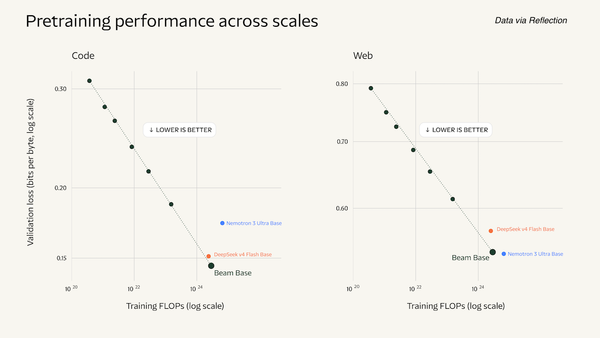
- Nvidia courts a new partner as Reflection releases Beam, an open weight model from an independent U.S.-based lab.
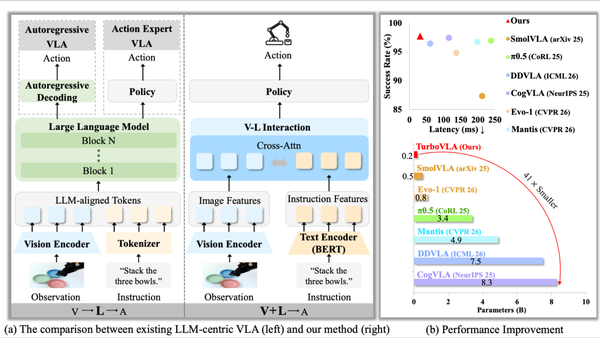
- A single decoder transforms small model outputs into action with TurboVLA, which utilizes an old-school architecture to attend to language and vision.
A special event for our community

AI Dev brings together developers who build with AI every day. You'll hear from engineers at the companies shipping agents, models, and infrastructure, then meet them in person on the demo floor. Join us in New York City on November 30 and December 1.
Data Points is produced by human editors with AI assistance.