Search Engine Wars, AI Edition: Google makes less money on LLM-powered search even as OpenAI works to attract its users
Google is turning its search engine into a chatbot, and OpenAI is turning its chatbot into a search engine.
Google is turning its search engine into a chatbot, and OpenAI is turning its chatbot into a search engine. Yet neither company has made AI-powered search bring in as much revenue per query as traditional search links.
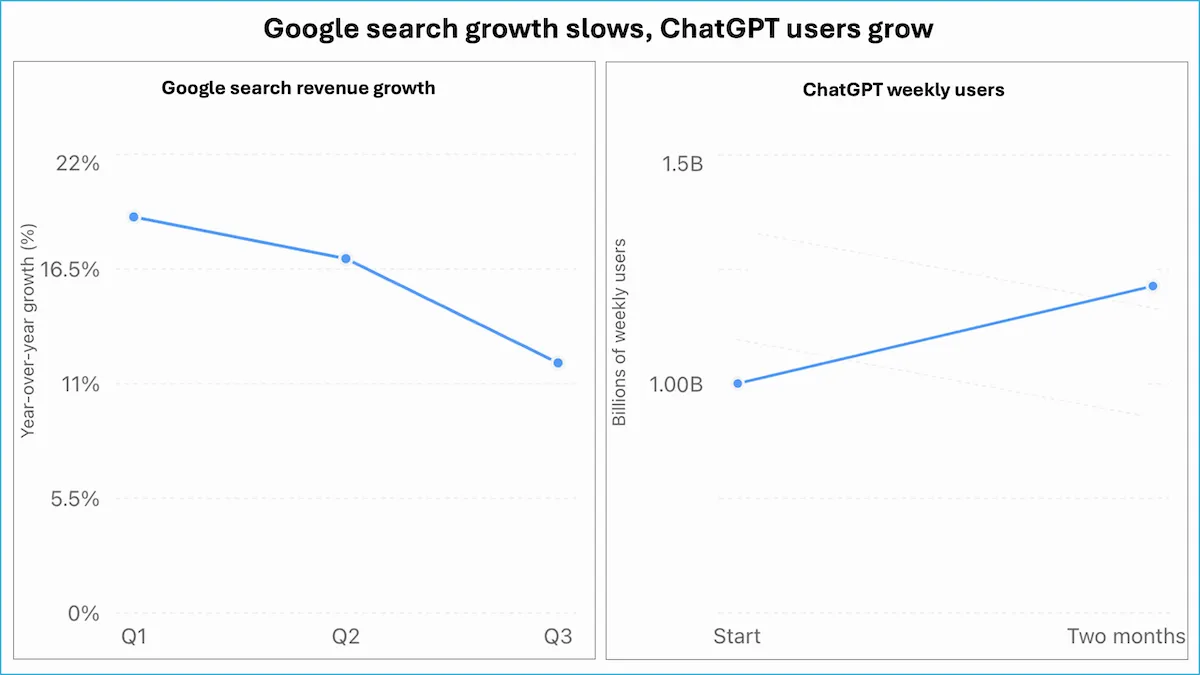
What’s new: On October 29, the day after Alphabet, Google's parent company, reported its financial statement for July through September, its market value fell by nearly $500 billion, its biggest one-day decline on record, The Wall Street Journal reported. Google’s search revenue growth slowed to 12 percent, down from 19 percent and 17 percent in the previous two quarters. Meanwhile, OpenAI’s business expanded, presumably including many queries that once would have been entered into a search engine. An OpenAI executive said ChatGPT’s weekly users had grown from 1 billion to 1.2 billion in two months, and it claims to handle roughly one-fifth as many searches as Google.
How Google search pays: Google makes money when advertisers pay for their messages to appear beside search results, but that business is shrinking.
- Google collected $63.35 billion from traditional search and related ads from July through September, including ads in AI Overviews and AI Mode. The number of queries it received grew at its fastest rate in five years
- Google didn’t reveal how much of that revenue came from AI Mode, but an AI Mode query brings in less revenue than a comparable traditional search, because it shows fewer ads and advertisers pay less for them, Ars Technica wrote. In effect, Google’s AI is cannibalizing its search business.
How AI search ads work: Meanwhile, both Google and OpenAI are pushing ads into AI-generated search results.
- On the day it issued its financial report, Google said AI Mode will show ads in 11 countries, up from 1 previously. In the U.S., ads will appear when a user enters a follow-up query.
- OpenAI, which began to test ads early this year, now shows them in 89 countries to users of ChatGPT's free and low-cost Go plans. OpenAI says its ad sales reached a pace of $1 billion per year within 200 days of launch, a figure that hasn't been verified independently. That works out to about $250 million every three months, compared with Google's $63.35 billion.
Yes, but: OpenAI is a private company, so it's impossible to assess how much of Google's search business ChatGPT actually has taken, and estimates vary widely. When it said it processed one-fifth the number of searches Google does, it didn’t explain which Google figure it compared against, Search Engine Journal noted. In February, the search-marketing firm Ahrefs estimated 12 percent, using a different definition of search.
Behind the news: While Google and OpenAI compete for AI-powered search, the web publishers whose pages AI models use to generate search results are seeking more control over how AI companies use their work. One proposal would let them put a flag on their pages that would ask AI developers not to use them to train models. Google, Microsoft, OpenAI, and Anthropic said they plan to honor the flag. Meanwhile, Google offers publishers a way to exempt their pages from AI Overviews and AI Mode.
Why it matters: AI has many uses, but it’s not yet entirely clear how to build highly profitable businesses on it. AI-powered search could be one answer, since advertisers already pay to reach users through search engines. Ironically, AI is drawing more people to search faster than it’s drawing advertising money. But until AI search ads earn as much as the traditional ads they replace, relying purely on AI search for revenue doesn’t seem like a surefire way to replicate Google’s previous success.
We’re thinking: Chatbots may eventually eat into users’ web searches, but the users of the future won’t necessarily be people. AI agents carrying out tasks such as shopping on a user's behalf will also see ads that could sway their behavior or recommendations to users. In fact, Time magazine already sells ads aimed at agents instead of people.