Qwen3.8-Max Lands With A Bang: Inside Alibaba's two new models, Qwen3.8-Max and Qwen3.8-27B
Open models are getting larger and more capable. A few weeks ago, Moonshot AI announced Kimi K3, the largest and best-performing open weights model yet. Last week, Alibaba answered by releasing weights for a giant of its own.
Open models are getting larger and more capable. A few weeks ago, Moonshot AI announced Kimi K3, the largest and best-performing open weights model yet. Last week, Alibaba answered by releasing weights for a giant of its own.
What’s new: Alibaba first unveiled Qwen3.8-Max, a 2.4 trillion-parameter vision-language model trained to carry out long-running coding and knowledge work tasks, on August 2. The company released the weights of both Qwen3.8-Max and the smaller Qwen3.8-27B within a week. While smaller Qwen releases have been open weights, this is the first Max-tier model with downloadable weights. However, the open weights version of Qwen3.8-Max is limited to text input and output and doesn’t support the full million-token context window.
- Input/output: Text, image, and video in (up to 1 million tokens), text out (up to 131,000 tokens, up to 262,000 reasoning tokens, 77.6 tokens per second)
- Architecture: Mixture-of-experts transformer with hybrid attention, 2.4 trillion parameters total, 95 billion active per token
- Features: Reasoning (none, low, medium, or xhigh, with xhigh as default), reasoning text retained by default, function calling, structured output, prefix completion, context caching
- Performance: Fifth overall and second among open models on Artificial Analysis’ Intelligence Index (58), first overall on 𝜏³-Banking (51.3 percent), second on Arena.ai’s Vision Arena (1,301 Elo), fourth on Arena.ai’s WebDev Code Arena (1,667 Elo)
- Availability/price: API on Alibaba Cloud Model Studio at $2.00/$0.25/$6.00 per million input/cached/output tokens, subscription via QwenWork (currently free public beta in China only or via subscription in U.S.), weights for Hugging Face and ModelScope under a custom license
- Undisclosed: Knowledge cutoff, training data and methods
How it works: Alibaba has not yet published a technical report or model card for Qwen3.8-Max. The company says the model is built from Qwen3.5, its earlier vision-language model. Alibaba’s release notes for the model highlight reinforcement learning for agentic work and training that teaches the model to visually verify its own output using the model’s vision capabilities.
- Qwen3.8-Max’s mixture-of-experts transformer activates roughly 4 percent of its parameters to process each token. For Qwen3.5, hybrid attention combines standard attention layers with Gated Delta Network layers, a memory-efficient alternative to standard attention; Qwen3.8-Max closely follows that recipe.
- Like Qwen3.5, Qwen3.8-Max processes text and images jointly from the start of pretraining, rather than attaching a vision encoder to a trained language model. Alibaba says this design lets Qwen3.8-Max check rendered output as it plans, executes, and verifies its work.
- Alibaba also introduced QwenWork, an agentic harness designed to run the model.
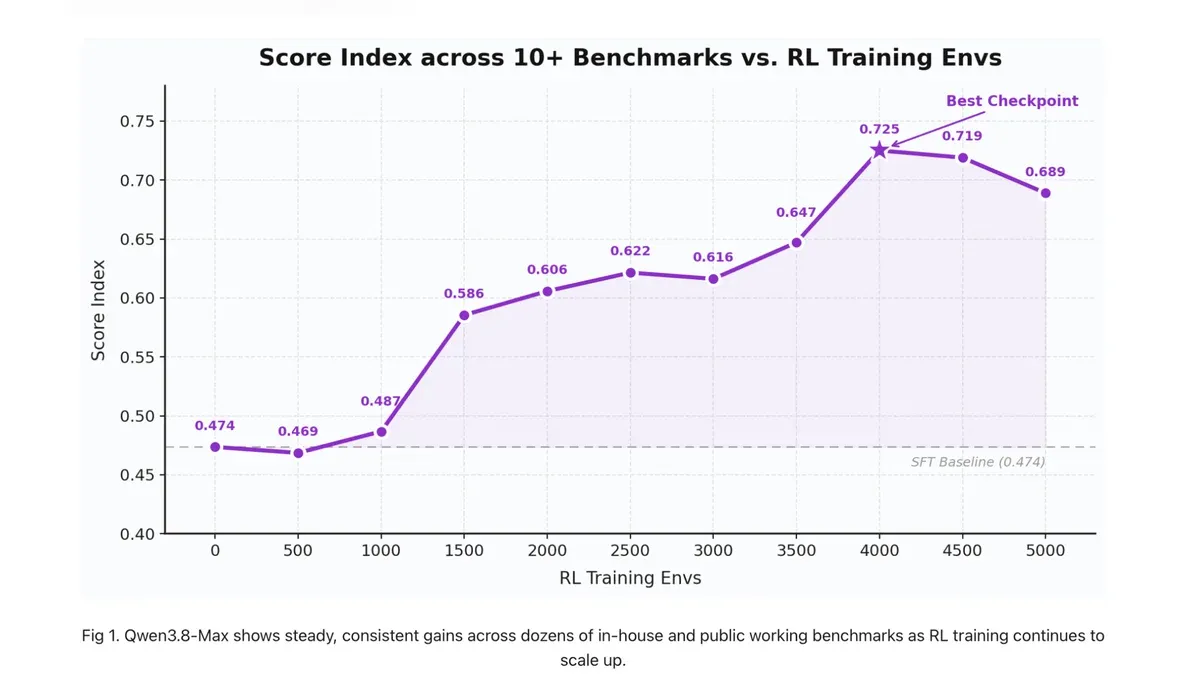
- Alibaba fine-tuned Qwen3.8-Max via reinforcement learning in agentic environments, including QwenWork and other harnesses, that scaled along three axes: task length (single, multiple, or multiple days’ worth), workspace complexity (single file, multiple files, or hierarchical folders), and the harness in use (different tools, versions, and installed skills). One reward system graded every output by executing code, judging text and rendered images against rubrics, and inspecting results with agents. A data balancer kept each training batch’s mix of tasks, difficulty, and harnesses even to stabilize training.
- Qwen3.8-Max’s downloadable weights are text-only, and do not include vision input or the 1 million token context window. They are available under a custom license, similar to the MIT license, but requiring attribution for uses above 100 million monthly active users or $20 million in monthly revenue. Model-as-a-service or coding assistants built on Qwen3.8-Max with revenue over $50 million annually also must seek a separate license. Qwen3.8-27B’s weights include the model’s full capabilities and are covered by a standard Apache 2.0 license.
Performance: In independent evaluations at launch, Qwen3.8-Max trailed only a handful of top proprietary models and Moonshot AI’s Kimi K3 in overall intelligence. It likewise placed near the top in front-end coding, vision, and agentic work, leaping over Qwen3.7-Max on virtually all benchmarks. But these gains came at a price. The model generated more tokens than its rivals, which drove up its cost per benchmark task completed despite low per-token prices.
- On Artificial Analysis’ Intelligence Index, a composite of nine evaluations of economically useful tasks, Qwen3.8-Max set to reasoning (58, $1.13 per task) jumped 11 points over Qwen3.7-Max set to reasoning (47, $0.54 per task) to fifth overall rank and second among open-weights models. That put it above Claude Opus 4.8 set to max reasoning (57, $2.03 per task) and Muse Spark 1.2 set to xhigh reasoning (57, $0.40 per task) but behind Kimi K3 set to max reasoning (60, $0.86 per task).
- On Artificial Analysis’ 𝜏³-Banking tests of simulated customers' banking requests, Qwen3.8-Max achieved 51.3 percent, the best score of any model tested. On GDPval-AA v2, a head-to-head ranking of models’ work on tasks in economically central fields, Qwen3.8-Max achieved 1,739 Elo, behind only Claude Opus 5 set to max reasoning (1,846 Elo) and Claude Fable 5 set to max reasoning with fallback (1,743 Elo).
- On Arena.ai leaderboards, which rank models by human votes in blind head-to-head comparisons, Qwen3.8-Max debuted fourth (1,667 Elo) on WebDev Code Arena, behind Claude Opus 5 set to max reasoning (1,686 Elo) and Kimi K3 set to max reasoning (1,675 Elo). On Vision Arena, Qwen3.8-Max debuted second (1,301 Elo), behind only Claude Fable 5 (1,315 Elo).
- Qwen3.8-27B is currently third among open weight models with an Artificial Intelligence average of 52, comparable with GPT-5.6 Luna, and behind only . It is easily the most capable model capable that can currently run locally on a consumer machine.
Behind the news: Qwen 3.8-Max’s downloadable weights mark a strategic shift from Alibaba’s recent practice of keeping its most capable models to itself. Since the Max line began in January 2025, the company has offered those models, most recently Qwen3.7-Max, through its API and Qwen Chat app while releasing weights only for smaller models like Qwen3.6-27B. In Alibaba’s absence, other labs in China, including Moonshot AI and Z.ai, traded the open weights lead among themselves. Days after Kimi made its K3 model available, Alibaba previewed Qwen3.8-Max at the World AI Conference in Shanghai, before it made the model available via API on August 2. Z.ai followed with GLM-5.3 on August 14, a model that netted a 60 average on the Artificial Analysis Intelligence Index.
Why it matters: As always, open weights gives developers more options, from self-hosting to using Alibaba’s official tools or API. Admittedly, few teams can serve a 2.4 trillion-parameter model themselves, so the payoff will arrive via price-reducing competition among third-party hosting providers and distilled descendants like Qwen3.8-27B. Downloadable weights also let developers shop for better privacy terms, since any provider can serve them, including those that retain no customer data.
We’re thinking: It’s disappointing that the open weights version of Qwen3.8-Max doesn’t include the full capabilities of the Alibaba API version, but Qwen3.8-27B on a laptop is a fun consolation prize — even if it does seem to overthink things sometimes.