Google’s Robotics Model Has Legs: Gemini Robotics 2 gets Google closer to true multi-embodiment
Google’s latest vision-language-action model can walk a humanoid robot across a room, crouch to a low shelf, and close a five-fingered hand around a light bulb.
Google’s latest vision-language-action model can walk a humanoid robot across a room, crouch to a low shelf, and close a five-fingered hand around a light bulb. Google says it’s the first model in its robotics family to run the legs and the hands from one set of weights, a breakthrough that simplifies model training and design.
What’s new: Google released Gemini Robotics 2 (GR2), a model that turns camera images and typed instructions into commands for a robot's joints. Whereas earlier models in the Gemini Robotics family drove only the upper body for tabletop work, GR2 moves a humanoid’s legs, torso, arms, and hands together. One fixed set of the model’s trained weights runs three machine setups across two robot bodies.
- Input/output: Camera images and text instructions (input) to joint commands (output), driving either a five-fingered hand with 22 degrees of freedom (Sharpa or Inspire hands) or a simple two-fingered gripper (Robotiq)
- Features: Leg and hand control; multi-embodiment (one checkpoint runs Apptronik's Apollo 2 humanoid with Sharpa hands, the same Apollo 2 with Inspire hands, and a Franka Duo arm rig with a Robotiq gripper)
- Performance: Self-reported success rates of 45.7 to 76.3 percent on whole-body pick-ups, 32 to 92 percent on multi-finger tasks, and 74.2 to 89.6 percent on gripper tasks
- Availability: Early-access partners, with no public API
- Undisclosed: Google published no model card for Gemini Robotics 2, and gave no base model, parameter count, training-data breakdown, or price
How it works: The release pairs Gemini Robotics 2 with Gemini Robotics ER 2, a separate reasoning model that breaks a job into steps and hands them to GR2 one at a time. Google published no model card or technical paper for GR2, so its safety report and announcements provide what we know.
- Google trained the model for each task in the demonstration videos using a mix of teleoperation, in which a person operates the robot remotely while the movements are recorded, plus video examples and simulation.
- GR2 runs one set of trained weights across three machine setups; no version was trained per configuration. Motion transfer, introduced alongside Gemini Robotics 1.5, trains a single model on data pooled from robots of different shapes, sensors, and joint counts. This makes data recorded on one machine setup valuable learning material for data on another.
Performance: Google ran every evaluation of GR2 on its own defined tasks and hardware, and no outside group has published tests of the model. Google reports the whole-body and gripper figures as averages over several tasks in a category and the finger figures as individual tasks. The nearest baseline is Google’s own first robotics model from March 2025, which was adapted to a two-armed Franka robot and averaged 63 percent across the tasks it was given.
- An Apollo 2 robot with Inspire hands, trained to pick things up while using the legs, succeeded 76.3 percent of the time from a shelf, 68.4 percent from a table, and 45.7 percent from the floor. Google reports each as an average over several tasks in that category.
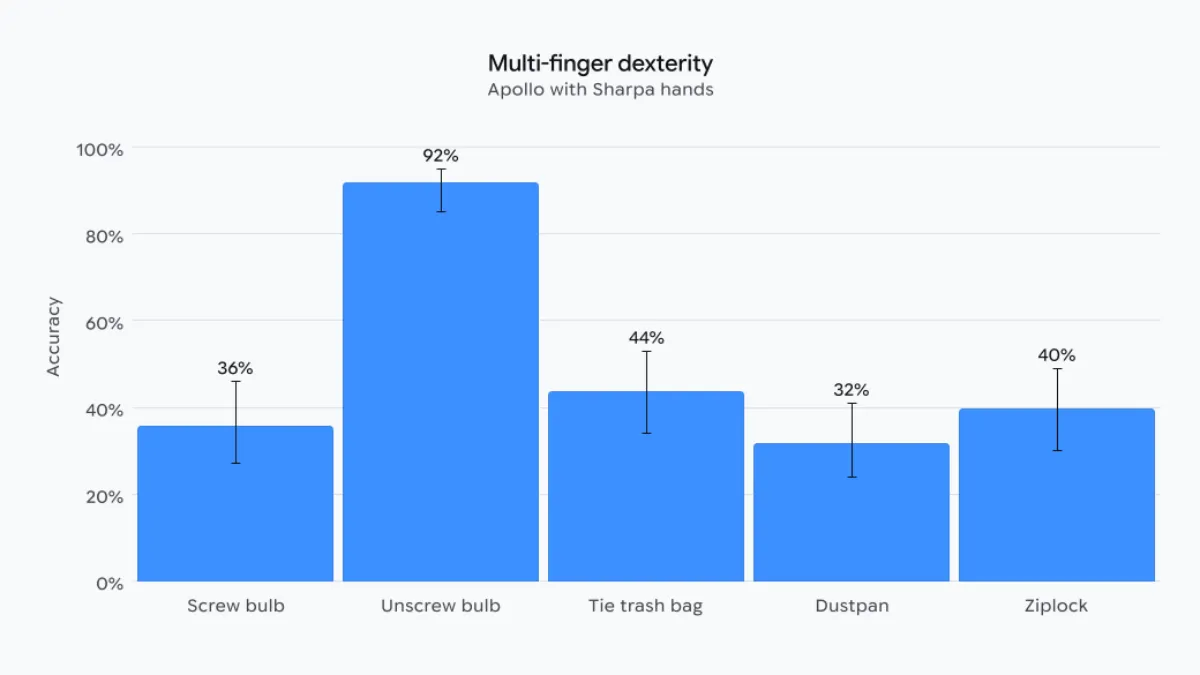
- Fine finger work using Apollo 2 with Sharpa hands produced the lowest figures Google published: Tying a trash bag succeeded 44 percent of the time, sealing a zippered bag 40 percent, and sweeping with a dustpan 32 percent.
- On the Franka robot, GR2 averaged 89.6 percent on precise insertion, 78.9 percent on tool kitting, and 74.2 percent on general pick and place. This task list differs slightly from that measured for Gemini Robotics 1.
- Gemini Robotics ER 2’s judgment about whether a task was physically possible for the robot depended on being told what Gemini Robotics 2 had practiced. With no summary of that training it was right 62.0 percent of the time; with a highly detailed summary, 95.8 percent.
- Google also introduced a safety benchmark, ASIMOV-Agentic. Google found that no system it tested, its own included, can both catch hazards to a person from a moving robot and avoid stopping for nothing. Holding needless stops under 5 percent meant missing more than 40 percent of the moments a person was too close. Consequently, Google recommends running these models alongside conventional physical safety equipment rather than in place of it.
Screwing in a light bulb: One pair of tasks in Google’s results illustrates how an apparently simple task, when reversed, can be a challenge in robotics. Unscrewing a bulb succeeded 92 percent of the time, the highest figure in Google’s finger-work set. Screwing one in succeeded 36 percent of the time. Unscrewing starts from a settled position (bulb already in the socket), so the hand needs only grip and rotation. Screwing one in has to establish bulb-in-socket alignment first, with the hand wrapped around the bulb.
Behind the news: An updated Gemini Robotics reasoning model called ER 2 is paired with this release. ER 2 plans steps, tracks progress from a video feed, and calls an action model as a tool. Another model, Gemini Robotics On-Device 2, runs on the robot’s own hardware without a network connection and adapts to an unfamiliar two-armed body in a few hours using typically fewer than 200 examples.
Why it matters: Many robotics models are trained for one task, one machine, and one environment at a time, and changing a single variable often means starting from scratch. There is also no corpus of robot motion at anything close to the scale of the text and images behind vision-language models. The latest Gemini Robotics models are an experiment in learning from more generalized training data than has been available for robots in the past. It shouldn’t matter if you change the type of hands, number of joints, or tasks performed: The goal of a true multi-embodied robotics model is to successfully transfer knowledge from one setup to another, as transformer-based language models have done so successfully with text.
We’re thinking: How many Gemini robots does it take to screw in a light bulb? At the current 36 percent success rate, just under three.