Muse Code Wants Your Data: Meta's Muse Spark 1.2 and Muse Code approach the intelligence frontier at a discount
Meta will cut coding bills from dollars to pennies for developers who let the company learn from their work.
Meta will cut coding bills from dollars to pennies for developers who let the company learn from their work.
What’s new: Meta introduced Muse Code, a command-line agentic coding harness, and Muse Spark 1.2, the capable, low cost-per-task model behind it.
- Input/output: Text, images, video, and PDF in (up to 1,048,576 tokens), text out
- Features: Adjustable reasoning levels (none, minimal, low, medium, high, xhigh), tool use, structured output, web search, context caching, background subagents that persist across a session
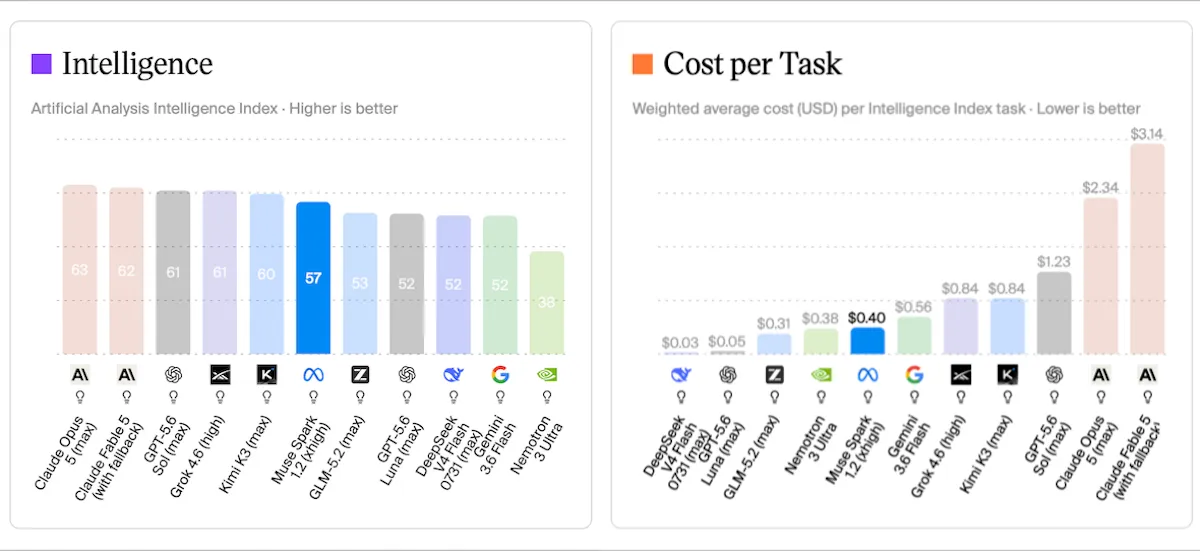
- Performance: Achieved 57 points on Artificial Analysis’ Intelligence Index, first on Vals AI’s Finance Agent v2 and on Artificial Analysis’ AA-LCR
- Availability/price: Muse Code in beta for macOS and Linux, Muse Spark 1.2 via Meta Model API. Standard tier $1.25/$0.15/$4.25 per million input/cached/output tokens (prompts and outputs not used for training); contributor tier $0.10/$0.002/$0.20 per million input/cached/output tokens (prompts and outputs used for training); web search $2.50 per thousand queries
- Undisclosed: Parameter count, architecture, knowledge cutoff, training data, and method details
How it works: Muse Code runs in a terminal. Given a software task, it plans changes, writes code, and checks results at each step using Muse Spark 1.2. Meta trained the model to work with Muse Code, using data from Muse Spark 1.1. The company describes three design choices that distinguish the agent from a single loop that calls a model repeatedly.
- A main agent delegates to a set of subagents that remain for the length of a session instead of being created and discarded for each task. Subagents edit in parallel inside isolated worktrees, separate working copies of a repository that keep simultaneous changes from conflicting, Mark Zuckerberg wrote.
- Because they persist, subagents retain context they have already learned about a repository rather than re-derive it. The subagents also determine when to report back to the main agent on their own.
- The agent writes every model call, tool run, plan approval, and file edit to a log on the user’s machine. If the agent crashes, it reads the log and resumes from the step it reached rather than starting over, which helps agents to work on long-running tasks.
- The agent ships with three default skills that users can call: /plan converts a request into a roadmap the user must approve, /grill probes that plan for weak points, and /goal drives work until an objective is met.
Performance: Independent evaluations place Muse Spark 1.2 a notch below the intelligence frontier, but at a lower cost per task than most models around or above its level.
- On Artificial Analysis’ Intelligence Index, a composite of nine evaluations of economically useful tasks, Muse Spark 1.2 set to xhigh reasoning (57, $0.40 per task) ranked sixth, above Grok 4.5 set to high reasoning (56, $0.36 per task), and just behind Qwen3.8-Max set to reasoning (58, $1.13 per task). The new model’s Intelligence Index score was 4 points above last month’s Muse Spark 1.1 (53, $0.29 per task).
- On Artificial Analysis’ AA-LCR, a test of reasoning across long documents, Muse Spark 1.2 set to xhigh reasoning (83.3 percent) outperformed all other models tested.
- On the Vals Index, a composite of finance and coding tasks weighted by potential economic impact, Muse Spark 1.2 set to xhigh reasoning (71.88 percent, $0.70 per task) ranked fifth, ahead of Claude Opus 4.8 set to max reasoning (70.36 percent, $7.52 per task) and behind GPT-5.6 Sol set to max reasoning (73.12 percent, $7.46 per task) — less than one tenth of the cost per task.
- On Vals AI’s Finance Agent v2, which assigns models the work of entry-level financial analysts, Muse Spark 1.2 set to xhigh reasoning (60.60 percent, $0.77 per task) ranked first of 45 models, significantly cheaper than second-place Claude Opus 5 set to max reasoning (58.63 percent, $5.12 per task) and taking roughly half the time per test.
Behind the news: Muse Spark 1.2 is already an inexpensive model, but if it catches on — OpenAI and other companies have tried similar initiatives — a contributor discount for the model’s use in Muse Code is potentially a transformative one. Companies’ appetite for training data drives new policy pushes and business intiatives.
- In a long essay, Mark Zuckerberg argued that United States labs are disadvantaged by restrictions on training data.
- Of all training data, high-quality code is a scarce commodity. Hugging Face published The Stack v3 last week, a 4.9 trillion-token crawl of public GitHub assembled to replace its years-old predecessor. But a public repository shows only polished code, not all the reasoning, mistakes, and repairs that went into it. Sessions from a working coding harness capture that entire process.
- The Muse Spark 1.2 discount lands in a price competition that has escalated over the summer: OpenAI cut GPT-5.6 Luna’s prices by 80 percent to $0.20/$1.20 per 1 million tokens of input/output, and DeepSeek-V4-Flash-0731 arrived at $0.14/$0.28 per 1 million tokens of input/output. Meta’s contributor tier undercuts them both and virtually everyone else selling high-performing models through an API.
Why it matters: The contributor tier buys Meta something its apps don’t supply. Facebook, Instagram, and WhatsApp generate enormous quantities of data, but not the kind of coding data required to train coding agents. Meta is short of such data and is willing to give away most of the price of the Muse Spark 1.2 to get it. Meta sells the same model at two prices, and the discount buys Meta the right to train on whatever passes through the agent. That trade requires no contract: A developer picks it by typing a different model name. The tier containing these data terms caps at 100 requests per minute per team versus 3,000 requests per minute for the standard tier, limits that make it practical mainly for individuals and small teams — the developers least likely to have a lawyer on retainer, and the ones whose entire product may sit in the repository the agent reads.
We’re thinking: No one is forced to give up their data to use Meta’s best model or agent. But developers weighing Muse Code’s discount are deciding, whether they think about it deliberately or not, what their own code and expertise are worth. Model builders have long trained on developers’ code by scraping it from public repositories and forums. Meta is trying to turn that knowledge transfer into a market. Like all markets, this one rewards the side that knows what its goods are worth, and the goods for sale here, both repositories (public or private) and a recording of how the work was done, lacked a clear price before. Meta has transparently priced the discount. Likewise, developers should price the value of their data before calling the trade a true bargain.