AI Can Help Heal Romantic Distress: Inside overit, a study of chatbot therapy after breakups
Chatbots that are designed to treat mental health issues typically require multiple sessions, posing a risk that users will drop out before they receive much benefit. Researchers showed that chatbots can provide relief in a single session.
Chatbots that are designed to treat mental health issues typically require multiple sessions, posing a risk that users will drop out before they receive much benefit. Researchers showed that chatbots can provide relief in a single session.
What’s new: Thomas Menzel at Technical University of Munich and University of Cambridge, along with Michel Schimpf and Thomas Bohné at University of Cambridge, built overit, a chatbot app designed to help users recover from romantic breakups. In a randomized, controlled trial, users felt substantially better after one conversation.
Key insight: Romantic breakups can continue to cause distress long after they occurred. Often, the former lovers are troubled by self-limiting beliefs about themselves (“I was abandoned because I am not enough”) or the world (“nobody could want me”). According to memory reconsolidation theory, recalling a distressing memory, contemplating a self-limiting belief about it, and then presenting an interpretation that contradicts the earlier belief (“You did the best you could, but you were failed by someone you trusted”) can durably update the painful memory. If that’s true, a chatbot that elicits a self-limiting belief and guides the user toward a counterfactual interpretation could bring about a lasting reduction in distress.
How it works: Users filled out a survey that included a breakup distress score, breakup timing, and the ex-partner's name (along with follow-up surveys after the trial period). Then they discussed their breakups with a mobile app based on Claude Sonnet 4.5.
- Given their survey responses, the app guided them through four phases of conversation. The app (i) asked open-ended questions about a breakup and its impact, (ii) elicited beliefs and identified at least one self-limiting belief, (iii) offered alternative perspectives, and (iv) asked users what they had learned from the conversation and how they felt now. It progressed from one phase to the next after a number of turns or reaching a certain milestone, capping conversations at 18 turns.
- With each user input, the app asked Claude Sonnet 4.5 to assess the current phase by checking the last three turns against five milestones: (i) identifying a self-limiting belief, (ii) challenging it, (iii) steering the user toward a counterfactual interpretation, (iv) articulating a new insight, and (v) concluding the dialog.
- Then the model considered the conversation history, instructions for the current phase (for example, to identify the core self-limiting belief in phase two), and survey data and generated a response.
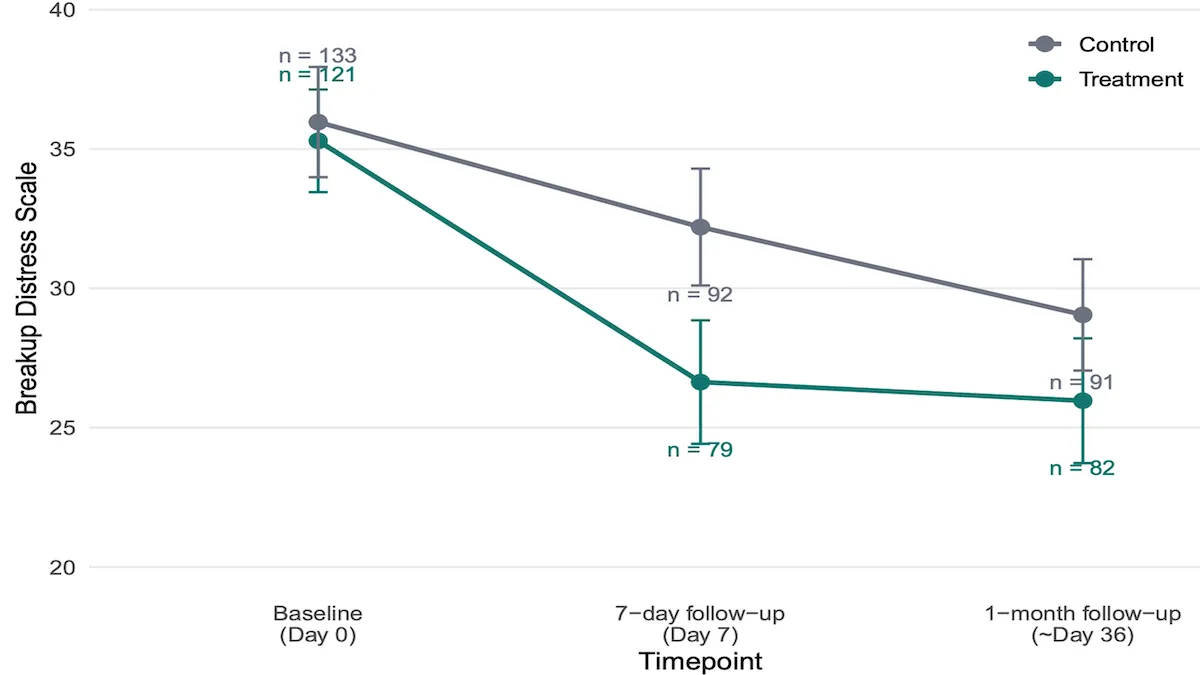
Results: The authors ran a randomized, controlled trial with 171 participants in the U.S. and UK who had experienced a breakup within 18 months on average. Half of participants conversed with the app, via text or voice, in a single conversation of roughly 20 minutes; the other half did not interact with the app. The authors measured the participants’ distress via the Breakup Distress Scale, a 16-item questionnaire that yields scores between 16 and 64.
- After 7 days, the group that used the app had experienced a large reduction in distress (from 35.3 to 26.6) relative to the control group (from 35.9 to 32.2).
- After one month, the group that used the app showed lower distress (26.0) than the control group (29.0).
- People who used the app were more likely to report a “sudden insight” about their breakup (such as “I had been carrying the blame for my failed relationship instead of recognizing that I did everything the best I could and I was failed by someone I trusted”): 61.7 percent versus 19.3 percent. Those who had such experience tended to report feeling better afterward.
Why it matters: Chatbots frequently sycophantically affirm a user’s expressions. This can be troublesome in therapeutic settings, where an analytical approach would be more helpful. This work addresses that issue by dividing each input into calls for evaluation and generation. Prompting the LLM first to evaluate the conversation’s state and then to generate a response separates the tasks of tracking therapeutic progress and expressing empathy to the user, which supports the LLM’s ability to provide helpful output. This approach offers a template for building goal-directed conversational agents that challenge users (in this case, to examine and reinterpret painful memories) rather than simply comforting them.
We’re thinking: Any chatbot session is less expensive than a human therapist, but a single 20-minute conversation that can meaningfully improve a subject’s mood and attitude is truly favorable economics, even at Claude’s rates.