Gemini Leads the Pack Again: Google Gemini 4 Carbon tops Intelligence Index, cybersecurity benchmarks
Google’s Gemini 4 Carbon puts the company on top of Artificial Analysis’ Intelligence Index, edging past Anthropic’s Claude Opus 5.5, while costing less per task.
Google’s Gemini 4 Carbon puts the company on top of Artificial Analysis’ Intelligence Index, edging past Anthropic’s Claude Opus 5.5, while costing less per task. As with Gemini 4 Argon, Google is making Carbon available to select cybersecurity companies ahead of general availability.
What’s new: Google announced Gemini 4 Carbon, a multimodal model that it says is designed for cybersecurity tasks. There is no set date for Carbon’s wider release.
- Input/output: Text, image, speech, and video in (up to 1 million tokens), text out (94.6 tokens per second)
- Features: Adjustable reasoning
- Performance: First on Artificial Analysis’ Intelligence Index v5.0 (59), second on Vals AI’s Vals Index v2.2 (70.36 percent), first on Arena.ai’s Text leaderboard (1,528 Elo)
- Availability: A small set of Google-selected companies, with access expanding gradually to other companies in its Fairwind Program
- Price: Via API at an introductory price of $2/$0.10/$10 per million input/cached/output tokens, then $4/$0.20/$20 per million input/cached/output tokens
- Weights/license: Proprietary
- Undisclosed: Parameter count, architecture, training data and methods, knowledge cutoff, end date of introductory pricing, date for broader availability
How it works: Google says Gemini 4 Carbon builds on Gemini 4 Argon, which it described as a mixture-of-experts model trained via reinforcement learning on reasoning, problem-solving, and theorem-proving data. The company says it worked to improve Carbon in coding, science, multistep agentic tasks, full-stack web development, and multimodal understanding. Carbon shares Gemini 4 Argon’s safety measures, including resistance to prompt injection and adversarial prompts. The company also filtered Argon and Carbon’s training data to remove sexual abuse material, personally identifiable information, and pages from low-trust websites.
Performance: Gemini 4 Carbon ranks first on Artificial Analysis’ recently updated Intelligence Index v5.0 and second on Vals AI’s Vals Index. It leads most tests of expert knowledge and factual recall but trails Claude Opus 5.5 on Artificial Analysis’ Coding Agent Index.
- On Artificial Analysis’ Intelligence Index, a weighted average of nine tests of knowledge work, coding, science, and general knowledge, mostly using private test sets, Gemini 4 Carbon set to high reasoning ranks first (59, $7.76 and 21.6 minutes per task), ahead of Claude Opus 5.5 and GPT-6 Astra. It costs less per task than Claude Opus 5.5, but more than GPT-6 Astra.
- Carbon ranks first on four of the nine individual Intelligence Index tests: AutomationBench-AA, which measures performance on business tasks; HLE-Diamond, expert-level academic questions revised from Humanity’s Last Exam; Terminal-Bench-Science 0.1, research tasks in the sciences carried out in a terminal; and AA-Omniscience v1.1, which measures general knowledge against hallucination rates.
- On Artificial Analysis’ Coding Agent Index v2.0, which tests combinations of models and harnesses on three coding benchmarks, Gemini 4 Carbon set to high reasoning running in Google’s Antigravity CLI ranks second (59, $7.74 and 29.8 minutes per task). It trails Claude Opus 5.5, but Carbon costs less per task and finishes faster.
- On Vals AI’s Vals Index v2.2, eight finance, coding, legal, and tax benchmarks weighted by each sector’s share of U.S. gross domestic product, Gemini 4 Carbon set to high reasoning ranks second (70.45 percent accuracy, $10.51 and 47.75 minutes per task), trailing only Claude Sonnet 5.5 set to max reasoning, while again costing less and finishing faster.
- On Arena.ai’s Text Arena leaderboard, which ranks models via blind head-to-head comparisons, Gemini 4 Carbon ranks first (1,528 Elo), ahead of Gemini 4 Argon and Claude Opus 5.5.
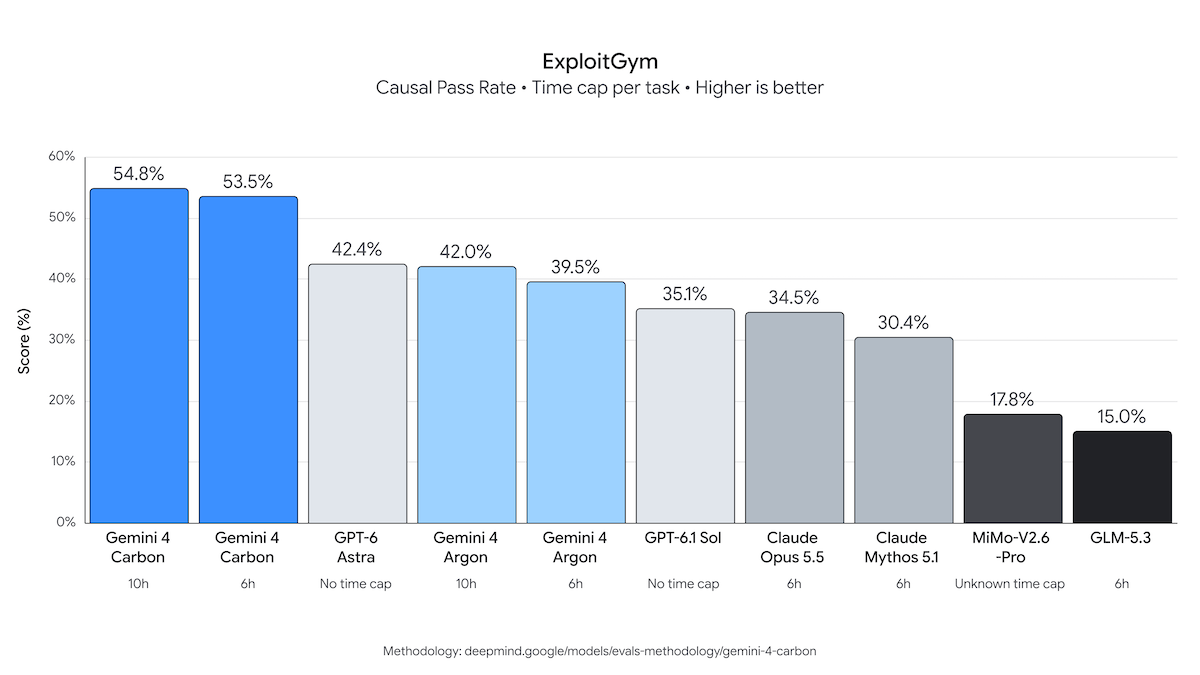
- Gemini 4 Carbon leads all models on three challenging cybersecurity benchmarks: CWE-bench (71.0%), ExploitGym (54.8%), and SEC-bench Pro (88.2%). These scores are self-reported.
Behind the news: Gemini 4 Carbon arrived around two weeks after Google made Gemini 4 Argon broadly available, and just a day after Artificial Analysis revised its Intelligence Index. The updated Index swaps in more demanding tests and splits the score evenly among knowledge work, coding, science, and general knowledge. Models’ scores on version 5.0 don’t compare directly with those of earlier versions. For example, Kimi 3.1 Pro, the best-performing open weights model, was just three points behind Claude Opus 5.5 using the old Index; now it is 12 points behind Claude Opus 5.5 and 13 points behind Gemini 4 Carbon.
Why it matters: Once Gemini 4 Carbon’s introductory discount ends, it will cost exactly what Claude Opus 5.5 costs per token. Yet on Artificial Analysis’ index, it finishes tasks with 29 percent fewer output tokens and costs 23 percent less per task. As frontier models converge on price and score, token efficiency becomes an increasingly competitive feature.
We’re thinking: Google CEO Sundar Pichai introduced Gemini 4 Carbon by reminding followers that he’d said Google would release models “periodically.” Two frontier models within a few weeks is an impressive pace. Gemini 4 Carbon’s 9-point lead over Gemini 4 Argon on Artificial Analysis’ index shows that frequent releases can bring big gains. We hope Google maintains this rapid rhythm.