Hermes Agent Challenges OpenClaw: OpenClaw created a class of personal agents; upstart Hermes Agent is outworking it
OpenClaw, the immensely popular AI agent, has fast-rising competition.

OpenClaw, the immensely popular AI agent, has fast-rising competition.
What’s new: Hermes Agent, an open-source agent launched in February by the New York-based AI lab Nous Research, recently moved ahead of OpenClaw on a leaderboard that tracks the number of tokens agents consume daily, as tallied by the AI-model platform OpenRouter. Some users have complained that Hermes Agent is less token-efficient, but its ability to define and sharpen new skills (specialized instructions, workflows, and/or domain knowledge) calls attention to self-improvement as a core agentic capability. You can download it here.
How it works: Hermes Agent’s capabilities largely overlap with those of OpenClaw. Hermes Agent differs primarily in its memory architecture and ability to build skills automatically. It’s designed to run locally or in the cloud, supports a wide variety of large language models, and integrates with around 20 messaging services. Using a model that runs locally (or one that generates new access tokens after logging in from a browser) makes it possible to get up and running without storing an API key. It works with integrated development environments via the Agent Communication Protocol.
- Agentic loop: Like OpenClaw, Hermes Agent’s agentic loop works as follows: (i) The agent assembles a prompt based on its defined personality, instructions, tools, skills, memory, knowledge about the user, and conversation history including the most recent message. (ii) If the prompt exceeds the input limit of the associated LLM, it asks the LLM to summarize old messages in the conversation history to reduce the size. (iii) It sends the assembled prompt to the LLM and either calls a tool, calls a skill, or responds to the user. (iv) If it calls a skill or tool, it executes that call, which also outputs a tool call, skill call, or response for the user. This cycle repeats until the model generates a response for the user.
- Skills: Hermes Agent uses the standard SKILL.md format for instruction files that tell the agent how to accomplish a task by calling tools that run bash scripts, search the web or files, query databases, and so on. It comes with built-in skills, and additional skills are available from Skills Hub (which currently is much smaller than OpenClaw’s immense, crowd-sourced skill library). However, it also creates new skills automatically. When Hermes Agent works on a problem for a long time or fixes an error and decides it has completed the task successfully, it calls a tool to create a skill. To prevent agent-generated skills from growing out of hand, an additional background system called Curator (i) archives every skill that has not been used in over 90 days by moving it to a separate folder, and (ii) uses an LLM determine whether each skill should be kept as is, merged with other skills, or archived.
- Memory: Hermes Agent maintains two general memory files that it adds to the prompt. One details user preferences, and the other includes information about workflows and lessons learned. It calls a built-in memory tool to add to these files. When it decides to add a memory, it checks the memory to see if it’s worth adding and which of the two files to add it to. (For example, it does not add the memory if a similar memory already exists or the memory is too vague.) When it determines that adding the memory would exceed a preset file length, it examines the relevant memory file and merges related entries. Hermes Agent also maintains a database of conversations that it can search using a separate tool. In addition, it can take advantage of external memory providers such as Honcho, which analyzes the user’s identity after every message to derive preferences, goals, and patterns.
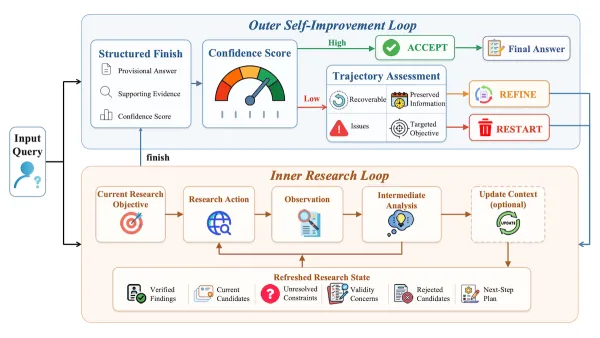
- Persistent goal tracking: Users can specify a goal in a message. Once the agent finishes its response, it will call a judge model to evaluate whether the goal was completed. If not, it continues working. This loop continues until the goal is judged to have been completed or the agent reaches a maximum number of turns. Anthropic Claude Code, OpenAI Codex, and OpenClaw (via a plugin) offer a similar capability.
Behind the news: Agentic capabilities emerged as large language models gained the abilities to plan across multiple steps, reflect on earlier outputs, and use external tools to perform actions online. Coding agents such as Anthropic’s Claude Code and OpenAI’s Codex gained traction among software developers in 2025, helping to build enthusiasm for more-autonomous AI systems. In early 2026, OpenClaw became an open-source phenomenon with a personal agent that ran continuously to execute online tasks and interacted through messaging platforms such as WhatsApp and Telegram; its inventor went on to join OpenAI. OpenClaw’s popularity, along with its security issues at launch, brought forth a wave of “Claw”-like agents including, in February 2026, Hermes Agent. Interest accelerated in late April and May as successive releases made it easier to use and its self-improving behavior more robust.
Why it matters: General-purpose agents are rapidly extending the landscape of AI-driven capabilities. A typical set of features is beginning to coalesce, but new features are still emerging. Hermes Agent, with its more sophisticated memory and ability to turn successful behaviors into skills, is a case in point. It points toward a shift from stateless AI assistants to agents that accumulate experience, adapt to users, and automate ongoing work beyond isolated tasks.
We’re thinking: It may seem only natural, but open-source agents that aren’t tied to a particular LLM, messaging platform, or skill format are especially valuable. These agents are available in your usual messaging channels and can take advantage of the best AI models available within the limits of their harnesses.