Gemini 4 Carbon leads the Intelligence Index: Grok Bot gets throttled after unsustainable demand
robots.txt rules to block AI crawlers get simpler. Nemotron 3.5 Transcribe claims high marks on translation. EmbeddingGemma 2 is the best free multimodal option. Spotify explores fan-created AI remixes.

In today’s edition of Data Points, you’ll learn about our top headlines, and more:
- robots.txt rules to block AI crawlers get simpler
- Nemotron 3.5 Transcribe claims high marks on translation
- EmbeddingGemma 2 is the best free multimodal option
- Spotify explores fan-created AI remixes
But first:
Gemini 4 Carbon leapfrogs Argon, but only some testers can use it
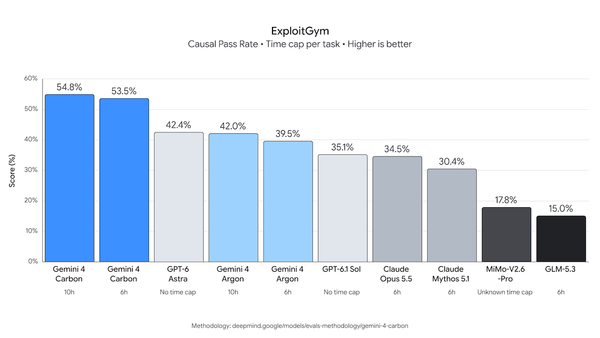
Google announced Gemini 4 Carbon, a frontier model released two weeks after Gemini 4 Argon, and is making it available initially only to a subset of selected users through its Fairwind Program. General access for developers, businesses, and consumers has no date; Google says it will come “as soon as possible” after more guardrail work. Google reports Carbon ranks first on the Artificial Analysis Intelligence Index v5.0 at 59, and scores 88.2% on SEC-bench Pro (finding vulnerabilities), 54.8% on ExploitGym (exploitation), and 71.0% on CWE-bench (patching), all evaluated without guardrails. It also reports a 2x gain over Argon in generating secure code on internal benchmarks, a jump of 89 Elo points to fourth place on WebDev Arena (1769), and internal runs lasting days on multi-step engineering tasks such as tracking down bugs across large codebases. Launch pricing matches Argon at $2 per million input tokens and $10 per million output tokens, with cached input tokens 95% cheaper. Most figures come from Google’s own testing, but the model is not yet in general release, so developers cannot check these results or test it on their own code for now. (Google)
Subscribers see Grok Bot limits reduced due to high costs
Elon Musk wrote on X on Sunday that the cost of serving Grok Bot, SpaceX’s AI agent, was “unsustainably high relative to revenue,” in response to subscribers complaining that their usage limits ran out quickly. The remarks came less than two weeks after he called Grok Bot the fastest-growing product he had ever seen on SpaceX’s third-quarter earnings call, where he also said per-user weekly usage was rising. Grok Bot requires the $30-a-month Premium tier or higher, and the $100 Super and $200 Ultra plans carry much higher limits, though it is unclear which plan the complaining users held. Musk gave no figures for what Grok Bot costs to run and did not say whether usage limits were lowered. Separately, Cursor users, whose subscriptions share a weekly allowance with Grok under xAI’s unified plans, reported unexpected usage spikes on Cursor’s forum, and Cursor logged and later resolved a billing and usage dashboard problem on Sunday. (Forbes)
AI leaders join to enable opt-out rules for websites
Google, Microsoft, Anthropic and OpenAI announced they will support a crawling standard that lets site operators block all generative AI training scrapers with one robots.txt entry. Today, a site must add a separate entry for every AI provider, and for each scraper a provider runs. The companies have submitted a draft to the Internet Engineering Task Force, which maintains the Robots Exclusion Protocol (the format robots.txt follows), and the setting would not cover models that perform only non-generative tasks. Microsoft also plans an AI Grounding setting that blocks requests made to answer a user’s question rather than to gather training data, including from third-party tools built on Microsoft technology, and OpenAI plans similar controls. Microsoft and OpenAI expect to add support in the coming months and Google sometime next year, while Meta has voiced support for the idea but has not committed to implementing it. Until the standard is final and shipping, site owners who want to opt out of AI training still need per-crawler entries, and the pending AI Grounding controls suggest training and answer-time access may soon be blockable separately. (Silicon Angle)
Nvidia’s transcription/translation model may be worth testing
Nvidia released Nemotron 3.5 Transcribe, an open-weight speech model that transcribes, labels up to eight speakers, translates, and answers questions about audio in one pass, across 40 languages and up to 100 hours of recording. It is a 30-billion-parameter mixture-of-experts model with 4 billion active parameters, and it runs on a single GPU. Nvidia reports a 30.8 percent word error rate out of the box, 20.8 percent with careful prompting, and 11.8 percent after fine-tuning on the Eka Care Indian medical speech benchmark; the article does not say how the first two figures were measured. A checkpoint is on Hugging Face, along with Granary v2, an open dataset of 843,579 hours across 48 languages whose recordings each carry three transcript styles (verbatim, normalized numbers, filler words removed) that can be requested by prompt. For developers, this means one self-hostable checkpoint can replace a pipeline of separate transcription, diarization (speaker labeling), and question-answering models. The Granary data also gives a starting point for fine-tuning on domain-specific audio. (Silicon Angle)
Open Google embedding model makes multimodal retrieval easier
Google released EmbeddingGemma 2, an open embedding model that maps text, images, audio, video, and combinations of them into one shared vector space, along with a technical report. The model has about 740 million parameters. The authors say it sets a new Pareto frontier (the best available trade-off between model size and accuracy) on embedding benchmarks across all modalities, beating specialist models and models two to twelve times larger; the abstract does not name the benchmarks or give scores. They credit simplified per-layer embeddings and a multi-stage training curriculum that moves through modalities and objectives in sequence. For constrained environments, the model supports loading only selected modality encoders, adjustable vision token budgets, truncatable embedding dimensions, and quantized weights. A single open model that covers several modalities could replace separate text, image, and audio embedding pipelines in retrieval systems. (Hugging Face)
Spotify may introduce paid AI remixes, pay labels and musicians
Spotify is aiming to launch a paid AI feature in the first quarter of 2027 that lets subscribers make their own remixes and covers of existing songs, according to the Financial Times, citing unnamed sources. The company is considering an extra $4 to $5 a month, with a possible unveiling around the Grammy Awards in February; timing and price are not final. The feature depends on licensing: Spotify has deals with Universal Music Group, Merlin and Believe, and is still negotiating with Sony Music and Warner Music. Artists can opt out even if their label signs, and sources say major contemporary stars have been harder to recruit than older acts. Royalties from fan remixes would go to the original artists, and plays would count toward the original songs’ chart totals, unlike generators such as Suno that create new songs from text prompts. (Financial Times)
Want to know more about what matters in AI right now?
Read the latest issue of The Batch for in-depth analysis of news and research.
Last week, Andrew talked about the leading fears surrounding AI, the impact of fear-mongering on public perception, and the importance of assessing genuine concerns amidst AI advancements.
Read Andrew’s letter here.
Other top AI news and research covered in depth:
- Dawn of the Agents explores whether AI agents will self-organize or lose control due to inadequate safety practices.
- AI Bites the Hand That Feeds It highlights concerns from scientists and other users about AI companies potentially training on or misusing sensitive data.
- AI Detectors Find the Devil’s Work reports on the challenges faced by writers, students, and engineers who are falsely accused of using AI.
- Leaders Lock Models Away examines the implications of companies or governments potentially shutting down frontier AI development.
A special event for our community
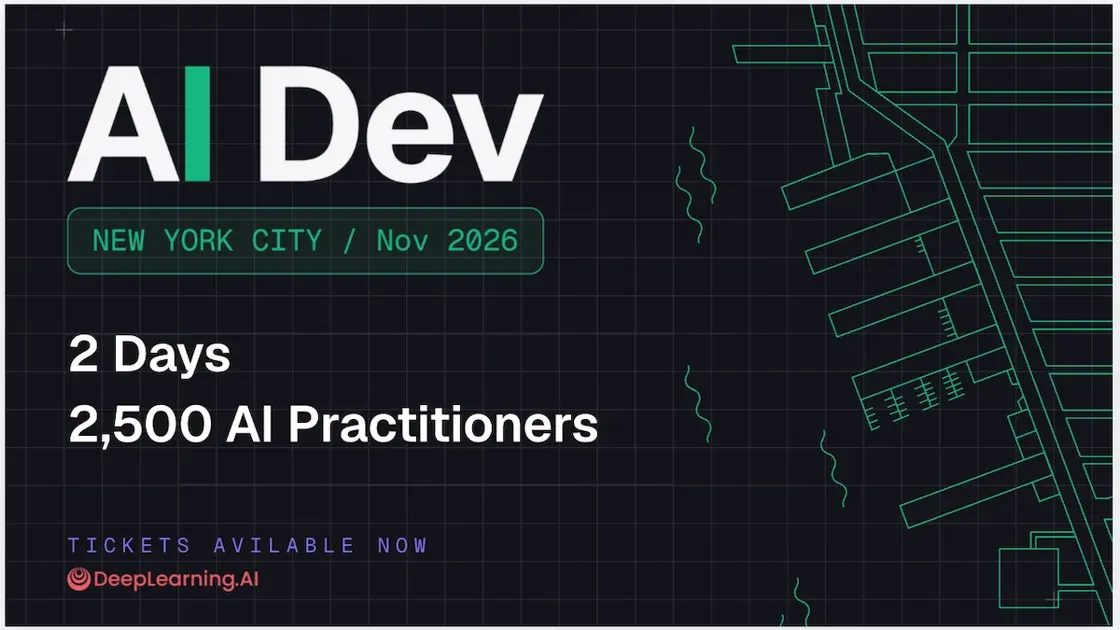
AI Dev brings together developers who build with AI every day. You'll hear from engineers at the companies shipping agents, models, and infrastructure, then meet them in person on the demo floor. Join us in New York City on November 30 and December 1.
Data Points is produced by human editors with AI assistance.