Fable Holds The Top Spot (For Now): Anthropic’s Claude Fable 5.1 is an agentic powerhouse
While last week’s OpenAI launch may have made a bigger splash, Anthropic’s new model remains an agentic workhorse, with top marks on independent evaluations from Artificial Analysis and Vals AI.
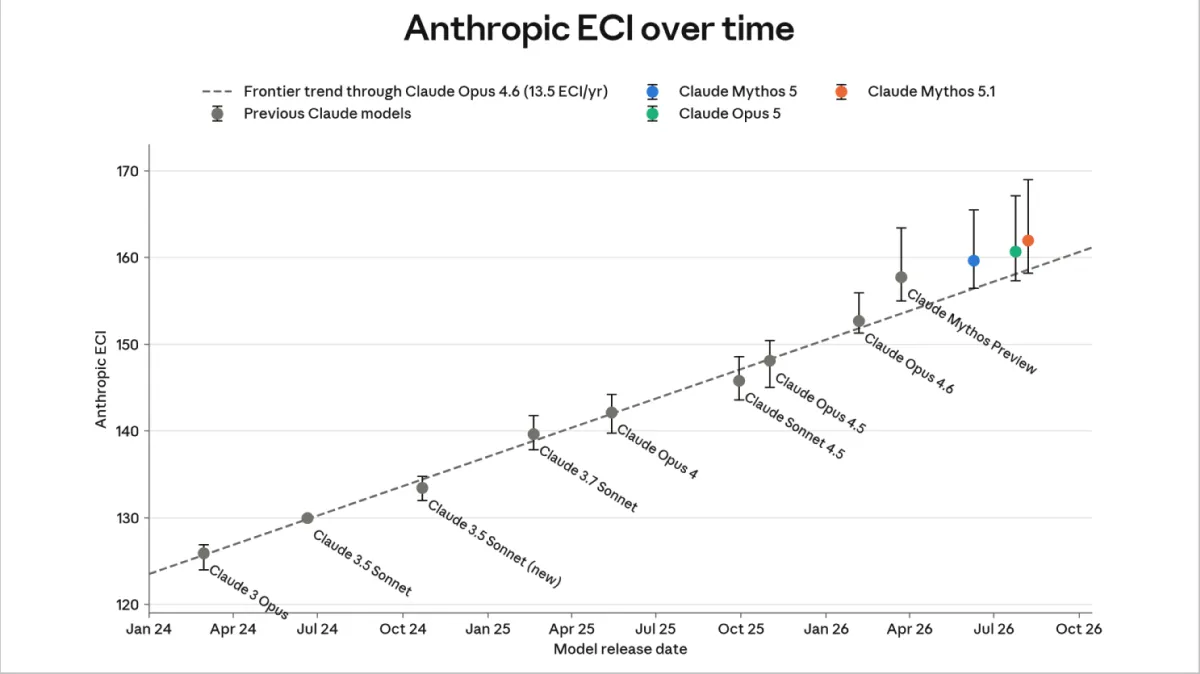
While last week’s OpenAI launch may have made a bigger splash, Anthropic’s new model remains an agentic workhorse, with top marks on independent evaluations from Artificial Analysis and Vals AI.
What’s new: Anthropic introduced Claude Fable 5.1 and Claude Mythos 5.1. Fable and Mythos are two titles for the same model, differing only in safeguards and fallbacks. Anyone can use Claude Fable 5.1, but only cybersecurity or life sciences organizations in the United States selected by Anthropic can use Claude Mythos 5.1.
- Input/output: Text and images in (up to 1 million tokens), text out (up to 128,000 tokens, 69 tokens per second)
- Knowledge cutoff: June 2026
- Features: Reasoning always on, five levels (low, medium, high, xhigh, and max, defaults to high), reasoning levels can change mid-conversation without invalidating cache (beta), tool use with optional readable progress updates (beta), prompt caching, per-turn system messages (beta), statistical watermarking of generated text, optional fallback to Claude Opus 4.8 or Claude Opus 5 for prompts that trigger bio or cyber classifiers
- Performance: Claude Fable 5.1 with fallback ties for first on Artificial Analysis’ recently updated Intelligence Index v4.3 (53) and leads Vals AI’s Vals Index (68.83 percent)
- Availability/price: Via Claude.ai and Claude API, and external providers such as Amazon Web Services, Google Cloud, and Microsoft Azure; Claude Mythos 5.1 only via Project Glasswing, both models via API at $10/$0.25/$50 per million input/cached/output tokens, cache writes $12.50/$20 per million tokens, batch processing $5/$25 per million input/output tokens; both models require 30-day data retention, and Zero Data Retention is only available with Anthropic’s authorization.
- Weights/license: Proprietary
- Undisclosed: Parameter count, architecture, specific training data and methods
How it works: Anthropic disclosed little about how it built the model beyond its training data, reasoning controls, and safeguards.
- Anthropic trained the model on private and public datasets, including data from public websites gathered with their ClaudeBot web crawler and synthetic data generated by other models. The company then fine-tuned the model to align with values it defined using a constitution.
- Claude Fable 5.1 can read earlier Claude models’ reasoning, but earlier models can’t read its reasoning, and, for accounts created on or after August 31, editing an earlier conversation turn invalidates it. Anthropic says this change removes a documented way to extract a model's reasoning.
- A probe reads the model’s activations — rather than its text output — and routes anything cybersecurity-related to a large language model classifier trained to judge whether to block the exchange. Anthropic says the probes and classifier complement one another, each seeing what the other misses.
- Anthropic says that unlike Claude Fable 5, Claude Fable 5.1 is permitted to complete purely defensive cybersecurity work such as finding vulnerabilities in human-readable source code, but not in compiled binaries. It still falls back to Opus 4.8 or Opus 5 on what Anthropic deems to be dangerous tasks such as penetration testing, exploit writing, and scanning compiled binaries for vulnerabilities.
Performance: One independent evaluator ranked Claude Fable 5.1 and GPT-6 Astra as tied for first. Another evaluator placed Claude Fable 5.1 just above GPT-6 Astra. It leads in long-running work that uses tools, but it trails GPT-6 Astra on overall knowledge, computer use, and multistep tasks in terminal. Claude Fable 5.1 maintains a slight edge, but costs more money and time per task.
- On Artificial Analysis’ Intelligence Index v4.3, a composite of 10 evaluations of math, science, coding, and reasoning, Claude Fable 5.1 set to max reasoning with fallback (53, $7.63 and 12.2 minutes per task) tied for the highest score with GPT-6 Astra set to max reasoning (53, $3.26 and 8.2 minutes per task). It outperformedClaude Opus 5 at max reasoning (51, $5.86 and 13.9 minutes per task). Requests routed to Claude Opus 4.8 or Claude Opus 5 produced about 4 percent of the output tokens the evaluator measured.
- Claude Fable 5.1 set to max reasoning with fallback leads two of Artificial Analysis’ Intelligence Index’s hardest components: AA-Briefcase (1662 Elo, $22.71 and 70.2 minutes per task), which grades multi-week knowledge work projects, each with many tasks and thousands of source files; GDPval-AA v2 (1,764 Elo, $9.77 and 60 turns per task), an adaptation of OpenAI’s test of economically useful tasks across 44 occupations. It also leads SciCode (63.1 percent), which tests models’ ability to write Python for scientific computing problems, and Humanity's Last Exam (59.1 percent), expert-written questions spanning mathematics, humanities, and natural sciences.
- On the Vals Index, Vals AI’s composite spanning coding, law, medicine, tax, finance, and scientific reasoning, Claude Fable 5.1 set to max reasoning with fallback (68.83 percent, $28.92 and 76 minutes per task) ranks first, ahead of Claude Opus 5 set to max reasoning (67.21 percent, $18.81 and 56 minutes per task) and GPT-6 Astra set to max reasoning (66.61 percent, $19.09 and 25 minutes per task).
Yes, but: Anthropic’s published cybersecurity evaluations all belong to Claude Mythos 5.1 with safeguards off, a configuration most users cannot access. Anthropic says that configuration has the strongest cyber capability of any model it has released and that it sits in the lower of its Frontier Compliance Framework’s two risk tiers but close to the higher tier, reserved for models that can complete novel, autonomous attacks.
Behind the news: Independent benchmarks have presented a moving target this week. Claude Fable 5.1 arrived on September 1. OpenAI’s GPT-6 Astra arrived two days later, initially scoring two points less than Claude Fable 5.1 on Artificial Analysis’ Intelligence Index. Then the scoreboard flickered and resumed with new numbers. On September 4, Artificial Analysis shipped Intelligence Index v4.2, retiring GPQA-Diamond because models had saturated it, adding two harder tests, and doubling the share of the index scored on private tests to 40 percent, which it says reduces labs' ability to game evaluations. The organization called this an expedited interim update because the frontier was moving too fast to wait for its completed v5 Index. On September 7, Artificial Analysis upgraded their index again, upgrading Terminal-Bench to v4 and adding AutomationBench-AA. After these changes, Claude Fable 5.1 and GPT-6 Astra tied for first.
Why it matters: Anthropic named three issues that Claude Fable 5.1 was built to fix: high cost per task, data retention policies that disappointed enterprise customers, and overly restrictive safeguards. Independent testing supports just one of these unresolved issues to be fixed. Cost per task rose about 20 percent over Claude Fable 5 even after a 75 percent cut to the price of cached input. The 30-day data retention rule still applies to everyone except eligible enterprise customers, who can use zero data retention now and move to Enterprise Frontier Safeguards, which store customer data on their own infrastructure rather than Anthropic’s, later this fall. Only the safeguards are loosened, but not completely. According to Anthropic, developers should expect roughly 60 percent fewer cyber interventions per session in Claude Code.
We're thinking: A top score on a benchmark has an ever-shrinking shelf life, not only because new models arrive every week, but also because the evaluation that crowns a model this month may not exist by the next month — or even the next week!