Even Agents Benefit From Reminders: Meta research lets one agent acts as a memory surrogate for another
Agents can lose track of what happened earlier as their trajectories grow, either by truncating their contexts or by missing relevant information among irrelevant tokens.
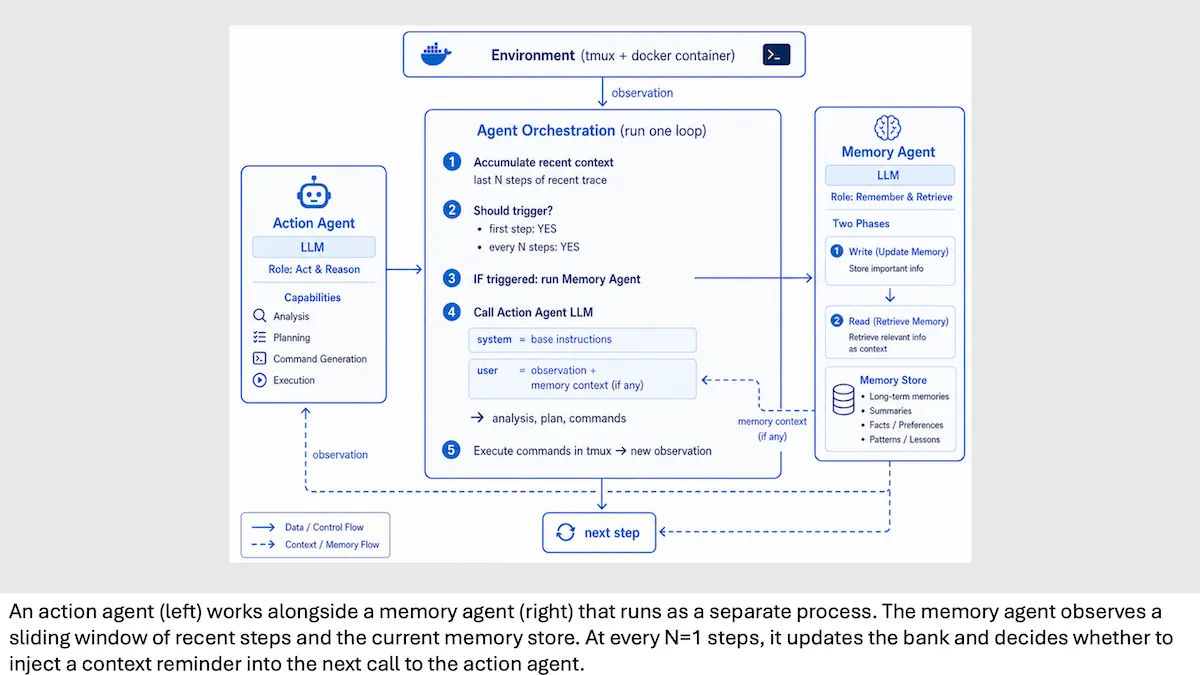
Agents can lose track of what happened earlier as their trajectories grow, either by truncating their contexts or by missing relevant information among irrelevant tokens. A fresh approach pairs an agent that performs actions with a separate agent that decides when to remind it of what it needs to know.
What’s new: Yifan Wu and colleagues at Meta AI introduced a Proactive Memory Agent that runs alongside a typical agent to maintain and selectively highlight information relevant to the current problem. The memory agent increased the action agent’s performance on all benchmarks the authors tested.
Key insight: Solving problems that accrue a long context, an agent carries information such as requirements, failed commands, and useful observations in its history — yet that information may not shape its next decision. Highlighting relevant memories can counteract such shortcomings without overwhelming the agent’s attention.
How it works: The authors built larger and smaller systems that paired a action agent with a memory agent. The action agents were based on Claude Sonnet 4.5, Claude Opus 4.6, or Qwen3.5-122B-A10B (which presumably is much smaller). The memory agents were based on Claude Opus 4.6 or, in the smaller system — after supervised fine-tuning and reinforcement learning on SETA command-line problems — Qwen3.5-27B.
- Given a description of a problem and the action agent’s eight most recent outputs or tool calls, the memory agent updated a set of problem-related notes that included facts, environment details such as the current working directory, successful fixes to issues encountered earlier, unfinished parts of the problem, and failed commands (to avoid repeating them).
- At every step, the memory agent added to the action agent’s input either nothing or a short reminder. A reminder could point to a part of the problem the action agent had ignored, a fact of the environment (for instance, available tools), or a command that had failed.
Results: In the larger system, the memory model raised the success rates of Claude Sonnet 4.5 and Claude Opus 4.5 on Terminal-Bench 2.0 and τ2-Bench. In the smaller system, it raised the fine-tuned Qwen3.5-27’s performance on Terminal-Bench 2.0.
- On Terminal-Bench 2.0, which contains 85 command-line problems, Claude Sonnet 4.5 reached 45.9 percent success with the larger memory model versus 37.6 percent without it. Similarly, Claude Opus 4.6 reached 45.9 percent with the memory model versus 43.5 percent without it. Qwen3.5-27B achieved 41.1 percent success with the smaller memory model and 37.6 percent without it.
- On τ2-Bench, which contains 278 airline, retail, and telecom problems, Claude Sonnet 4.5 reached 61.8 percent with the memory model versus 55.0 percent without it. Claude Opus 4.6 with the memory model reached 68.7 percent versus 66.2 percent without it. (The authors didn’t test the smaller system on τ2-Bench.
Why it matters: Using a separate agent to manage an agent’s context improves its performance decisively on the problems in this study. The memory agent doesn’t touch the model that actually does the work, so you can bolt it onto existing agents without retraining. It also means you can easily experiment with swapping models or agentic frameworks.
We're thinking: In a separate result, the authors found that their system outperformed one that reminded the action agent of relevant information at every step. Apparently reminding an agent is not enough. It’s necessary to remind it at the right moments.