DeepSeek Pushes the Frontier Again: DeepSeek refreshed its V4 Flash model with an impressive fine-tune
DeepSeek’s updated small model overtook the company’s own flagship.
DeepSeek’s updated small model overtook the company’s own flagship.
What’s new: A fresh round of fine-tuning, on an unchanged architecture, lifted DeepSeek-V4-Flash past the larger DeepSeek-V4-Pro on independent tests, at a fraction of the cost of proprietary models of comparable intelligence. The new release is titled DeepSeek-V4-Flash-0731, an official version of the smaller "Flash" model in its V4 family. It supersedes a preview version released in April.
- Input/output: Text in (up to 1 million tokens), text out (up to 384,000 tokens; 122.7 tokens per second)
- Architecture: Mixture-of-experts transformer, 284 billion total parameters, 13 billion active per token, optional speculative decoding module brings the checkpoint to 304 billion parameters
- Features: Reasoning (low, high, max) and non-reasoning modes, tool calls, context caching
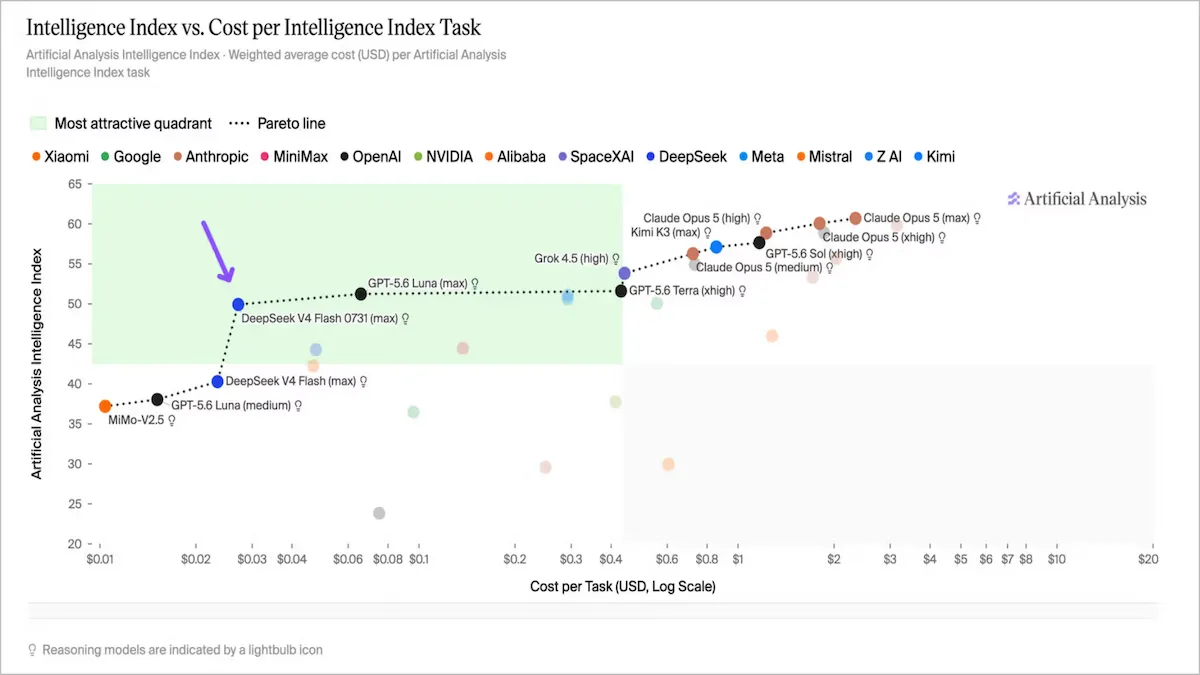
- Performance: Achieved 50 points on Artificial Analysis’ Intelligence Index, one point behind GPT-5.6 Luna set to max reasoning; on Artificial Analysis’ Pareto frontier for intelligence versus cost per task (meaning no model the evaluator tracks is both smarter and cheaper to run per task)
- Availability/price: Weights free for noncommercial and commercial uses under MIT license, via DeepSeek’s API at $0.14/$0.0028/$0.28 per million input/cached/output tokens
- Undisclosed: How the new fine-tuning differed from the preview’s fine-tuning, training data, and knowledge cutoff
How it works: DeepSeek said it boosted performance largely by performing a new round of fine-tuning, leaving the architecture and parameter count unchanged. The company did not explain how the new fine-tune differed from the last.
- The architecture (first introduced with the V4 series in April) cuts the cost of long input. Attention layers alternate between two schemes that compress the stored keys and values: One condenses every 4 tokens into a single entry and attends to only the most relevant entries, the other condenses every 128 tokens into a single entry and attends to all of them. At its full input length, DeepSeek-V4-Flash needs 10 percent of the computation and 7 percent of the memory for stored keys and values compared to DeepSeek-V3.2.
- DeepSeek pretrained DeepSeek-V4-Flash on more than 32 trillion tokens, then fine-tuned it in two stages. First, the team built a separate specialist model for each domain, such as mathematics, coding, and agentic tasks. Each specialist underwent supervised fine-tuning on domain data, then reinforcement learning via Group Relative Policy Optimization, an algorithm that rewards outputs that score well relative to other outputs generated for the same input. Second, the team merged the specialists into one model using on-policy distillation: The merged model wrote its own responses to training prompts, and training corrected each one toward the way the relevant specialist, chosen from more than 10, would have written it.
- The team trained the model’s different reasoning levels as distinct behaviors, applying different length penalties and context windows during reinforcement learning; the max level prepends a system-prompt instruction that pushes the model to decompose the problem fully and test edge cases and assumptions. During agentic tasks that call tools, the model keeps its entire reasoning history in context across every round, including across user messages, rather than discarding it as DeepSeek-V3.2 did.
- The released checkpoint ships with the speculative decoding module, DeepSeek-V4-Flash-DSpark, attached. A small draft module proposes several tokens ahead, and the main model verifies them at once rather than token by token, speeding up generation.
Performance: Independent evaluators found a large jump in agentic ability over the April preview, intelligence on par with proprietary models that cost significantly more to run per task, and a rank near the top of the open weights field.
- On Artificial Analysis’ Intelligence Index, a composite of nine evaluations of economically useful tasks, DeepSeek-V4-Flash-0731 set to max reasoning achieved 50 points, significantly ahead of the April preview version (40) and the larger DeepSeek-V4-Pro (44), tying Gemini 3.6 Flash set to high reasoning (50 points), barely behind GPT-5.6 Luna and GLM-5.2 (both set to max reasoning, tied at 51), and some distance behind the open weights leader, Kimi K3 set to max reasoning (57 points).
- DeepSeek-V4-Flash-0731’s cost ($0.03) to complete an Artificial Analysis Intelligence Index benchmark task at max reasoning via the DeepSeek API was substantially lower than GPT-5.6 Luna set to max reasoning ($0.05), a model of similar intelligence. (This comparison reflects OpenAI’s recent price cuts.)
- The model broadly improved on agentic tasks relative to the preview version. On GDPval-AA v2, a head-to-head model comparison on work tasks drawn from finance, law, healthcare, and other professions, DeepSeek-V4-Flash-0731 set to max reasoning achieved 1,558 Elo, second-best result among open weights models, behind Kimi K3 set to max reasoning (1,685 Elo) and ahead of GLM-5.2 set to max reasoning (1,508 Elo). On Terminal-Bench 2.1 (agentic tasks in a command-line environment), it solved 82.7 percent of problems, around 21 points higher than its preview version (61.8 percent). On τ³-Bench Banking (multi-turn tool use in banking scenarios), it achieved 31.1 percent, around 8 points higher than in preview.
- On Arena.ai’s CodeArena WebDev, where developers pick the better of two models’ outputs for the same front-end web development tasks, DeepSeek-V4-Flash-0731 set to high reasoning debuted at 1,577 points, seventh overall and third among open weights models.
Behind the news: The new DeepSeek-V4-Flash arrived during a crowded month as competitors cut prices and shipped efficiency updates within days of one another.
- One day before DeepSeek’s release, OpenAI cut the price of GPT-5.6 Luna by 80 percent to $0.20/$1.20 per 1 million tokens of input/output and GPT-5.6 Terra by 20 percent to $2/$12 per 1 million tokens of input/output. The company attributed the cuts to efficiency gains, including production inference code that GPT-5.6 Sol optimized.
- The week before, Google introduced Gemini 3.6 Flash and Gemini 3.5 Flash-Lite, updates aimed at speed and cost over capability. Artificial Analysis measured both models completing tasks in about half the time of their predecessors, and Gemini 3.6 Flash held the same 50 points on the Intelligence Index as the model it replaced while its cost per task declined from $0.59 to $0.50 per task.
- Open-weights developers pushed in the same direction. Thinking Machines’ Inkling Small, released the same week as DeepSeekV4-Flash, achieved 40 points on the Intelligence Index, within a point of the company’s flagship Inkling model despite having less than a third of its parameters, similarly higher than expectations for a smaller model.
Why it matters: Agents consume large numbers of tokens, so cost of token generation strongly influences what developers can automate economically. The updated DeepSeek-V4-Flash delivers intelligence close to proprietary models at well under half their cost per task, moving always-on work like triaging bug reports, reconciling invoices, and answering customer-service inquiries from pricey to pragmatic. And DeepSeek-V4-Flash is small enough that teams that need to keep data on their own hardware can skip the API: A 3-bit quantized version runs on a machine that has 110 gigabytes of memory.
We’re thinking: Not every customer wants the biggest, most arbitrarily powerful model for every task. Gemini Flash, Claude Sonnet, GPT-5.6 Luna, and DeepSeek-V4-Flash show that there’s a crowded market for highly intelligent, competitively priced, comparatively fast models that can iterate on a task and solve problems relatively inexpensively.