Claude Debuts Another Opus: Anthropic addresses some (but not all) complaints about Fable with Claude Opus 5
After launching Claude Fable 5, the future of Anthropic’s once-flagship Opus line was uncertain, except as a fallback for the company’s premium models.
After launching Claude Fable 5, the future of Anthropic’s once-flagship Opus line was uncertain, except as a fallback for the company’s premium models. Now it’s back as a highly-capable workhorse for everyday use.
What’s new: Anthropic launched Claude Opus 5, a vision-language model that’s cheaper to run and better at many tasks than Claude Fable 5.
- Input/output: Text and images in (up to 1 million tokens), text out (up to 128,000 tokens, 52.8 tokens per second)
- Knowledge cutoff: May 2026
- Features: Five reasoning levels (low, medium, high, xhigh, max; defaults to high), tool use, prompt caching from 512 tokens up, fast mode at roughly 2.5 times standard speed, no data retention
- Performance: Tops Artificial Analysis’ Intelligence Index (61 points); easily tops ARC-AGI-3, a test of how efficiently agents learn unfamiliar interactive environments
- Availability/price: Default model for Claude Max subscribers ($100-200 per month), strongest model available to Claude Pro subscribers ($20 per month); API $5/$0.50/$25 per 1 million input/cached/output tokens; fast mode $10/$1/$50 per 1 million input/cached/output tokens on Claude API only
- Undisclosed: Parameter count, architecture, training data and methods
How it works: Anthropic disclosed little about how it built Claude Opus 5, except aspects of training and model controls.
- Anthropic trained the model on public and proprietary data, including material gathered from public websites and data that other models generated, then fine-tuned it to follow human values the company defined in a constitution. The company intentionally kept cybersecurity tasks out of training.
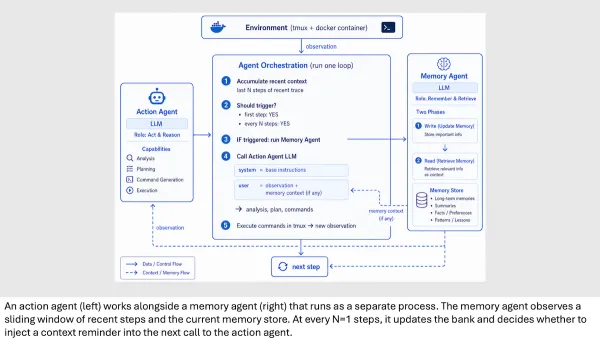
- Anthropic says the model better delegates to subagents without being instructed to and better checks its own work. Developers should forego verification-related instructions written for earlier models because such instructions make Claude Opus 5 over-verify.
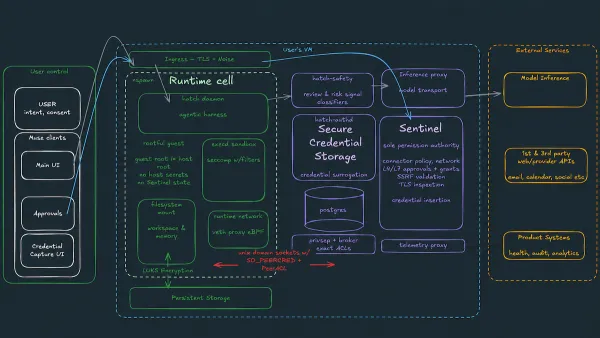
- Exchanges flagged as cybersecurity risks fall back to Claude Opus 4.8, but less often than on Claude Fable 5. A probe reads the model’s internal activations on every request and passes anything it flags to a second model trained to judge the input and output. The checks include everything the model reads, such as memory, files, search results, and connected tools, any of which can trigger a fallback. Anthropic says everyday defensive work such as scanning source code for vulnerabilities is permissible with Claude Opus 5 but ostensibly offensive requests such as generating exploits or penetration attacks trigger fallbacks. Questions about biology, chemistry, and life sciences do not fall back, as they do in Claude Fable 5, because Anthropic says Claude Opus 5 is less dangerous in those areas.
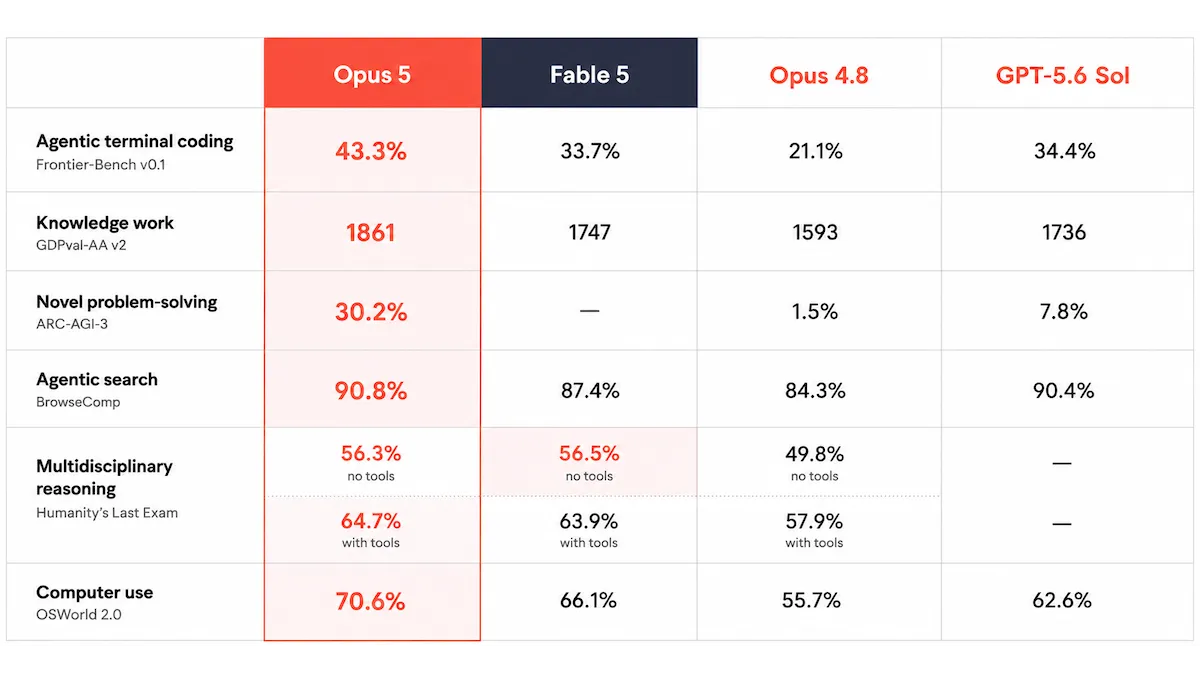
Performance: Claude Opus 5 leads many benchmarks at a cost per task lower than Claude Fable 5 but higher than most other models. The model’s widest performance margin came on a test of learning in unfamiliar environments.
- On Artificial Analysis’ Intelligence Index, a composite of nine evaluations of economically useful tasks, Claude Opus 5 set to max reasoning (61 points) edged out Claude Fable 5 set to max reasoning with fallback (60 points), OpenAI’s GPT-5.6 Sol set to max reasoning (59 points), and all other models. Cost separates them more sharply than capability does, with Claude Opus 5’s average of $2.03 per task sitting between Claude Fable 5’s $2.75 per task and GPT 5.6 Sol’s $1.54 per task. Claude Opus 5 set to xhigh reasoning tied for first place with GPT-5.6 Sol set to max reasoning (67) on Artificial Analysis’ Coding Agent Index. Other component tests where Claude Opus 5 outperforms Claude Fable 5 (and all other models) include GPTval-AA v2, AA-Briefcase (both of which measure agentic knowledge work), and MMMU-Pro (multimodal reasoning).
- On ARC-AGI-3, which places AI agents in games they have never played and rates how efficiently they learn the rules, Claude Opus 5 set to high reasoning (30.2 percent, $20.7k to run) achieved almost four times the result of the next-best model, OpenAI’s GPT-5.6 Sol set to max reasoning (7.8 percent, $25.1k to run).
- Claude Opus 5 set to max reasoning topped Terminal-Bench 3.0, which tests whether models complete business workflows, resolving 43.5 percent of tasks. It also led Zapier’s AutomationBench, a successor to Terminal-Bench which tests how agents resolve computer automation tasks, succeeding at 26.2 percent.
- On CursorBench 3.2, Cursor’s evaluation of coding inside its harness, Claude Opus 5 (70 percent, $8.23 per task) only trailed Claude Fable 5 set to max reasoning (70.5 percent, $17.32 per task).
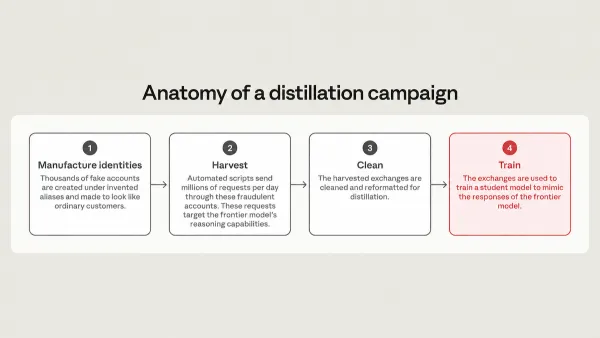
Behind the news: On July 22, White House science adviser Michael Kratsios said Moonshot AI built Kimi K3, the open-weights model that ranks fourth on Artificial Analysis’ Intelligence Index, by distilling Claude Fable 5. Treasury Secretary Scott Bessent threatened sanctions. But experts noted that Claude Fable 5 had been publicly available only a few weeks, too little time to distill data, train a model, and release it, said Braden Hancock, a researcher at Laude Institute.
Why it matters: Claude Opus 5 addresses many of the concerns longtime Claude users had with Fable 5: its frequent fallbacks and refusals for benign science questions, its exclusion from most subscription plans, its high price, and its onerous 30 day data retention policy. There are still cases where Claude Fable 5 is worth the premium: For example, Claude Opus 5 is more prone to hallucinations and less capable of factual recall. And it’s possible that current benchmarks may not fully capture the differences between them. But for most developers’ use cases, this is a welcome update.
We’re thinking: Although the new Opus model is less expensive than Fable or Mythos, it’s still quite pricey. While other labs are opting for speed and lower costs, Anthropic heads in the other direction, building larger, slower, highly knowledgeable, but more expensive models. The company bets that for fields like cybersecurity, software engineering, and document production, customers will be willing to pay a premium — and in cases where they need faster inference, they may pay twice as much.