A Full Accounting of Models’ GPU Use: Researchers detail the energy and water needed to train a family of open weight models
Assessments of the environmental impact of large language models typically focus on their final training runs, but there’s a lot more to building AI systems.
Assessments of the environmental impact of large language models typically focus on their final training runs, but there’s a lot more to building AI systems. Researchers calculated energy consumption, carbon emissions, and water usage throughout a model family’s development.
What’s new: Jacob Morrison, Noah A. Smith, and Emma Strubell at the University of Washington, Allen Institute for AI, and Carnegie Mellon University estimated the environmental impact of developing, from start to finish, the open weight models Olmo 3 7B and Olmo 3 32B (which were fine-tuned to follow instructions) as well as Olmo 3 7B Think and Olmo 3 32B Think (fine-tuned to reason). Experimentation — not training — dominated the environmental picture. The authors claim to be the first to appraise each post-training stage individually and to compare such appraisals in reasoning and instruction-tuned variants. They did not study inference.
Key insight: Measuring a model’s greenhouse-gas emissions, electricity consumption, and water consumption during only its final training run misses much of its environmental impact, since researchers conduct experiments at each stage (to perform ablation studies, design reward functions, optimize data mixtures, and tune hyperparameters) before settling on the recipe. Measuring the impact of everything that went into developing the model both provides a more accurate picture and reveals the most environmentally intensive activities.
How it works: The authors monitored five phases of development: (i) pretraining, (ii) midtraining (an emerging stage that typically sharpens distinct skills or imparts specific domains prior to fine-tuning), (iii) SFT, (iv) DPO, and (v) RL. They tracked all experiments as well as generation of synthetic training data and filtering of RL prompts to weed out those that were too easy. They tracked experimentation separately from final training runs.
- The authors measured GPU electricity consumption at sub-second intervals.
- To estimate total data-center electricity consumption, they multiplied GPU electricity consumption by various factors to account for the CPUs, memory, networking equipment, storage, and cooling infrastructure.
- They estimated greenhouse-gas emissions by multiplying total estimated electricity consumption by the local power grid’s carbon intensity according to a value provided by the electricity supplier.
- They estimated water consumption based on estimated electricity consumption and published estimates of water consumed by local power plants. The data center used a closed-loop cooling system that consumed no water.
Results: The greatest environmental impacts came from experimentation and synthetic data generation. All told, developing the Olmo 3 models consumed around 12.3 gigawatt-hours of electricity, roughly enough to power 1,200 average U.S. households for a year. It emitted around 4,250 tons of greenhouse gases, roughly the amount produced by 500 average U.S. homes in a year. And it consumed and used nearly 16 million liters of water, or as mush as 50,000 U.S. residents use daily. The authors based all estimates on measurements of electricity consumed by GPUs, so we’ll highlight those figures below.
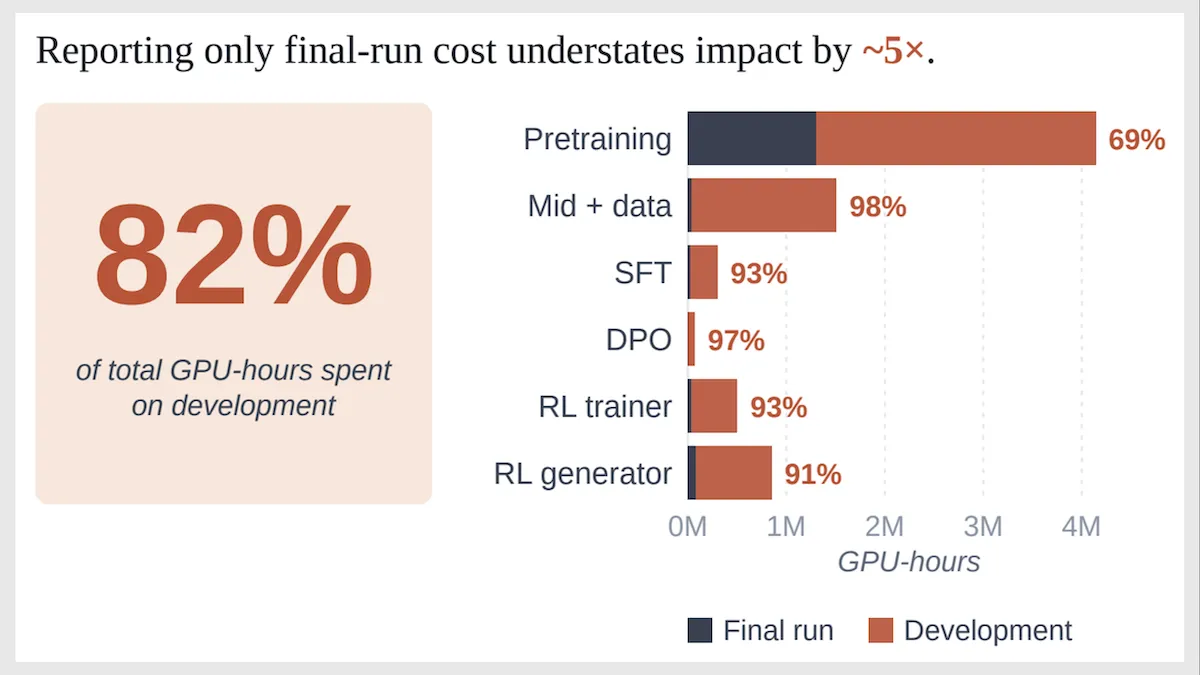
- Of development phases, pretraining had the most environmental impact. Pretraining consumed 30.9 percent of GPU hours, midtraining 18.8 percent, RL 3.8 percent, SFT 2.3 percent, and DPO 0.5 percent. Generating synthetic data consumed 36.9 percent of GPU hours.
- Experimentation consumed several times more resources than final training. Of the GPU hours spent on training-related activities (everything except generating synthetic data), 82.2 percent went into experimentation, while 17.8 percent went to the final training run.
- The reasoning models were relatively energy-intensive. For all fine-tuning stages, Olmo 3 32B Think required 14 times more GPU hours than the instruction-following version (although fine-tuning consumed a relatively small amount of total energy).
Why it matters: The authors address gaps in earlier efforts to determine the environmental impact of AI that focused on final training runs and inference. The result is a more realistic estimate of the costs in energy, water, and greenhouse-gas emissions. For the Olmo 3 reasoning models, experimentation produced the most greenhouse gases and consumed most of the resources and. These aspects of development likely will weigh even more heavily as models are built to generate longer reasoning traces, use more tools, and undergo more extensive reinforcement learning.
We’re thinking: When experimentation is costly — in both environmental and financial terms — people who can tell which experiments are worth running are especially valuable.