AI on Mobile Skyrockets: State of Mobile 2026 Report shows AI chatbot, search, and assistant growth outpaces gaming, social, and more
Downloads of mobile AI apps and resulting revenue are surging.
Downloads of mobile AI apps and resulting revenue are surging.
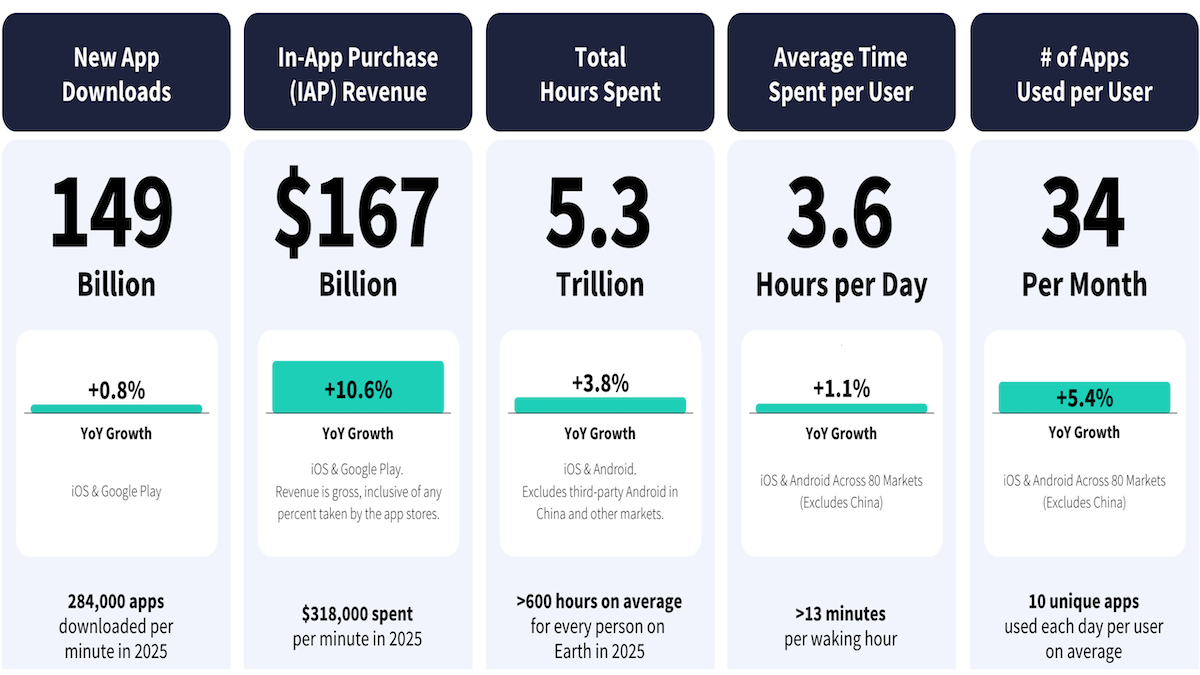
What’s new: The State of Mobile 2026 report by Sensor Tower, a market research firm, tracks the rapid growth of AI assistants, generative apps, and AI companions on smartphones. Last year, thanks to spending on AI apps, revenue from non-game apps exceeded gaming revenue for the first time, according to the firm’s analysis.
How it works: The authors evaluated the market for mobile AI in 2025. They estimated numbers of downloads, hours of use, and in-app revenue (but not advertising revenue) from the iOS App Store and Google Play based on proprietary data and data from developers. They did not obtain data from other app stores, so the report doesn’t reflect mobile activity in regions such as China, where users download apps mostly from stores run by domestic companies.
- Overview: Global revenue from AI-powered apps and downloads accelerated last year. Revenue tripled to more than $5 billion, while downloads doubled to over 3.8 billion.
- Leaders: The most-downloaded AI app, defined as one that uses AI for creative or generative tasks, was OpenAI ChatGPT followed by Google Gemini, DeepSeek, ByteDance Doubao, and AI-enhanced search engine Perplexity. OpenAI and DeepSeek accounted for almost 50 percent of global AI downloads, up from 21 percent in 2023, when Sensor Tower began tracking this category. Established tech companies like Amazon, Google, and Microsoft accounted for 30 percent of downloads in the past year, up from 14 percent in 2023. The long tail of AI startups made up the last 20 percent.
- Assistants versus generators: All of the top 10 most-downloaded apps were AI assistants. Nonetheless, generative apps like the Suno music generator and Bytedance’s Jimeng AI text-to-video app showed strong growth. The number of U.S. users of the top 10 AI assistants amounted to roughly 60 percent of the total population.
- Engagement: Users spent 48 billion hours in AI apps, roughly 3.6 times the total in 2024 and nearly 10 times the number of hours in 2023.
- Apps versus web: Around 110 million U.S. chatbot users — more than half — used AI exclusively via mobile apps, up from 13 million mobile-only users at the beginning of 2024. Another 34 million users of AI assistants gain access to them via both apps and the mobile web.
Behind the news: Mobile AI assistants are only a few years old, and user behavior is changing quickly. OpenAI introduced its first ChatGPT mobile app in May 2023. Today nearly every major AI assistant is available as an app. Earlier this year, Microsoft found that Copilot users behaved differently on mobile devices and at different times of day. For instance, mobile users were more likely to discuss health and fitness than work and productivity.
Why it matters: AI is becoming habitual for millions of users, not just when they’re working but also when they’re away from their desks and mobile devices are more handy than desktops. In that context, AI apps increasingly compete for time and attention directly with games, social media, and short-form videos. Both time and attention spent lead to more revenue and long-term use.
We’re thinking: The question whether AI-driven revenue will catch up to enormous capital expenditures has led to worries about an AI bubble. This blistering pace of growth in mobile AI revenue is encouraging!