Mistral’s Skills Match Its Global Appeal: Mistral Large 4, the leading European AI model, outperforms all open models outside of China
Mistral’s latest model is its largest and most capable, and the most powerful yet released by a European company.
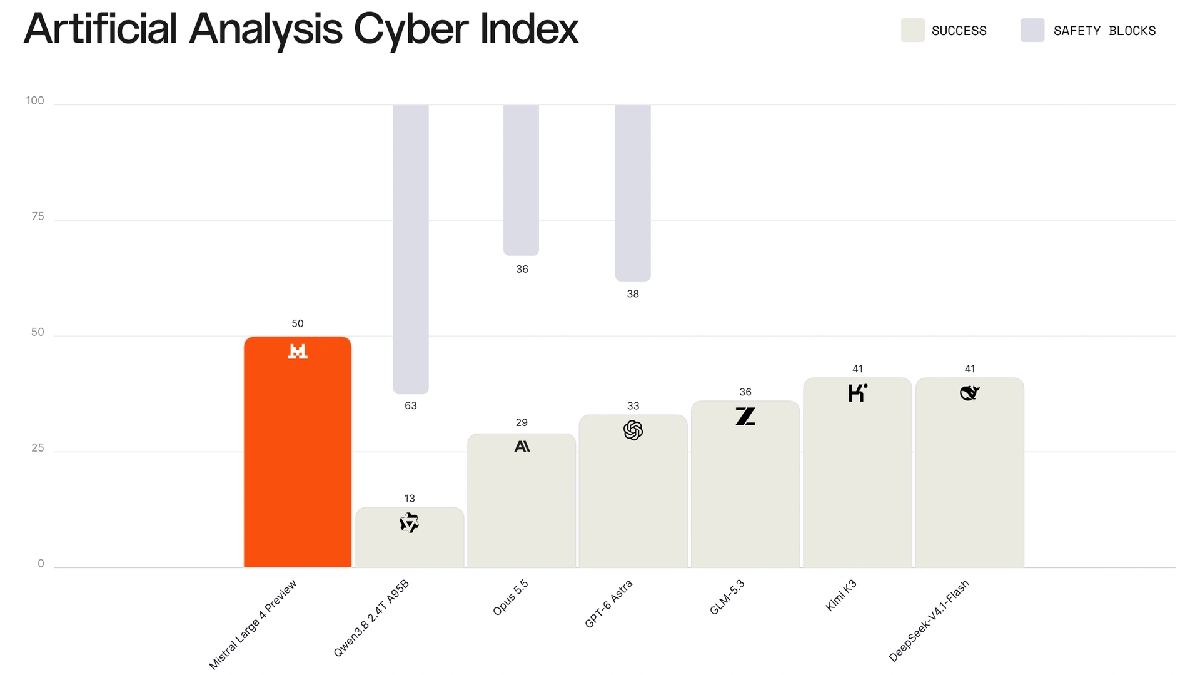
Mistral’s latest model is its largest and most capable, and the most powerful yet released by a European company. Its performance on independent benchmarks is comparable to GPT-6 Luna. It trails less-expensive China-based open weights models but performs better than all U.S.-based open models. It leads all models in finding and repairing a class of software vulnerabilities.
What’s new: Mistral announced API preview access to Mistral Large 4, nicknamed “le Chonk.” Mistral says it will release the model’s weights by the end of this month. Meanwhile, selected companies, partners, and government agencies have access to a version with limited safeguards and extra cybersecurity capabilities.
- Input/output: Text and images in (up to 1 million tokens), text out
- Architecture: Mixture of experts, 1.05 trillion parameters, 52 billion active per token; 1.6 billion-parameter vision encoder
- Features: Reasoning (none or high via API), function calling, tool use, regional inference
- Performance: Highest-scoring model from outside China and the United States on Artificial Analysis’ Intelligence Index (38), first among publicly available models on Artificial Analysis’ CyberGym-E2E-AA, a test of finding and fixing memory-safety bugs (82 percent)
- Availability/price: Public preview via Mistral Studio API, 1.36/0.14/$4.18 per million input/cached/output tokens, half price for two weeks after launch, half price for batched requests
- Weights/license: Not yet released, license for weights not yet announced
- Undisclosed: Knowledge cutoff, output limit, architecture details, specific training data and methods
How it works: Mistral has said little about Mistral Large 4’s architecture but says it will share more when the model’s weights become available. The company says it pretrained the model from scratch and then fine-tuned it using supervised learning followed by reinforcement learning (RL).
- Mistral trained the model on 3,800 GPUs in its own data centers. The training data included publicly available web data, licensed datasets, and inputs and outputs from users of Mistral’s products who opted into data-sharing. The datasets spanned more than 160 languages, including all of the European Union’s official languages.
- A single RL run mixed many different types of tasks, such as single-turn chat, science problems, safety, factual accuracy, and long-running tool use. The tasks ran in environments that shared resources, including code sandboxes, web search, and APIs. Depending on the task, rewards came from unit tests, reward models, language model judges, or tests that inspect code without executing it.
- The RL run that produced the model’s API preview is still in process. Currently, many copies of the model attempt tasks in parallel, and post-training periodically updates the model at the same time rather than waiting until a round of attempts finishes.
Performance: The preview of Mistral Large 4 outscores every other model built outside China and the United States on Artificial Analysis’ popular Intelligence Index. It trails a handful of other open weights models, all from companies in China, but is ahead of all U.S.-based open models. The model preview’s strongest results come in cybersecurity tasks.
- On the Intelligence Index, a weighted average of 10 evaluations of math, science, coding, and reasoning, Mistral Large 4 set to reasoning (38, $1.13 per task) ties GPT-6 Luna (38, $0.07) and trails three cheaper open weights models: MiMo-V2.6-Pro (46, $0.13), GLM-5.3-Flash (42, $0.25), and DeepSeek V4.1 Flash set to max reasoning (39, $0.27).
- On Artificial Analysis’ Cyber Index, which measures models’ abilities to find and fix security vulnerabilities in code repositories, Mistral Large 4 set to reasoning (50 percent, $2.79 per task) ties GLM-5.3-Flash set to reasoning (50, $0.32) and trails only Grok 4.7 set to xhigh reasoning (56, $11.67) and MiMo-V2.6-Pro set to reasoning (56, $0.18) among publicly available models. The Daybreak Blue version of GPT-6 Sol at max reasoning, available only to organizations selected by OpenAI, tops the list with a 69 percent success rate at $1.77 per task.
- On one component test of the Cyber Index, CyberGym-E2E-AA (tasks related to memory-safety bugs in popular open-source C and C++ projects), Mistral Large 4 solved 82 percent of tasks, the highest score among publicly available models, behind only GPT-6 Sol Daybreak Blue at max reasoning (93).
Behind the news: Mistral’s flagship models have alternated between closed and open weights and have been sometimes more and sometimes less competitive with top proprietary models. The company introduced Mistral Large, a proprietary model, in early 2024. Mistral Large 2 followed in July 2024 with weights licensed for research and non-commercial use; at the time, Mistral Large 2 was competitive with OpenAI’s GPT-4 and Anthropic’s Claude Sonnet 3. In December 2025, Mistral released Mistral Large 3 under the permissive Apache 2.0 license, along with smaller Ministral 3 models, which the company built by repeatedly pruning and distilling the larger model.
Why it matters: The most capable open weights models on popular benchmarks are from companies based in China. Developers in the United States and Europe are trying to compete: In the U.S. Nvidia, Reflection AI, and Thinking Machines Lab, among others, have made progress, but Mistral remains the leading European lab. All of these companies pitch their models to organizations that want AI they can better control, whether via further post-training or greater trust they will be able to access the models regardless of geopolitics. Companies and governments all over the world, from South Korea to Saudi Arabia to Mexico, would prefer not to depend on either the United States or China for their access to intelligence. As Mistral CEO Arthur Mensch said earlier this year: “If you treat intelligence as electricity, then you just want to make sure that your access to intelligence cannot be throttled.”
We’re thinking: If you need AI sovereignty, and some industries and nations do, the best kind is running an open weights model on your own hardware. It doesn’t matter where a model was built (the U.S., Europe, China, or elsewhere) if your data and the model’s weights are entirely under your control.