Custom Models for Law, News, and Finance: Thomson Reuters’ Thomson LLM, based on Qwen 3.5, trained on proprietary data
Thomson Reuters launched a proprietary large language model family called Thomson.
Thomson Reuters launched a proprietary large language model family called Thomson. It’s built on a Qwen model using a custom data engineering and re-training pipeline to provide more accurate and complete responses in fields such as law and finance than general-purpose LLMs.
What’s New: Thomson Reuters built Thomson as a domain-specific model that specializes in law, business, tax, finance, news, and related knowledge work fields. Thomson will be deployed first inside one of Thomson Reuters’ existing products, CoCounsel Legal, a tool for research, analysis, and drafting documents. It will be extended to other Thomson Reuters products at unspecified dates.
- Input/output: Text in (up to 262,000 tokens), text out
- Architecture: Mixture-of-experts transformer, 397 billion parameters, 17 billion active per token
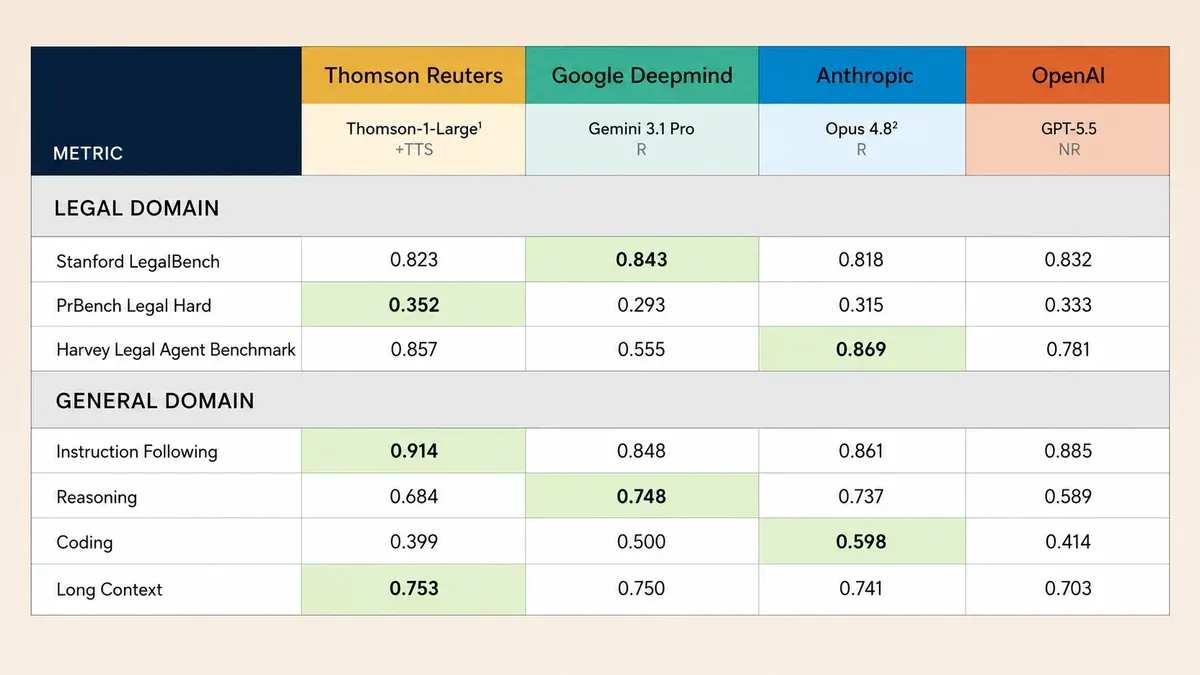
- Performance: Thomson-1.0-Large narrowly outperformed GPT-5.4 and Claude Sonnet 5 on both completeness and factuality for tax, legal, and news content; rails both models on open web content on factuality by roughly 15 points; Thomson-1.0-Small similarly outperformed Gemma4-31B and Claude Haiku 4.5.
- Availability: Business customers only.
- Weights/license: Thomson-1.0-Large is proprietary, but a 35 billion parameter version, Thomson-1.0-Small, will be released as an open weights model on Hugging Face for academic and non-commercial use
- Undisclosed: Price
How it works: Thomson Reuters built Thomson-1.0-Large on top of Qwen3.5-397B-A17B, an instruction-tuned open weight model. It employed what the research authors call Continual Learning, a mix of full-weight mid-training and fine-tuning, on a selection of the company’s large data corpus. In a press release, the company disclosed that it invested $40 million in total training costs over three months.
- The authors re-aligned Qwen to better reflect the company’s style and values, including journalistic objectivity. They aligned the model to a constitution using direct preference optimization (DPO). The constitution is open source and can be adapted or revised for similar projects.
- For domain expertise, Thomson Reuters and its partner DatologyAI curated a 200 billion token mid-training dataset out of a 19 trillion token candidate pool. The training data is composed of three roughly equal parts: curated proprietary documents (news, regulatory filings, case law, contracts), synthetic data pairs of successful professional tasks, and select general-capability materials.
- The authors fine-tuned the model using DPO for a final round of alignment training and to increase accuracy and efficiency in agentic deep research. They also used group sequence policy optimization (GSPO) to manage context compaction and document caching, to avoid overfilling the context window or triggering redundant API calls.
- Thomson-Small-1 was trained in a similar manner using Qwen3.6-35B as a base.
- The company touts its data-centric pipeline and mix of alignment, mid-training and post-training methods. It says future versions of Thomson may use an alternate base model — possibly Inkling Large — and will train on a larger data set than 10 percent of the Thomson Reuters corpus.
Behind the news: Thomson Reuters has long used AI in its products for legal and financial professionals and government agencies, but the company’s latest AI-powered product is its first LLM. The company is under pressure from both new AI-native companies like Harvey and Legora and general-purpose LLMs and agents from OpenAI, Anthropic, Google, and others that offer alternatives to many of its products.
- Thomson is less narrowly focused than Harvey’s new legal model Tenet and boasts a larger data corpus that includes news, business, tax, and finance. Thomson Reuters also said Thomson is less narrowly focused on performance on specific benchmarks, including Harvey’s popular BigLawBench and LAB (Legal Agent Benchmark).
- CoCounsel Legal is an AI assistant that draws on proprietary information, as well as users' own documents, to perform legal tasks such as researching questions, comparing documents, and creating timelines of events. Thomson will now be the model that powers some features within CoCounsel, while others will rely on proprietary models, including Anthropic’s Claude. The cost of CoCounsel’s various tiers is not publicly available, but the company claims the product has over one million customers.
Why it matters: The Thomson paper authors argue that their approach to domain-specific LLMs represents a special case of sovereign AI, but at the corporate rather than the national level. Instead of yielding data to a larger AI company and being subject to its infrastructure and data retention policies, Thomson Reuters licenses its models to companies that run them on their own hardware, ensuring that sensitive data never leaves the premises. Also, its models can be further trained on a company’s private data using Thomson’s midtraining methods, without the high costs of pretraining or the relatively limited effectiveness of an inexpensive fine-tuning method like LoRA.
We’re thinking: Model customization remains an exciting prospect for a wide range of AI applications, and the growing availability of open weight models creates an important foundation for teams to experiment with them. Still, companies like Thomson Reuters will have to prove to customers that their products are worth the price given the relatively small improvement in performance.