Lingua Franca for Science Labs: SAIL’s Science Context Protocol helps AI Agents communicate about local and virtual experiments
An open protocol aims to enable AI agents to conduct scientific research autonomously across disciplinary and institutional boundaries.
An open protocol aims to enable AI agents to conduct scientific research autonomously across disciplinary and institutional boundaries.
What’s new: Shanghai Artificial Intelligence Laboratory (SAIL) published Science Context Protocol (SCP), an open-source standard that connects agents with local clients, central hubs, and edge servers to conduct automated scientific inquiry. SCP is published under the Apache 2.0 license, allowing commercial use and modifications.
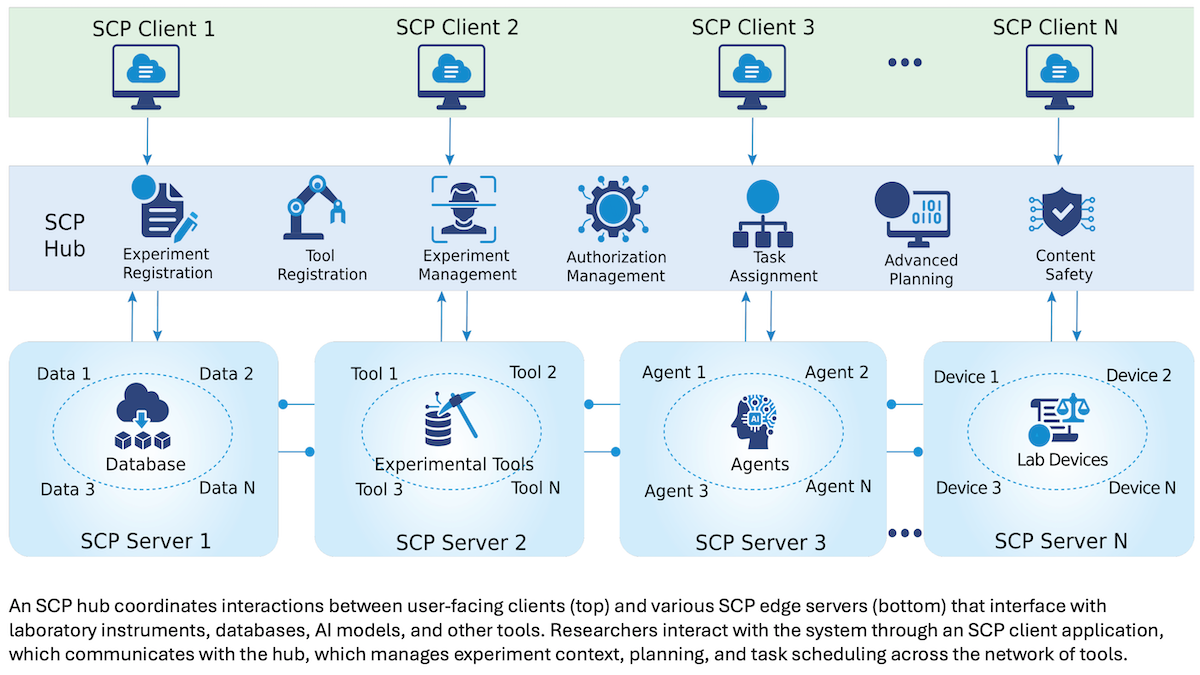
How it works: SCP attempts to make experiments using AI agents and robotic equipment as reproducible as possible. Like Model Context Protocol (MCP), it enables agents to interact with external resources. Unlike MCP, in which servers stand alone, SCP’s design requires centralized hubs that manage other servers as well as the client applications that enable users to access them. In addition, SCP’s structure offers greater security by governing messages and tools more strictly than MCP, which is necessary in scientific experimentation, the authors say.
- SCP’s fundamental data unit is an experiment. Every experiment is stored as a JSON structured data file with a persistent identifier and record of an experiment’s type, goals, data, and configuration. The format makes experiments traceable, versionable, machine-readable, and consistent with institutional policies that govern data.
- An SCP client authenticates users and gives them access to institutional resources. Researchers can describe an experiment’s goal in natural language (for example, “increase the brightness of this fluorescent protein”) or upload a complete research plan in text or PDF for their hub to analyze.
- An SCP hub takes a goal or other request and uses large language models to generate a set of experimental plans that list steps to carry out the experiment. The hub measures and ranks each plan according to its resource requirements, cost, and risk at each step. The user selects one plan, and the hub then orchestrates and schedules multiple agents and servers, which carry out the experiment. After an experiment is completed, the hub archives it for researchers to consult, alter, or repeat.
- Edge servers manage the experiments planned by the hub and stream data back to it (which in turn returns data to the client). Servers may belong to an institution, or they may be devoted to a particular discipline like biochemistry or mathematics, each with its own specialized tools and databases.
- The protocol currently includes more than 1,600 tools, which can include virtually any resource that can be used in an experiment. These can be software applications like search, but they could be robots, lab hardware, or human technicians. The authors hope to create a standard for all tools used in any experiment.
Behind the news: SCP draws on earlier data management efforts for generalist AI agents and scientific inquiry. It extends MCP by enforcing tighter security, managing experiments, and providing specialized drivers for scientific tools. It also builds on earlier protocols for scientific research, including A-Lab (materials science), OriGene (biology), LLM-based approaches like Agent Laboratory, and agents for specific tasks like Biomni (biology hypotheses and analysis). SCP, however, aims to be more general than these field- or tool-specific resources, allowing researchers in a variety of scientific fields to standardize their methods and better foster multidisciplinary work.
Why it matters: Scientific research relies on both human and technology working in concert. SCP aims to standardize the connections between them. It can manage both simulated experiments that use only computing resources as well as physical ones that involve robots and other lab equipment. It also allows for better communication between institutions and disciplines by supporting dedicated servers on bigger networks. These distinctions (human/robot, digital/physical, disciplinary differences) are beginning to blur. SCP is a step toward that future.
We’re thinking: AI is poised to vastly accelerate scientific research. SCP offers a standardized way to connect specialized models, like AlphaFold, with systems that automatically generate hypotheses, such as AI Co-scientist, and robotic labs that test them, such as RoboChem. This automated experimental workflow has the potential to advance scientific discovery at machine speed.