Mistral 3 update adds four new open models: Amazon Nova 2 family competes with low prices, new agents
Nvidia’s open VLA reasoning model for self-driving cars. Hugging Face’s Claude skills pack that fine-tunes language models. LangChain’s LangSmith no-code, all-chat agent builder. MCP Blockly, a project for students to build their own MCP servers.

Welcome back! In today’s edition of Data Points, you’ll learn more about:
- Nvidia’s open VLA reasoning model for self-driving cars
- Hugging Face’s Claude skills pack that fine-tunes language models
- LangChain’s LangSmith no-code, all-chat agent builder
- MCP Blockly, a project for students to build their own MCP servers
But first:
Mistral releases open models from 3 billion to 675 billion parameters
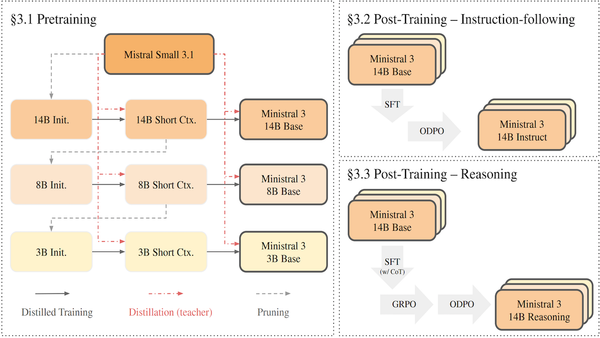
Mistral launched Mistral 3, a family of open-weight models including three small dense models (3B, 8B, and 14B parameters) and Mistral Large 3, a sparse mixture-of-experts model with 41 billion active and 675 billion total parameters. All models are released under the Apache 2.0 license with multimodal capabilities including image understanding. Mistral Large 3, trained on 3,000 NVIDIA H200 GPUs, debuted at number two on the LMArena leaderboard for open-source non-reasoning models and runs on a single 8×A100 or 8×H100 node using vLLM. The smaller Ministral 3 models achieve 85 percent accuracy on AIME 2025 with the 14B reasoning variant while generating significantly fewer tokens than comparable models. The models are available today on Mistral AI Studio, Amazon Bedrock, Azure Foundry, Hugging Face, and several other platforms. (Mistral AI)
Nova models from Amazon boost performance, keep low price
Amazon released its Nova 2 model family, including four new AI models designed for optimal price-performance. The lineup includes Nova 2 Lite for fast reasoning, Nova 2 Pro for advanced intelligence, Nova 2 Sonic for speech-to-speech conversational AI, and Nova 2 Omni, a unified model that processes text, images, video, and speech while generating both text and images. Amazon also introduced Nova Forge, an open training service that enables organizations to build customized model variants called “Novellas” by combining proprietary data with Nova’s capabilities throughout the training process. (Amazon)
Nvidia DRIVE, first open reasoning model for self-driving vehicles
Nvidia released DRIVE Alpamayo-R1, an open vision-language-action model that combines chain-of-thought reasoning with path planning for autonomous vehicle development. The model breaks down driving scenarios step-by-step, evaluating possible trajectories and using contextual data to select optimal routes in complex situations like pedestrian-heavy intersections or obstructed bike lanes. Reinforcement learning during post-training significantly improved the model’s reasoning capabilities compared to the pretrained version. Built on Nvidia Cosmos Reason, AR1 allows researchers to customize the model for non-commercial applications including benchmarking and experimental AV development. (Nvidia)
Fine-tuning language models with Claude, Hugging Face Skills
A new Hugging Face Skills package enables Claude Code to submit fine-tuning jobs to cloud GPUs, monitor training progress, and publish models to the Hugging Face Hub. The system handles GPU selection, authentication, script generation, and training configuration through conversational instructions. Users can fine-tune models from 500 million to 70 billion parameters using supervised fine-tuning, direct preference optimization, or reinforcement learning methods. Training costs range from under one dollar for test runs on small models to 15 to 40 dollars for production runs on 3 billion to 7 billion parameter models. The skill requires a Hugging Face Pro or Team subscription and works with Claude Code, OpenAI Codex, and Google’s Gemini CLI, with integrations for Cursor, Windsurf, and Continue coming later. (Hugging Face)
LangSmith launches no-code, chat-driven Agent Builder
LangChain released Agent Builder, a tool that lets users create production-ready AI agents through chat without writing code. Unlike traditional workflow builders that require mapping fixed step-by-step processes, Agent Builder creates dynamic agents that reason autonomously, delegate work to subagents, and improve through user feedback over time. The beta release includes custom tool integration via MCP servers, multi-model support for OpenAI and Anthropic, API access for programmatic invocation, and workspace-level agent sharing for teams. Early users built agents for sales research, bug ticket creation, email triage, and recruiting, with setup taking roughly five minutes through conversational prompts. (LangChain)
MCP Blockly bridges Scratch and server development with visual block programming
A new tool lets students build Model Context Protocol servers using drag-and-drop blocks paired with an AI assistant that edits the visual workspace directly. The system translates block arrangements into a custom domain-specific language that AI models can read and modify, allowing the assistant to construct programs step-by-step while students observe the logical progression. When complete, the assistant can deploy finished servers to Hugging Face Spaces automatically, generating Python code and verifying deployment. The approach aims to build conceptual understanding of MCP architecture rather than creating dependency on AI-generated code, letting learners intervene and modify blocks at any point to see how changes affect outcomes. (Hugging Face)
A special offer for our community
DeepLearning.AI recently launched the first-ever subscription plan for our entire course catalog! As a Pro Member, you’ll immediately enjoy access to:
- Over 150 AI courses and specializations from Andrew Ng and industry experts
- Labs and quizzes to test your knowledge
- Projects to share with employers
- Certificates to testify to your new skills
- A community to help you advance at the speed of AI
Enroll now to lock in a year of full access for $25 per month paid upfront, or opt for month-to-month payments at just $30 per month. Both payment options begin with a one week free trial. Explore Pro’s benefits and start building today!
Still want to know more about what matters in AI right now?
Read this week’s issue of The Batch for in-depth analysis of news and research.
This week, Andrew Ng talked about the widespread distrust of AI in the U.S. and Europe, the need for the AI community to address public concerns and avoid hype, and the importance of building trust by making AI beneficial for everyone.
“Despite the AI community’s optimism about the tremendous benefits AI will bring, we should take this seriously and not dismiss it. The public’s concerns about AI can be a significant drag on progress, and we can do a lot to address them.”
Read Andrew’s full letter here.
Other top AI news and research stories we covered in depth:
- Meta’s SAM 3 image segmentation models analyzed and created bodies and other objects through an open 3D generation pipeline.
- World Labs made its Marble world model public and added the Chisel editing tool for generating and editing virtual spaces.
- Baidu’s Ernie 5 model natively generated multiple media, with Ernie-4.5-VL-28B-A3B-Thinking topping Vision-Language metrics.
- Google DeepMind’s RoboBallet project blended GNNs with RL to coordinate teams of 8-armed robots.