Copilot’s Users Change Hour to Hour: Microsoft study shows people use AI very differently at different times or on different devices
What do users want from AI? The answer depends on when and how they use it, a new study shows.
What do users want from AI? The answer depends on when and how they use it, a new study shows.
What’s new: A Microsoft study reveals that people used Copilot differently late at night on their phones than during the workday on their laptops. Conversations that focused on productivity and career were more likely during the day and on desktop devices, and health, gaming, and philosophical questions dominated non-work conversations. As 2025 went on, more users asked the AI agent for personal advice.
How it works: Researchers analyzed anonymized summaries of 37.5 million Copilot conversations between January and September 2025 to study how customers used the system, making this the largest study of its kind to date. The authors conclude that AI has become more socially integrated, as users employ it in aspects of their lives beyond work.
- The authors examined a random sample of Copilot conversations by paid and unpaid users, excluding commercial, enterprise, and education accounts. Each conversation included timestamps and device type. The authors used AI tools to summarize roughly 144,000 conversations daily. They built classifiers to assign each summary a topic (like “technology”) and intent (like “seeking advice”), identifying about 300 topic-intent pairs.
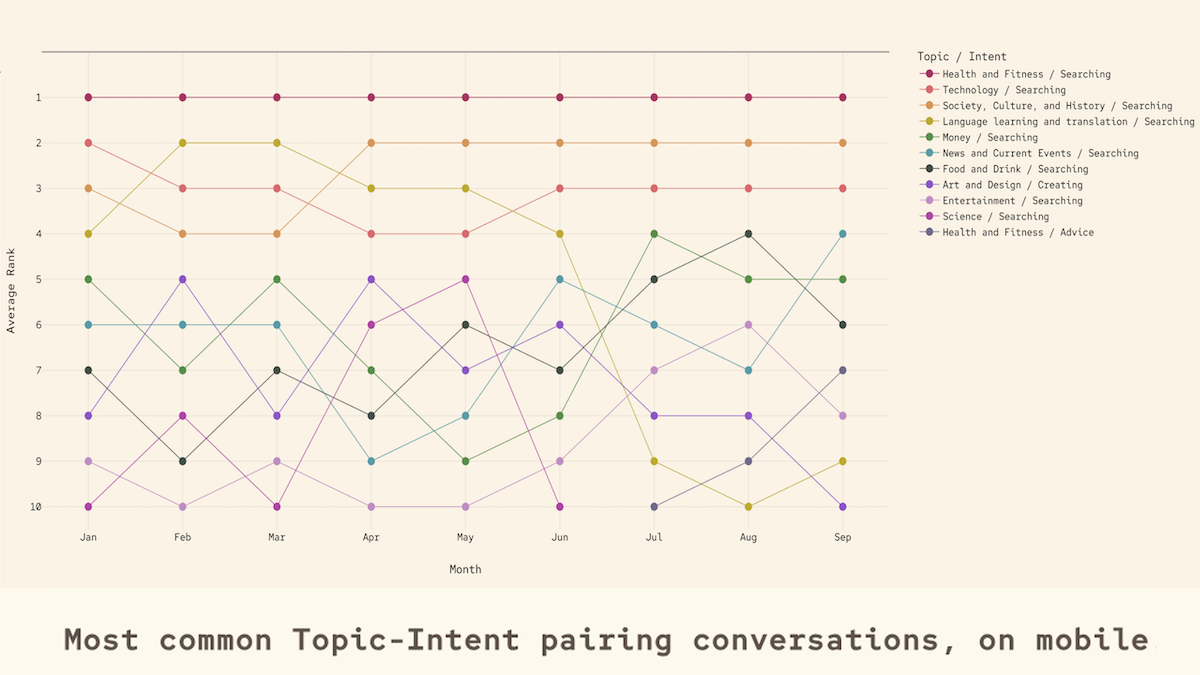
- The study ranks the frequency of topics and intents by time of year, time of day, and device type. The top 5 topics in order were (i) technology, (ii) work and career, (iii) health and fitness, (iv) language learning and translation, and (v) society, culture, and history. The top intents were (i) searching, (ii) seeking advice, (iii) creating, (iv) learning, and (v) technical support.
Analysis: Topics and intents differed depending on device used, time of day, and time of year.
- Users were much more likely to discuss health and fitness on mobile devices than desktops. Seeking advice about personal matters spiked near Valentine’s Day. Philosophical questions became more common later at night, while entertainment-related conversations plummeted during the workday.
- As the year progressed, topics and intents became less focused on work and technology and drifted towards social and personal matters. This shift suggested that the user base became both larger and less technical and/or users began using AI for both personal and professional matters.
Behind the news: Microsoft’s report follows similar studies by some of its AI rivals.
- In September 2025, OpenAI and Harvard released a study of ChatGPT use from 2022 to 2025. It showed that 30 percent of uses were related to work while 70 percent were related to non-work activities. In addition, the gender gap among users among users shrank steadily during that period.
- In January 2025, Anthropic’s study of Claude showed that the model’s user base focused on work, especially software development and text communications. A small but growing number of users engaged in games like Dungeons & Dragons and sexual roleplay (despite prohibition of that use by Claude’s terms of service).
Why it matters: The authors argue that the AI community may need to rethink chatbot design altogether. If users treat chatbots differently on mobile and desktop devices, AI builders would do well to design their systems to suit the devices that will deliver them. Application design is one way to accomplish this, but system prompts may be another. Desktop chatbots and agents can respond with more information-dense answers, guiding users to execute tasks, while mobile agents can offer shorter, more empathetic responses.
We’re thinking: Studies of chatbot usage conducted by different companies show different results. Perhaps each company’s users treat AI differently, so the results of any given study may not apply generally. That said, the Microsoft study suggests that the device used and the time when it’s used can have a big impact on what users want — important considerations for designing any application.