Google Orchestrator, llama.cpp 1.0, The "Token Tax," and Agent Messaging
The Batch News & Insights: look forward to seeing many of you at AI Dev in New York City on Monday Nov 30th!

Dear friends,
I look forward to seeing many of you at AI Dev in New York City on Monday Nov 30th!
It is Thanksgiving here in the U.S., and I am reflecting on how grateful I am to be part of the AI community and for the incredible opportunities that lie ahead of us. Changes in AI are letting us do work at a pace and quality that was almost unimaginable a year ago. At the same time, this puts pressure on everyone to learn new skills. Despite AI’s amazing ability to solve verifiable tasks — like solve math problems such as the Riemann hypothesis — its far weaker performance on unverifiable tasks that require judgement means much work remains for people to do.
I am fortunate to have many friends across Silicon Valley and beyond, whom I meet and sometimes collaborate with and who help keep me sharp at the cutting edge of AI. I know that not everyone has similar opportunities, which is why I treasure in-person events like AI Dev.
AI Dev New York 2026 will focus on the AI Engineering Skills Map, which shows the most valuable skills for you to know to become skilled in AI Engineering. We have mapped every skill on the map — like building agentic systems, making systems secure and reliable, and coding agent foundations — to particular AI Dev sessions. I aim for everyone who attends to come away with meaningful new skills in AI Engineering, and also to come away with new friends so our community becomes stronger!

The AI world can feel crazy some days, with rapid changes coming every week. I’m grateful for the many people in my life — professional and personal — who help me to experience life at a slower, more human pace. I hope you all have a chance to slow down and enjoy the company of friends and family over the coming holidays.
Perhaps I’ll see you next week at AI Dev. Until then, Happy Thanksgiving!
With gratitude,
Andrew
A MESSAGE FROM DEEPLEARNING.AI
Black Friday for readers of The Batch: 25 percent off AI Dev NYC, our best offer yet and our last before the event. Join Andrew Ng, Yann LeCun, and teams from OpenAI and Runway at Chelsea Piers, Nov 30 - Dec 1. Tickets are almost gone. Claim your discount.
News
Carbon, Hydrogen, Neon, Oh My!
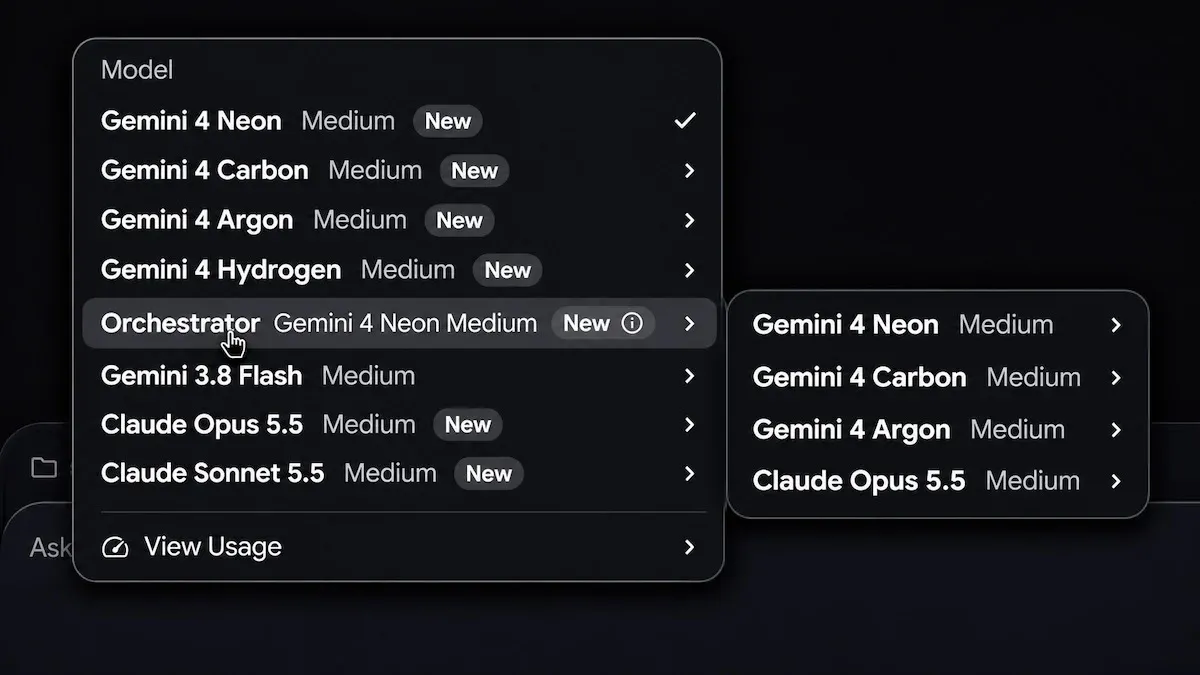
Google introduced two faster, less expensive Gemini 4 models and a way for its coding agent to hand work back and forth between models mid-task.
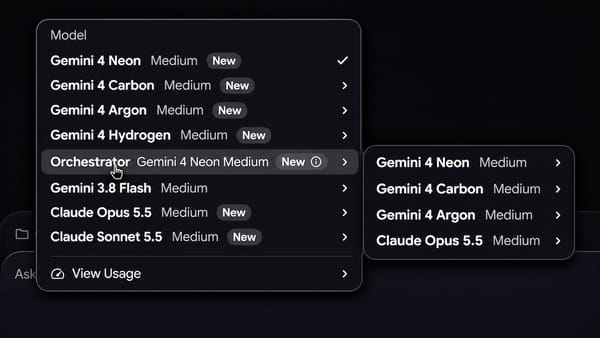
What's new: On November 12, Google released Gemini 4 Hydrogen, a model built to carry out coding and other agentic tasks quickly and at lower cost than Gemini 4 Carbon. On November 18, the company added Gemini 4 Neon, a model that rivals Carbon’s performance at an intermediate speed and cost. In addition, Antigravity, Google’s counterpart to OpenAI's Codex and Anthropic’s Claude Code, gained Orchestrator, an option that allows larger models like Carbon or Neon to plan a task and have smaller models like Hydrogen carry it out.
- Input/output: Text, images, audio, and video in, text out (up to 1 million tokens of input and output combined; up to 64,000 output token by default
- Speed: Hydrogen, 173 tokens per second at its highest setting; Neon, 99 tokens per second, both according to Artificial Analysis
- Architecture: Adapted from Gemini 4 Carbon
- Price: Hydrogen $1.50/$7.50 per million input/output tokens via API; Neon $3.00/$15.00 per million input/tokens
- Weights/license: Proprietary
- Undisclosed: Parameter count, architecture details, how Google adapted Hydrogen or Neon from Carbon, training data and methods
How it works: Orchestrator divides each task between a planner and an executor instead of running one model for everything, according to Antigravity’s documentation. Unlike setups that split a task between different agents, Orchestrator keeps a single agent within a single context window (conversation) and switches the model behind it.
- First, the planner (either Carbon, Neon, or Argon) studies the code without changing anything. Then it writes a plan that spells out what the actor model should do.
- Hydrogen carries out the plan: It changes the code, builds and tests it, and confirms that the results match what the plan called for.
- Hydrogen hands control back to the planner when it runs into trouble, such as a check that fails twice or an interface that behaves differently than expected. The planner rewrites the plan according to Hydrogen's feedback, then passes the work back.
Performance: Hydrogen trades some of Carbon’s capability for speed and lower cost, according to independent tests. Using Carbon as a planning model and Hydrogen as an actor inside Orchestrator nearly matches using Carbon alone, according to Google. Neon, meanwhile, outperforms Carbon on overall intelligence while costing less per task.
- Hydrogen set to high reasoning scored 51 on Artificial Analysis’ Intelligence Index, roughly matching Gemini 4 Argon (50). Set to xhigh, Hydrogen scored 54, took 14.9 minutes, and cost $3.16 per task. Neon at xhigh scored 61, costing $6.44 per task and taking 25.8 minutes per task. Carbon set to high scored 60, took 32 minutes, and cost $5.48 per task at its introductory price.
- Google says that on Terminal-Bench, which tests an agent’s ability to complete tasks in a computer terminal, using Carbon and Hydrogen together in Orchestrator came close to Carbon’s success rate while finishing 19 percent faster and consuming 24 percent less of its token quota on average.
- Hydrogen’s lower price doesn’t always mean fewer tokens. Set to extra-high, Hydrogen generated 304 million output tokens over the Intelligence Index’s tests, compared with Carbon’s 205 million.
Behind the news: Google made Gemini 4 Carbon widely available on November 10, following Argon in September. The power and cost of Gemini’s models roughly correspond with the weight of their element names: Hydrogen is light and fast, while Carbon is relatively heavier and more substantial. But the elementally heavier Neon is faster than Carbon, and Argon, now the least capable of Gemini’s “element” models, is heaviest of all.
Why it matters: Pairing a cheaper model with a costlier one isn’t new. Anthropic’s Claude Code offers a related “advisor” option, in which a cheaper model does the work and consults a stronger one at key moments, such as before committing to a plan or when it gets stuck. OpenAI’s Codex lets developers assign different models to subagents, but it delegates work to them only when instructed. Sakana’s Fugu takes this logic one step further, using a dedicated orchestrator model that can call models from Google, OpenAI, or Anthropic at each step. All these efforts show that the best model for a coding task may turn out to be two or more models working together.
We’re thinking: Google has made three very capable new models available within the last month. We can all be thankful for this rapid pace of progress.
llama.cpp Makes It Official
llama.cpp, an open source software package that helps users run AI language models locally, finally reached version 1.0 after more than three years in development. The milestone signals that its developers consider it mature and stable enough for a major release.
What’s new: The llama.cpp team at Hugging Face released version 1.0.0 of llama.cpp and of ggml, the library that performs its underlying math. The release shows that llama.cpp is still widely used and under active development, and that local AI is arguably more popular than ever. The new package adds support for several new models, including Kimi-K3.1 Pro, a text-to-speech feature for its built-in server, and a redesigned chat interface.
How it works: Georgi Gerganov started llama.cpp in March 2023, about a week after Meta’s first LLaMA language model leaked online. Gerganov wrote it as a plain C/C++ program, compiled to run directly on a computer’s processor. Meta’s own code for running LLaMA required Python, the PyTorch framework, CUDA, and an Nvidia graphics chip. Gerganov’s version had no dependencies and could run on a MacBook or any other machine, regardless of whether it had a specific GPU. Llama.cpp has been in use ever since, powering apps like Ollama and LM Studio that likewise help run local AI models on ordinary machines.
- While it’s perhaps best known for running AI models on laptops, llama.cpp can perform inference on hardware that ranges from servers to edge machines. The project supports “more than 150 architecture variants,” the team says.
- llama.cpp loads models stored in GGUF, a file format designed to load quickly. Hugging Face hosts thousands of models compatible with llama.cpp.
- The software relies heavily on quantization, which shrinks a model by storing its weights (the numbers that encode what it learned) at lower precision, for instance as 4-bit instead of 32-bit numbers. Quantized models require less memory and often run faster, sometimes at a cost in accuracy.
- The ggml library interacts with different kinds of hardware through separate backends, modules written for specific chips or programming standards. These include CUDA for Nvidia GPUs, Metal for Apple chips, and the cross-vendor Vulkan standard, as well as backends for ordinary CPUs.
- A bundled server accepts requests in formats modeled on OpenAI’s and Anthropic’s APIs, so many apps written for cloud models can use a local model instead. The project makes “no strong claims of compatibility” with OpenAI’s specification but says the server “suffices to support many apps.”
Behind the news: llama.cpp’s 1.0 release caps a period of steady growth for the project.
- GitHub’s annual Octoverse report ranked llama.cpp fifth among independent open-source projects for growth in contributors this year, and third in overall engagement.
- Development is constant. The project published 50 nightly builds over November 15 and 16 alone, and version 1.0 arrived nine days after version 0.9.0.
- Hugging Face, which the ggml team joined in February 2026, provides the project with “long-term sustainable resources,” the team said at the time, and Nvidia, AMD, Qualcomm, Arm, IBM, and Intel supply hardware for self-hosted test runners, according to the v1.0.0 announcement.
Why it matters: llama.cpp turned running language models from a data-center job into something a laptop can do. That lets people and organizations keep their data on their own machines, consult AI without an Internet connection, and avoid paying a cloud provider for every token. Because so many tools now build on llama.cpp, the project’s continued health matters to everyone who uses them, not just to its own developers.
We’re thinking: Kudos to llama.cpp’s founding team and its growing community of developers! Anyone who works on open source and open models can draw inspiration from their achievements.
One successful run does not mean your agent is reliable. Learn to read your agent’s traces to find recurring failures, build code evaluators and LLM judges you can trust, and use evals to check that each change makes your agent better. Enroll now
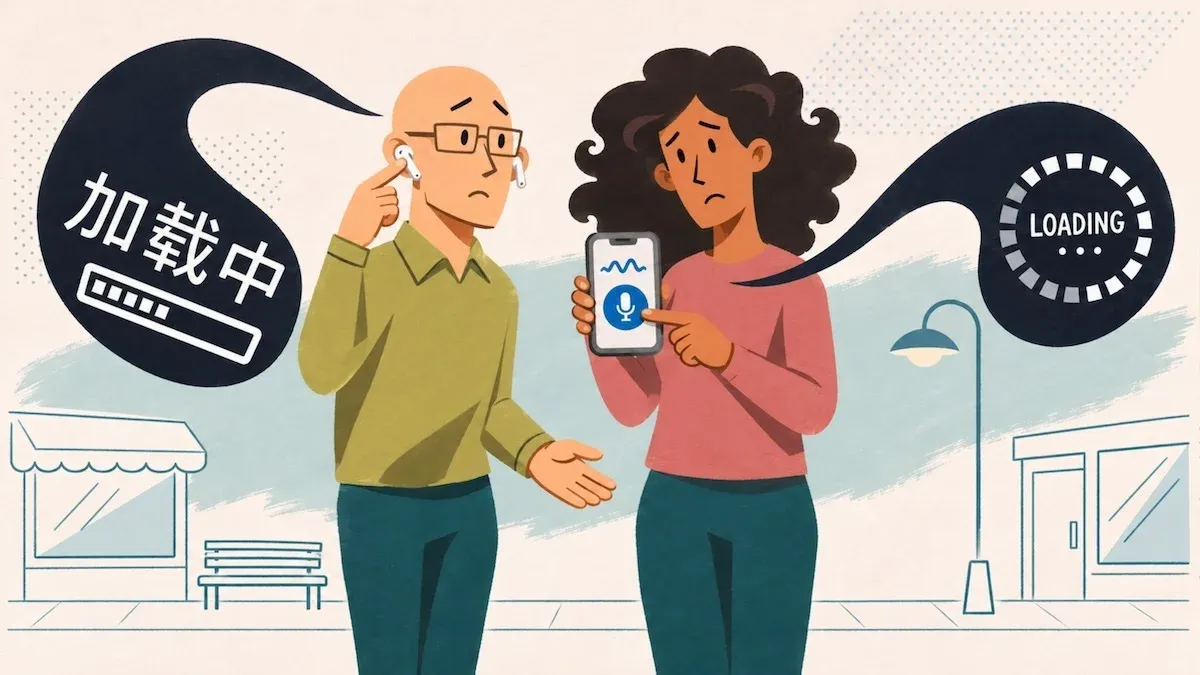
How the “Token Tax” Hurts Non-English Users
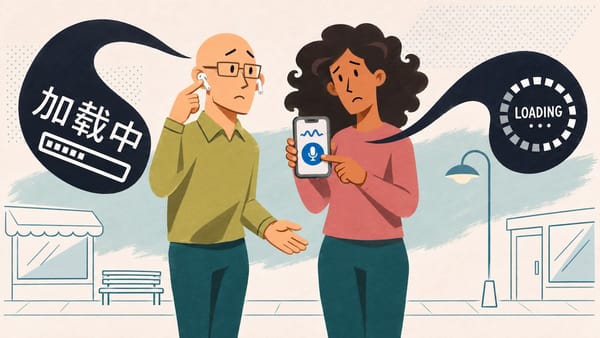
Using AI models costs non-Western speakers in emerging markets far more than they do for English speakers. A recent study quantifies the difference across more than 200 languages.
What’s new: All language models break words into tokens. But not every language is tokenized equally well. Low-resource languages are not well-served by popular existing tokenizers. According to a study published by the Coalition for Language Equity in AI Research (CLEAR), token counts (and therefore cost) for identical content can be up to 17 times higher for the worst-served languages than for the most efficiently tokenized ones.
How it works: Tokenizers turn text into tokens based on how frequently sequences of characters appear in an LLM’s training data. That means that the more often a language’s words appear in a data set, the more efficiently that language can be turned into meaningful blocks. Meanwhile, languages with less representation are split into much smaller segments, leading to significantly higher token counts per word or phrase. This leads to a correspondingly higher cost for the exact same content.
- CLEAR showed that in GPT-5, the same sentence in English (“People should benefit from AI, regardless of the language they speak”), Malayalam (“ആളുകൾ ഏത് ഭാഷ സംസാരിക്കുന്നവരായാലും, AI-യിൽ നിന്ന് പ്രയോജനം നേടണം”), and the East African language Amharic (“ሰዎች የሚናገሩት ቋንቋ ምንም ይሁን ምን ከ AI ተጠቃሚ መሆን አለባቸው።”) costs 13 tokens, 26 tokens, and 78 tokens, respectively, even though the difference in character counts is negligible.
- CLEAR tallied the maximum/minimum token count ratio for tokenizers across the FLORES-200 languages (204 low-resource language and script pairs) and, on either end of the scale, gave the tokenizers an A for a ratio of three times or less and an F for a ratio exceeding 12 times. Many of what were then the most advanced, general-purpose AI models’ tokenizers — GPT-5 and Llama 3.3 among them — got an F, while Google’s Gemini/Gemma family earned the study’s best grade, a B.
Behind the news: This isn’t the first time that a light has been shone on token bias. CLEAR cites two 2023 studies that were among the first to examine the issue.
- In “Language Model Tokenizers Introduce Unfairness Between Languages,” presented at NeurIPS in 2023, Petrov et al. argued that tokenization differences didn’t just cost more (15 times in their study), but also slowed down AI inference for some global users.
- In “Do All Languages Cost the Same,” Ahia et al. analyzed OpenAI’s popular language model API across 22 typologically diverse languages and found that speakers of many of them, particularly languages with scripts underrepresented in training data, were overcharged for the same content while also getting poorer results.
- A 2024 study on GPT-4o found that its tokenizer contained many overly long Chinese tokens, a large share of them drawn from spam, gambling, and adult-content web text. GPT-4o handled these tokens worse than GPT-4 did, which the authors tie to how the tokenizer treats long, statistically frequent vocabulary items from noisy training data.
- While some tokenizers have improved, newer models within a family can actually perform worse than their predecessors. In the CLEAR study, Alibaba’s Qwen 3.6 had a max/min token count ratio of 13.1 times, while the older Qwen 3 had one of 10.5 times.
Why it matters: Startups and users in emerging markets are already at a disadvantage when it comes to getting the reliable connectivity and/or computing power required to use most LLMs. Adding a tax for local languages restricts the worldwide market for AI and pushes more queries to Roman scripts or other global languages like Mandarin Chinese. This reduces our planetary linguistic diversity to something closer to a monoculture.
We’re thinking: As linguistic units, tokens capture meaning better than whole words or individual characters, but where one token stops and the next begins is still quite arbitrary. We need continued textual scholarship and ethnographic work to properly capture nuances in meaning within these languages and their scripts. Better tokenization should be part of that effort too. This will ensure better translation and generation as well as more equitable pricing.
Communicating Agents’ Thoughts
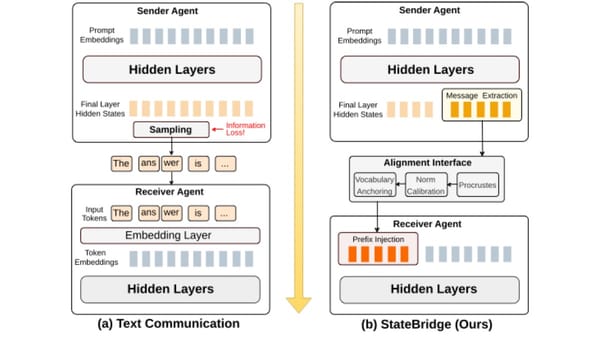
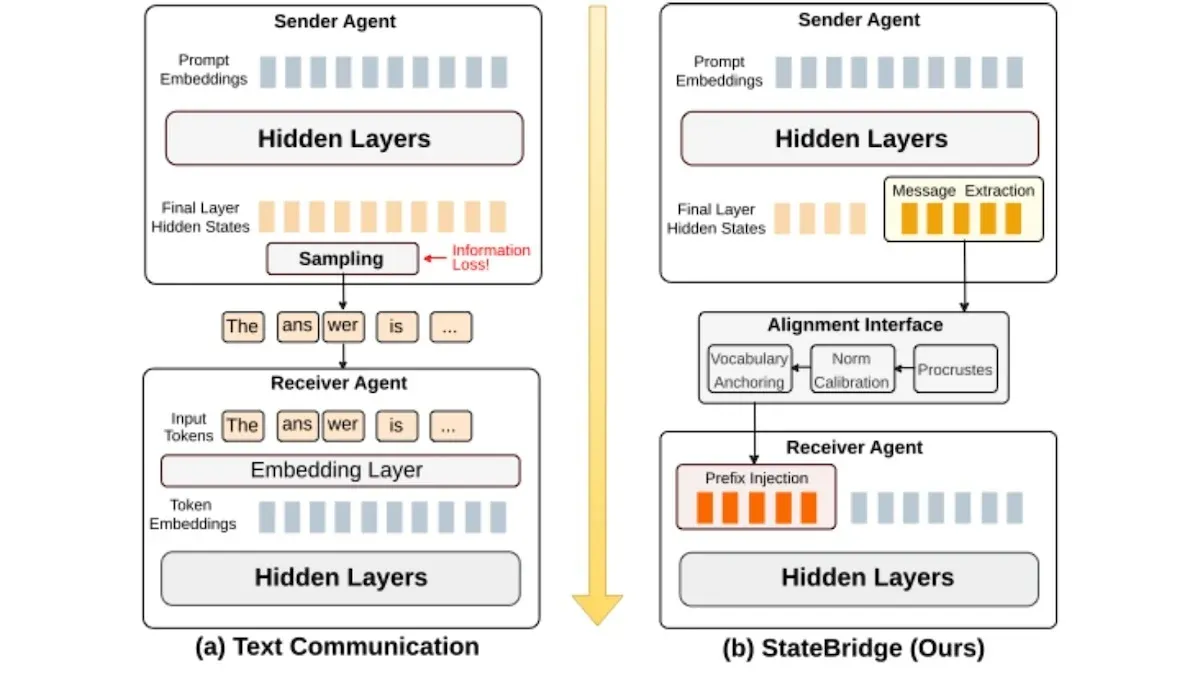
When one AI agent sends a text message to another, the tokens it sends contain less information than the hidden states of the agent’s LLM. Researchers enabled agents based on the same LLM to transmit hidden states without further training.
What’s new: Yanwen Peng and colleagues at the University of Sheffield developed StateBridge, a method that enables agents that are based on the same LLM to communicate with one another through hidden states without further training. The code is freely available for both commercial and noncommercial uses under the Apache 2.0 license.
Key insight: Each token a sender agent writes has two vectors: (i) the hidden state computed by the final layer of the sender agent's model prior to generating the token, which holds information such as the agent's confidence in the token and traces of alternatives it did not choose, and (ii) the resulting token embedding. Sending the token embedding alone loses information in the hidden state. Sending the hidden state keeps that information, but the receiver cannot read it: The two vectors point in different directions and differ greatly in magnitude, and the receiver was pretrained to take token embeddings as its input. So the hidden states have to be moved toward the receiver’s input space. This is the key to communicating the sender agent’s thoughts directly.
How it works: The researchers built agents based on three Qwen3 models (4, 8, and 32 billion parameters) and OLMo3-7B-Think. To produce inter-agent communications, they used four agents in sequence: planner, critic, refiner, judge (roles defined by LatentMAS, an earlier method that feeds the sender agent’s key-value cache into every layer of the receiver agent’s model). Given a prompt, the planner outlines a response, the critic checks the plan, the refiner revises the plan, and the judge uses the revised plan to produce final output. At each handoff, the StateBridge method converts the sender’s hidden states into vectors the receiver takes as input in place of the sender’s generated tokens.
- The authors paired the sender’s hidden states with their token embeddings. The sender generated its message, such as the planner’s plan, as text, one token at a time. The authors kept the hidden states of the message’s last 64 tokens, since later hidden states reflect more of the preceding text.
- They rotated the hidden states toward their token embeddings. They normalized both sets of vectors, the 64 hidden states, and their 64 token embeddings, so both had a mean of zero and equal variance. Then the authors found the single rotation that brought the hidden states, on average, as close as possible to their own token embeddings without modifying the distances and angles between the hidden states. Last, they scaled the rotated hidden states to the token embeddings’ original mean and variance.
- After the rotation, they gave every hidden state the same magnitude. Matching the token embeddings’ mean and variance adjusted the hidden states as a set, not one by one, so individual hidden states could still be larger than token embeddings. In this way, they scaled each hidden state to the average magnitude of all the token embeddings in the model’s vocabulary.
- They modified each hidden state to be more similar to its closest token embedding. For each hidden state, they searched the vocabulary for the token embedding that pointed in the direction most similar to that hidden state’s. (It didn’t necessarily correspond to the token the sender wrote.) They replaced each hidden state with a weighted average: 70 percent the hidden state and 30 percent its closest token embedding. This weighted average moved each hidden state to be more similar to the kinds of inputs the receiver saw during pretraining.
- They prepended the resulting 64 hidden states to the token embeddings of the receiver’s prompt. The receiver then became the sender and generated the next message. (The judge‘s message was the final response).
Results: The authors tested StateBridge with the Qwen3 models and OLMo3-7B-Think. The tests included answering questions (MedQA), coding (HumanEval+), and math (GSM8K) plus, for the two larger Qwen3 models, further math and science benchmarks (such as GPQA-Diamond). With every model tested, their method achieved higher average results than three alternatives (a single agent working alone, the same four agents handing off text, and LatentMAS). It outperformed the best of them by 2.4 to 2.9 percentage points.
- StateBridge achieved its largest margin over the strongest alternative on GPQA-Diamond’s graduate-level science questions. With Qwen3-8B, agents using StateBridge solved 52.5 percent of the questions, compared with 45.5 percent using LatentMAS and 39.9 percent using a single agent.With OLMo3-7B-Think, agents using StateBridge solved an average of 76.7 percent of problems across benchmarks while the strongest alternative, four agents exchanging text, achieved 73.9 percent.
- LatentMAS solved 55.1 percent, below a single agent (71.8 percent).Why it matters: Compared to text communication, StateBridge raised the average performance of multi-agent systems for every model tested. And the barrier to experimentation is low, since you can jump straight in without needing to collect training data or train a model.
We’re thinking: StateBridge passes along only the hidden states for the last 64 tokens of each message, however long the message. Yet agents that used StateBridge achieved higher average scores than agents that handed off the full text. If 64 converted hidden states can stand in for a whole message, similar conversions might let agents pass other long inputs, such as retrieved documents or tool outputs, as a small number of vectors.