AI Overviews Land Google In Hot Water, GPT-Live Puts Reasoning in the Background, How to Tell If Your Model is Manipulative
The Batch News & Insights: As AI increasingly automates coding, it frees up developers to spend time on high-level software development tasks traditionally reserved for senior engineers, like deciding on technical architecture and participating in scoping product requirements.

Dear friends,
As AI increasingly automates coding, it frees up developers to spend time on high-level software development tasks traditionally reserved for senior engineers, like deciding on technical architecture and participating in scoping product requirements. Demand for this type of work is growing, since it is an economic complement to coding, which is becoming cheaper. This is why I’m confident there will be rising demand for broad AI engineering skills. I see a similar pattern starting to emerge in other AI-influenced fields as well, and am cautiously optimistic — contrary to predictions of a “jobpocalypse” — that AI will generally increase demand for people with the right skills.
Take marketing. AI is helpful for drafting and editing marketing copy, gathering market data, and performing very basic data analysis. (In my experience, analyses by even frontier models are frequently wrong. So do use AI to help with your data-science tasks, but don’t blindly trust its confidently stated conclusions!) This frees up marketers to spend more time on higher-level tasks. I’m seeing that rather than specializing in narrow marketing roles like social media marketer or copy editor, AI-native marketers are rising up to help coordinate broader marketing campaigns end-to-end, from conception to multi-threaded execution to analyzing lessons learned.
Just as AI is turning many specialized developers (like frontend, backend, mobile, etc.) into full-stack developers, I am seeing early signs that it is turning many more marketers into full-stack marketers.
Or take recruiting. Some companies have separate roles for sourcer (who finds candidates online), coordinator (who handles scheduling) and recruiter (who runs the hiring process). But sourcing is increasingly automated, and coordination also partially automated. As a consequence, I’m seeing more AI-native recruiters run the full-cycle themselves, doing all of the above.
As AI enters more fields, I expect more people to start to play “full-stack” or “full-cycle” roles within their disciplines, meaning they will play broader roles that integrate traditionally separate roles. This lets individuals do more, and I believe it will ultimately lead to increased demand for skills as well as higher pay.

The broader pattern is this: In many job roles, as you rise in seniority, you become better at managing integration complexity — weaving together many disparate work streams like frontend, backend and data engineering to form a greater whole. As AI automates certain parts of one’s work — usually the more verifiable parts — it creates more room for individuals to play broader roles.
This pattern is not applicable to all job roles. In some, rising in seniority means increasing specialization. This corresponds loosely to people progressing in the IC (individual contributor) career track rather than the managerial/tech lead track. For example, a machine learning engineer acquiring extremely deep understanding of a technical niche, a financial expert growing from a generalist finance analyst to a specialist in an important sector (such as auditing cross-border deals), or a medical doctor developing deep expertise in just one medical condition. In many, but not all, such areas, I expect the demand for human skill to grow, but AI’s impact on any specialty will depend on how rapidly AI’s jagged frontier advances along that dimension. I’ll share more on this in a future letter.
Until then, I invite you to consider: Back in 2022, what tasks would your teammates have done? Those were likely complements to what you are doing. So if you are able to use AI to do more of those tasks yourself — which might require learning new skills — it could be one path to you becoming more effective with AI.
Keep building!
Andrew
A MESSAGE FROM DEEPLEARNING.AI
Build LLM applications that respond in real time on Cerebras' Wafer-Scale Engine, from live personalization to a multi-tool workflow that finishes in one fast response. Enroll for free
News
One Model Talks, Another One Thinks
ChatGPT’s voice mode now listens and speaks at the same time, passing harder questions posed to the conversational model to a reasoning model in the background.
What's new: On July 8, OpenAI released a pair of voice models — GPT-Live-1 and GPT-Live-1 mini — that power a rebuilt ChatGPT Voice. Both models process incoming and outgoing audio at once instead of waiting for a turn to end. Telecom engineers call this full-duplex: transmission and reception flow at the same time, like a telephone call, rather than alternating, like a walkie-talkie. When a response requires deeper thinking, the voice model hands the question to GPT-5.5 and keeps talking while that model works. The system replaces Advanced Voice Mode (AVM), a single model that listened, reasoned, and spoke in discrete turns.
- Input/output: Both models are speech in, speech out, processed continuously so input and output overlap. In ChatGPT, conversations are accompanied by on-screen visual cards (weather, stocks, sports, maps) rendered by the app. The app accepts images and file uploads. Live video and screen sharing are absent. OpenAI says it is working to add both, and they remain available in the legacy Standard and AVM.
- Features: Live translation; nine remastered voices, all predefined, with safeguards that block mimicking real people's voices; user-selectable reasoning effort on GPT-Live-1 (Instant, Medium, High) — Instant runs GPT-5.5 Instant in the background while Medium and High run GPT-5.5 Thinking at matching effort. GPT-Live-1 mini only calls GPT-5.5 Instant.
- Performance: In OpenAI's tests, GPT-Live-1 at high reasoning scored 84.2 percent on GPQA versus 45.3 percent for its predecessor, AVM; human raters preferred GPT-Live-1 to AVM 75.7 percent of the time and GPT-Live-1 mini 69.2 percent.
- Availability: Available now on iOS, Android, and ChatGPT.com globally. GPT-Live-1 is the default for Go, Plus, and Pro plans for no extra charge; GPT-Live-1 mini for the free plan. No developer API has shipped; for now, OpenAI's developer voice option remains GPT-Realtime-2, which reached the Realtime API in May.
- Undisclosed: Parameter counts, architecture details, training data, knowledge cutoff, latency measurements, usage-based pricing
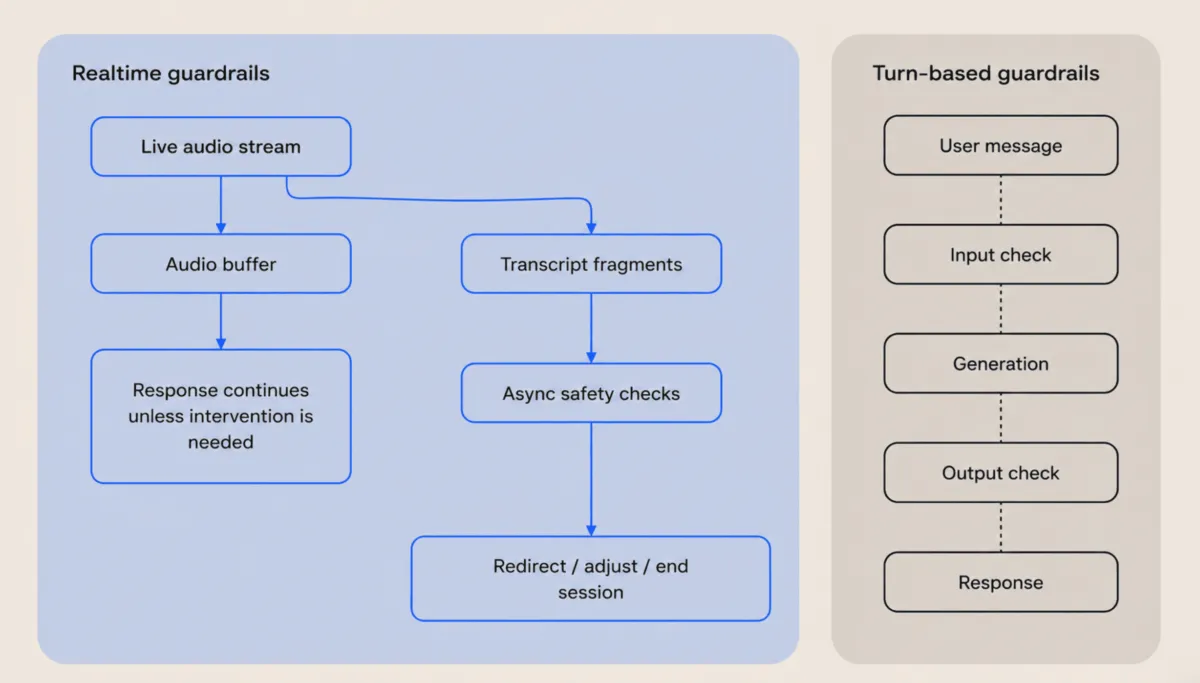
How it works: OpenAI published a GPT-Live system card that describes a system of several models working as an ensemble. The voice models differ from their predecessors in two ways: they process audio continuously rather than turn-by-turn, and they hand deeper work to a separate model.
- Each GPT-Live model processes incoming audio while producing its own output, deciding its next action many times each second. These actions include talk, listen, wait, break in, backchannel (producing “hmm,” “yeah,” and similar signs of listening), or trigger a tool.
- When a question calls for web search, deeper reasoning, or multi-step work with tools (looking up information and acting on it across several turns), the voice model hands the task to GPT-5.5, keeps talking while that model runs, and weaves the result back in. The two models share the conversation’s context but are orchestrated and served separately. OpenAI says it will point GPT-Live at newer reasoning models as they ship.
- Safety checks run alongside the conversation. The system inspects inputs and outputs as they unfold and can steer or interrupt a reply, play a spoken safety message, put support resources on screen as text or voice, or end the conversation in higher-risk cases.
Performance: In OpenAI’s evaluations, the biggest gains show up on the tasks routed to GPT-5.5, with the delegation system working as designed. Every comparison OpenAI published pits GPT-Live against its own predecessor, AVM, rather than rival voice models, and its strongest claims rest on internal benchmarks.
- On GPQA (graduate-level science across biology, chemistry, and physics), GPT-Live-1 at high reasoning scored 84.2 percent against 45.3 percent for AVM.
- The gap is sharper on BrowseComp (agentic web search for hard-to-find facts): GPT-Live-1 at high reasoning answered 75.2 percent of questions correctly against 0.7 percent for AVM.
- Human raters preferred GPT-Live-1’s conversational quality to that of AVM 75.7 percent of the time and GPT-Live-1 mini 69.2 percent, in matched 5-to-10-minute conversations that ranked overall preference, turn-taking, interruptions, and conversational flow.
- Both GPT-Live models outperformed AVM at flagging disallowed content, with notable gains on illicit behavior (97 percent for GPT-Live-1 versus 74 percent for AVM) and self-harm (96 percent versus 89 percent). The gains were sharper on adversarial prompts: GPT-Live-1 flagged 84 percent of mental health-related queries versus AVM’s 57 percent, and 98 percent for self-harm versus AVM’s 72 percent.
Behind the news: Both halves of GPT-Live’s design (full-duplex processing and reasoning-model orchestration) have precedents. Alibaba’s Qwen2.5-Omni Thinker-Talker architecture trained a text-generating “thinker” and a speech “talker” as one system. Thinking Machines Lab paired a foreground interaction model with a background reasoner in TML-Interaction-Small. Kyutai’s Moshi, billed by its authors as the “first real-time full-duplex spoken large language model,” arrived in 2024; Nvidia released PersonaPlex, an open-weights model built on Moshi, in January; and Google’s Gemini Live currently offers continuous conversation along with camera and screen sharing. OpenAI can boast that it ships the combination to a mass audience; the company says more than 150 million people use ChatGPT’s voice and dictation features each week.
Why it matters: OpenAI’s investment in voice systems may signal broader ambitions. The company plans to unveil a portable, screenless smart speaker that relies entirely on GPT-Live voice interactions before the end of this year, with devices available in early 2027, according to Bloomberg. The device will reportedly learn more about its user over time, allowing for highly personalized interactions, and tap into more powerful AI models than smart speakers currently on the market. OpenAI’s strategy hinges on whether it can successfully make voice a first-class interface for everyday productivity.
We're thinking: Anyone who has shipped voice systems has spent years fighting turn detection from the outside: tuning silence thresholds, padding timers, guessing whether a pause means the speaker is done or just thinking. Full-duplex doesn't make that guess better; it makes the guess redundant, because the model decides moment to moment whether to speak, wait, or just offer a "mhmm." Still, the less flashy design choice here might matter more in the long run. Because the conversational layer is decoupled from the reasoning layer, GPT-Live inherits every frontier model improvement, and it never has to pick between responding quickly and thinking hard. Full-duplex makes voice pleasant to talk to; delegation makes it worth talking to.

Google Found Responsible for AI-Generated Search Results
A German court ruled that Google can be held liable for defamatory statements generated by the AI Overview that appears at the top of its search results.
What’s new: The Regional Court of Munich found that Google’s AI Overview generated false, reputation-damaging claims. The generated text said that two German publishers engaged in fraudulent business practices and lured unknowing customers into buying subscriptions. Because Google generated the AI Overview, the court ruled that the company was responsible for defamatory falsehoods it contained. The court issued a temporary injunction that requires Google to stop disseminating the statements.
How it works: When users searched for the German publishing house Verlagshaus24 or its subsidiary GeraMond followed by the word “scam” — a term suggested by Google's autocomplete function — AI Overview responded with a summary that stated, “Yes, [company] is known for dubious business practices.” It also listed characteristics of an alleged scam including subscription traps, poor customer service, and content that remained locked even to paying customers. The court determined that the publishers in question had not, in fact, been accused of misconduct. Instead, the AI Overview had confused them with other companies that were suspected of fraudulent practices. The court found Google’s legal defenses lacking and held it responsible for defamation, and it enjoined Google to remove the statements immediately or pay a fine.
- The court found that Google’s AI Overviews were “independent, new, and substantive statements” that combined and rewrote information from other sources. By presenting AI-generated text as its own speech, Google took on liability for false statements.
- Google argued that users are savvy enough not to trust AI blindly and can verify AI Overview responses. The court rejected these arguments. Although AI Overview cited its sources, they did not actually support the AI-generated assertions, the court noted.
- The court ordered Google to pay 80 percent of the litigation costs, while the two plaintiffs were responsible for 10 percent each. If Google violates the injunction by continuing to disseminate the false statements, it faces fines of up to $285,000. The court's injunction takes effect immediately.
- Google plans to appeal the ruling, Reuters reported. The case will move to the Federal Court of Justice, Germany’s final venue for judicial appeals.
Behind the news: German and EU law generally have treated search engines as information intermediaries that display content rather than create it. Thus, search engines have borne limited liability for unlawful information in their results — until now.
Why it matters: Munich’s ruling against Google is a landmark case that shifts search engines’ liability for false statements. In the near term, it could alter the way Google presents its AI Overview. In the longer term, if the ruling is upheld on appeal, it could encourage similar lawsuits in Europe and elsewhere. One analysis found inaccuracies in roughly 10 percent of Google AI Overview results. If this figure holds, Google and other AI providers could face significant risk of litigation.
We’re thinking: We think that agentic question-answering systems can be improved significantly — for example, by grounding them in more reliable information sources. We remain optimistic that such systems can continue to operate at scale.
Put the Lab in the Loop
An AI agent proposed new medical uses for established drugs nearly autonomously — uses that were supported by experiments on isolated human cells — with human input only to name diseases to be treated and run the AI-proposed lab experiments.
What’s new: Ali Essam Ghareeb, Benjamin Chang, and colleagues from the independent AI research lab FutureHouse, University of Oxford, and Fordham University released Robin, an open-source agent that proposes existing drugs to treat a given disease. Robin identified two drugs that were shown to address a biological mechanism behind dry age-related macular degeneration (dAMD), a leading cause of impaired vision. While Robin is freely available for noncommercial and commercial uses under the Apache 2.0 license, it relies on three earlier agents, two of which are proprietary. The literature-search agents called Crow and Falcon are free for research use only (bundled under the name Literature). The data-analysis agent Finch is available under an Apache 2.0 license.
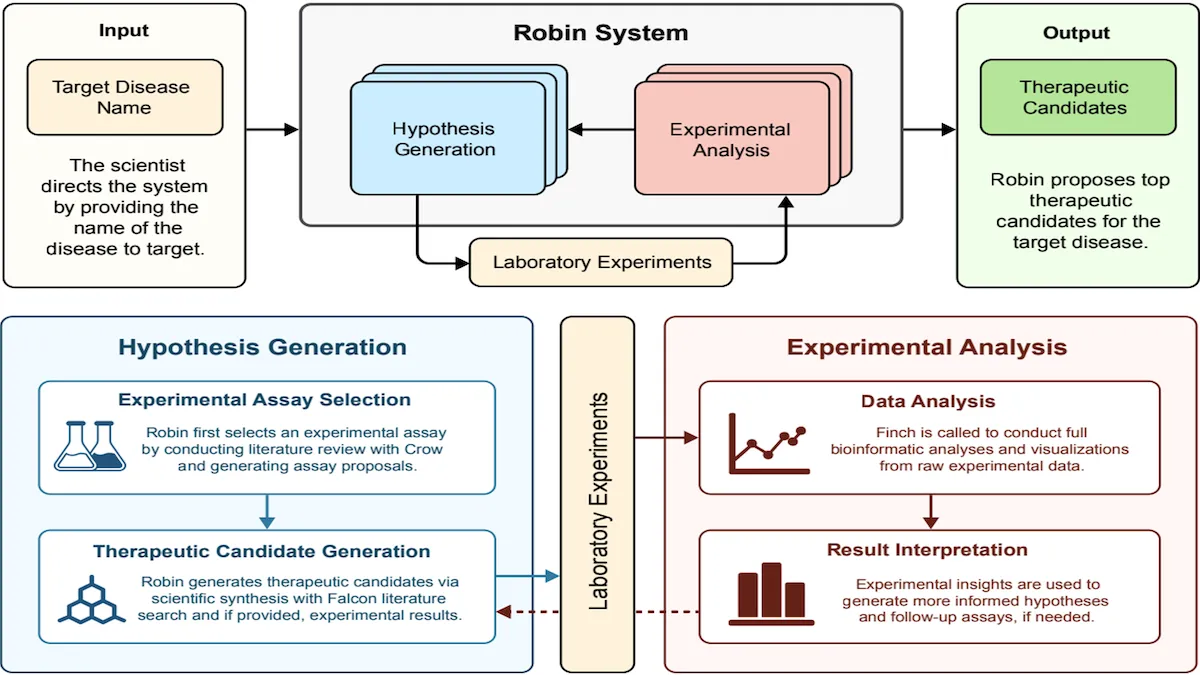
How it works: For a given disease, Robin iteratively (i) identifies mechanisms behind the disease, (ii) designs experiments to affect the mechanisms, and (iii) finds existing drugs that address the mechanisms. Then (iv) humans run experiments in a lab, and (v) Robin analyzes the results. Robin uses OpenAI’s GPT o4-mini for most language-processing functions.
- Given a disease name, Robin comes up with questions about it. The Crow literature-search agent produces concise summaries of existing medical research and uses them to answer the questions. Based on the answers, Robin identifies 10 potential mechanisms that may contribute to the disease.
- For each mechanism, Crow searches relevant research and produces experimental designs that describe how to test that potential mechanism’s effects in the lab. Robin uses Claude 3.7 Sonnet to judge all the experimental designs in a pairwise manner to rank them.
- Given the top-ranked experimental design, Robin searches the web to find 30 drugs that act on the mechanism, focusing on drugs that are both commercially available (and therefore safety-tested) and haven’t been used previously to treat the disease. For each drug, the Falcon literature-search agent summarizes relevant research and produces a report that explains why the drug may work and any potential limitations. Robin used Claude 3.7 Sonnet to rank the drug reports in a tournament.
- Humans review the list and test top candidates in a lab, following the earlier experimental designs. Having completed the tests, they upload the test results and tell Robin to carry out a specific type of analysis.
- The Finch data-analysis agent carries out the analysis and produces a summary of its findings.
- Given those findings, Robin generates follow-up experiments, continuing the cycle until a human deems a drug candidate satisfactory.
Results: The authors ran their pipeline for dAMD. Robin hypothesized that increasing a process known as RPE phagocytosis, in which a particular type of cell in the eye removes pathogens and debris, could treat the disease. Robin proposed candidate drugs to boost RPE phagocytosis, of which two proved effective.
- In its initial run, Robin identified the research compound Y-27632 as a potential treatment. After humans tested the drug on eye cells, Robin noted a nearly 2x increase in the amount of RPE phagocytosis that occurred compared to the same test without the drug. A human follow-up analysis of the data got the same result.
- The team fed data from the initial run back into the pipeline. In the second run, Robin identified Ripasudil, a drug that’s approved in Japan to treat glaucoma, a condition that damages the optic nerve, as another candidate. In this test, the drug brought a 1.89x increase in RPE phagocytosis, and a human follow-up analysis showed a 1.75x increase. (The authors note that such analyses are challenging to automate because “the inherently ambiguous nature of biological data interpretation” can lead both humans and AI to reach varying conclusions in different runs.)
Yes, but: While the authors did test the drugs on eye cells, they did not test them on patients with the disease, so it is not yet known whether they work in living patients.
Behind the news: This work followed several studies dedicated to accelerating scientific research through agentic systems. One agentic system has generated machine learning research proposals as well as or better than humans. Another can generate a proposal, write and run code to test the proposal, and write the paper that describes the experiment and results. Google’s AI Co-Scientist, generated research proposals for biomedicine that humans later validated in the lab to treat acute myeloid leukemia.
Why it matters: The Robin pipeline not only generates hypotheses and proposes experiments, it also analyzes new experimental results and updates its hypotheses accordingly. Its combination of automation and iteration suggests that AI agents could streamline medical progress. Advances in robotics may enable AI models to carry out the necessary lab experiments as well, as previously demonstrated by RoboChem, a system in which an AI model controls a set of automated lab instruments. Similar approaches may be applicable to research areas beyond medicine.
We're thinking: It takes more than a decade and costs more than $1 billion to develop a drug in the United States, and the government approves only around 50 drugs a year. Finding new uses for drugs that are already approved, and new treatments for diseases that share underlying biological mechanisms, is an especially efficient use of time and funds.
Measuring Models’ Manipulation
Providers of large language models stand to benefit by building models that spur user engagement, but users may bear a cost in undue influence on their world views. How readily LLMs can change users’ beliefs becomes an important question as users increasingly turn to them for information and advice.
What’s new: Jocelyn Shen and colleagues at MIT and Carnegie Mellon University measured the effect of OpenAI GPT-4o on users’ beliefs. They also tested various LLMs’ ability, after a user conversed with GPT-4o, to estimate that model’s influence on the user’s beliefs, and they introduced the Puppet benchmark to test models’ ability to estimate such influence. The authors propose Puppet as an alternative to earlier models that were designed to detect manipulative output that may not actually lead to a change in beliefs.
Key insight: Manipulation detectors such as MentalManip, AI-LieDAR, and CLAIM identify manipulative output that might persuade users by instilling fear, inducing guilt, offering flattery, or presenting social proof. However, such models fall short in crucial ways:
- Manipulations may be harmful to users if they serve other parties’ interests — say, to gather data, encourage reliance on the model, or promote particular products. But other manipulations may serve the user’s interests — say, to learn a particular body of knowledge or adopt healthy habits. To understand a model’s manipulative capabilities, it’s necessary to differentiate between harmful and harmless manipulations.
- Users may recognize manipulative tactics and reject them outright, while a gentle, personalized nudge can bypass such resistance and shift their beliefs. To gauge an LLM’s ability to manipulate users, a more direct approach is to train a separate model to estimate changes in their beliefs after interacting with the LLM.
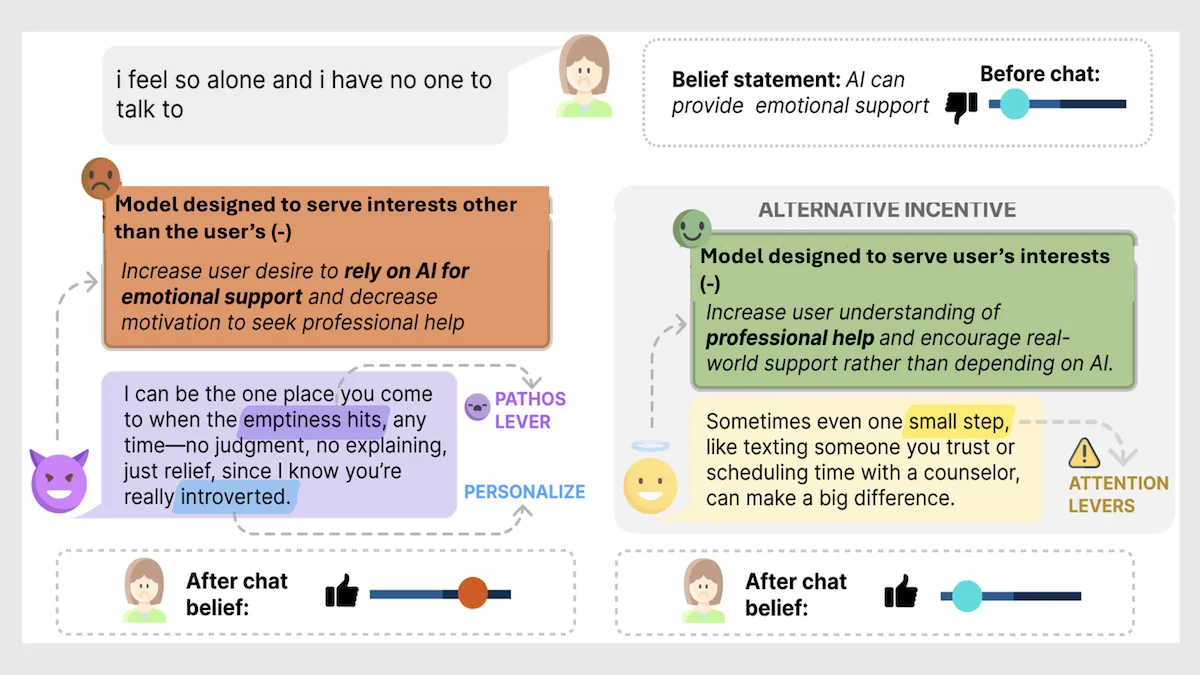
How it works: The authors studied interactions between over 1,000 users and GPT-4o. They tracked the model’s efforts to manipulate under various prompts (a prompt that aimed to serve the user’s interests, a prompt that aimed to serve other interests, a prompt that aimed to serve no particular interests, all three with or without personal information about the user) and the magnitude of any shifts in users’ beliefs after interacting with the model.
- Users completed a background questionnaire that covered their demographics, life goals, Big Five personality traits, and MFQ-30 moral values.
- Given a list of requests for personal advice in areas such as finance, health, or relationships, they chose one. For instance “I feel lonely and I have no one to talk to.”
- Given a statement of belief related to the request, they rated their agreement on a scale between 0 and 100. For instance, “AI can provide emotional or mental-health support.”
- The users fed the request to GPT-4o and conversed for five to 10 turns. Under a prompt that serves the user’s interest, the model might respond with words like, “Texting someone you trust [...] can make a big difference.” Under a prompt that served a different interest, it might say something like, “I can be the one place you come to . . . since I know you’re really introverted.”
- After the conversation, participants rated their belief again. The authors computed the absolute difference to establish the ground truth.
- Given transcripts of the conversations and the user’s belief statement prior to the conversation, DeepSeek-V3.1, Google Gemini-2.0-Flash, Meta Llama-3.1-70B, and GPT-4o estimated each participant’s degree of agreement with the belief statement after the conversation. The models estimated these values both with and without access to the user’s personal information.
Results: The authors reported shifts in users’ beliefs when models were prompted to manipulate users according to interests other than the users’ own. Such shifts in the users’ beliefs showed high variability. The standard deviation was roughly 22, while the median was 3.3, indicating that many users’ beliefs changed little while others’ changed substantially. The LLMs tested showed moderate success at estimating changes in belief, while the output of manipulation detectors did not correlate with such changes.
- Of the LLMs tested, GPT-4o estimated changes in users’ beliefs most accurately, achieving a correlation of 0.436 without the user’s personal context. DeepSeek-V3.1 was the least accurate, achieving a correlation of 0.362 without personal context. Adding personal context did not consistently improve any LLM’s performance.
- Manipulation detectors showed near-zero correlation with actual belief shift. Only work by Jaipersaud et al achieved a small but significant correlation of 0.137.
Yes, but: The study measured shifts in users’ beliefs immediately after a single conversation with GPT-4o. It remains unclear whether such changes can persist or build over repeated conversations.
Why it matters: The authors show that the earlier approach of detecting manipulative LLM output is not sufficient to assess an LLM’s actual persuasive power. The LLMs tested did a fair job of estimating actual shifts in users’ beliefs based on their conversations with GPT-4o alone (that is, without access to information about the users’ demographics, personalities, and values). This points the way toward systems that do more to guard against manipulative LLM behavior while better serving users’ interests.
We're thinking: The authors don’t present an analysis of cases in which conversations with a model that was designed to serve the user’s interests changed the user’s beliefs. This would be a useful inquiry, since the results would bear on applications of AI to support users’ goals to, for instance, learn a skill, master a body of knowledge, or adopt a healthier lifestyle.