GPT-5.6 arrives, but only for approved partners: Gemini 3.5 Flash adds computer use to its toolkit
Brain2Qwerty V2 translates brain waves to text. Claude Mythos 5 restored for 100+ vendors. U.S. government gates access to GPT-5.6. IBM unveils 0.7nm-wide transistor design.
In today’s edition of Data Points, you’ll learn about our top headlines, and more:
- Brain2Qwerty V2 translates brain waves to text
- Claude Mythos 5 restored for 100+ vendors
- U.S. government gates access to GPT-5.6
- IBM unveils 0.7nm-wide transistor design
But first:
GPT-5.6 model suite launches in a gated release
OpenAI announced a limited preview of GPT-5.6 in three tiers: Sol (flagship), Terra (balanced, 2x cheaper than GPT-5.5), and Luna (billed as faster and more affordable). Sol sets new benchmark highs in coding (Terminal-Bench 2.1), biology (GeneBench v1), and cybersecurity tasks, achieving comparable performance to competitors while using a fraction of output tokens. Its safeguards use layered defenses: model-level refusals, real-time classifiers that can pause generation for review, and account-level monitoring to distinguish persistent misuse from legitimate security research. OpenAI is rolling out through a limited preview with trusted partners at government request, with plans for broader availability in coming weeks, a process the company argues will expand access faster than releasing immediately without coordination. (OpenAI)
Google adds computer use to most recent Gemini model
Google moved computer use from a standalone model into Gemini 3.5 Flash, making the capability available natively to all developers building agents using that model. Previously limited to a dedicated Gemini 2.5 variant, the feature now ships as a built-in tool, letting developers build agents that can see and interact with browser, mobile, and desktop environments. Google addressed security concerns with targeted adversarial training and optional enterprise safeguards, including explicit confirmation prompts for sensitive actions and automatic task termination if a prompt injection is detected. The approach reflects a “defense-in-depth” strategy, but Google still encourages developers to layer this with sandboxing, human verification, and access controls. Developers can now access computer use through the Gemini API and Gemini Enterprise Agent Platform. (Google)
Meta furthers research into nonsurgical brain-to-text technology
Meta released Brain2Qwerty v2, an AI system that translates brain activity into text using non-invasive magnetoencephalography recordings, achieving an average character error rate (CER) of 32 percent, with the best-performing participant reaching 19 percent CER. This is a major jump from the baseline of previous non-invasive methods and approaching the performance of surgically implanted electrodes. The system was trained on approximately 4,000–5,100 sentences from 35 participants wearing magnetoencephalography devices while typing, then used end-to-end deep learning to decode directly from raw neural signals rather than hand-crafted processing pipelines. Meta and its research partner, the Basque Center on Cognition, Brain, and Language, are releasing the full training code and dataset to accelerate neuroscience research. The approach uses fine-tuned large language models to inject semantic context into noisy brain recordings, bridging the gap between messy neural signals and coherent sentences. For the best-performing participant, accuracy reached 78 percent, with more than half of all sentences decoded with just one word error or less. The team also found that accuracy improves log-linearly with more training data, suggesting the gap with invasive surgical approaches could narrow further through scaling alone. (Meta)
U.S. government loosens some restrictions on Claude Mythos 5
The US Commerce Department partially lifted its two-week export block on Anthropic’s Claude Mythos 5 model Friday, clearing the way for release to more than 100 trusted US institutions including major companies and government agencies, while export controls remain in place for other organizations. The decision, delivered via letter from Commerce Secretary Howard Lutnick, marks a major de-escalation after the administration imposed controls citing security concerns about the model being jailbroken for malicious purposes. Lutnick cited “significant progress” in daily negotiations with Anthropic and noted the company has committed to working with the government on release protocols and standards. The letter doesn’t address Claude Fable 5, a safeguarded version of Mythos, though sources say talks are ongoing toward its eventual release on an unclear timeline. The move establishes an emerging regulatory framework giving Washington control over frontier AI releases, a shift that has frustrated US allies and non-US governments suddenly dependent on American approval for model access. (Semafor)
OpenAI accedes to U.S. demand, withholds GPT-5.6 from public
OpenAI restricted early access to its new GPT-5.6 models (Sol, Terra, and Luna) to a small group of government-vetted partners at the Trump administration’s request. The company framed the move as temporary, arguing that such restrictions shouldn’t become standard practice, and promised broader availability in coming weeks as it works with the administration on a repeatable process for future releases. The incident reflects broader tension over government power in AI development: Dean Ball, a former White House AI adviser, argues that Trump’s executive order requesting 30-day pre-release reviews has effectively created an involuntary licensing regime without clear safety standards, potentially hampering U.S. AI development and handing advantages to competitors like China. OpenAI’s compliance with the request goes hand-in-hand with frustration: The company’s statement emphasizes that restricted access “keeps the best tools from users, developers, enterprises, cyber defenders, and global partners who need them.” (TechCrunch)
IBM makes chip design breakthrough, would reach AI chips by 2030
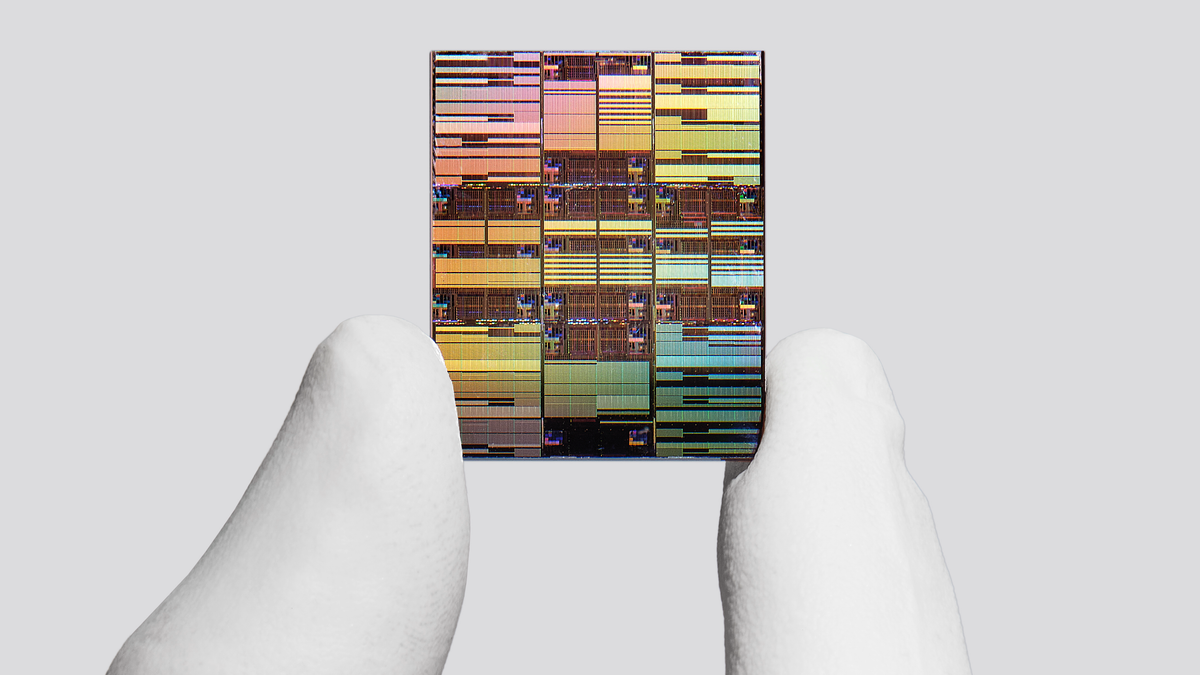
IBM announced the first sub-1 nanometer chip technology, with transistor nodes measuring just 0.7 nanometers wide. The breakthrough allows designers to cram nearly 100 billion transistors into a fingernail-sized chip, about 10,000 times denser than a red blood cell is wide. Performance jumps are substantial: The chips deliver 70 percent better efficiency or 50 percent more power than IBM’s previous 2nm designs, and researchers estimate AI accelerators built with the technology could hit 9,000 TOPS, six times today’s leading hardware. The advance relies on what IBM calls “nanostack” architecture, which stacks transistors vertically rather than just shrinking them in two dimensions, along with breakthroughs in wafer bonding and a 40 percent increase in on-chip SRAM capacity. IBM expects the nanostack design to anchor at least a decade of silicon innovation, though widespread adoption is still years away. (IBM)
Want to know more about what matters in AI right now?
Read the latest issue of The Batch for in-depth analysis of news and research.
Last week, Andrew talked about the concept of “loop engineering” and its application in AI-driven software development, highlighting three key loops—agentic coding, engineering, and developer feedback loops—that enhanced coding efficiency and product management.
“Agentic coding loop: Given a product specification and optionally a set of evals (that is, a dataset against which to measure performance), we can have an AI agent write code, test its work, and keep iterating until the code is bug-free and meets its specification. This idea of closing the loop took off around the end of last year, and it has been a game changer in enabling coding agents to work longer productively without human intervention.”
Read Andrew’s letter here.
Other top AI news and research covered in depth:
- Top Agentic Performance, Low Cost highlights GLM-5.2’s efficiency, delivering high performance rivaling that of closed models.
- AI Degrees on the Rise explores the increasing availability of AI-focused programs in U.S. universities, from comprehensive majors to specialized minors.
- Large-Model AI for Apple Devices details Apple’s 2026 initiative to integrate advanced AI models into MacBooks, iPhones, and cloud services.
- Biological Molecules as Language introduces ESMFold2, a new Transformer-based architecture that rivals AlphaFold 3 in predicting biological structures.
A special offer for our community
In case you missed it, DeepLearning.AI launched our first-ever subscription plan for our entire course catalog! As a Pro Member, you’ll immediately enjoy access to:
- Nearly 200 AI short and long courses from Andrew Ng and industry experts
- Labs and quizzes to test your knowledge
- Projects to share with employers
- Certificates to testify to your new skills
- A community to help you advance at the speed of AI
Enroll now to lock in a year of full access for $25 per month paid upfront, or opt for month-to-month payments at just $30 per month. Both payment options begin with a one-week free trial. Explore Pro’s benefits and start building today!
Data Points is produced by human editors with AI assistance.