Gemini 3 adds compute-intensive Deep Think: Two famous math problems solved by 10-person AI startup
An executive order that would challenge state AI regulations in the U.S. An 8B parameter open model that shines at coding and math tasks. Publishers’ copyright and trademark lawsuits against Perplexity. Gemini 3 Pro’s ability to visually recognize handwriting from any period.
In today’s edition of Data Points, you’ll learn more about:
- An executive order that would challenge state AI regulations in the U.S.
- An 8B parameter open model that shines at coding and math tasks
- Publishers’ copyright and trademark lawsuits against Perplexity
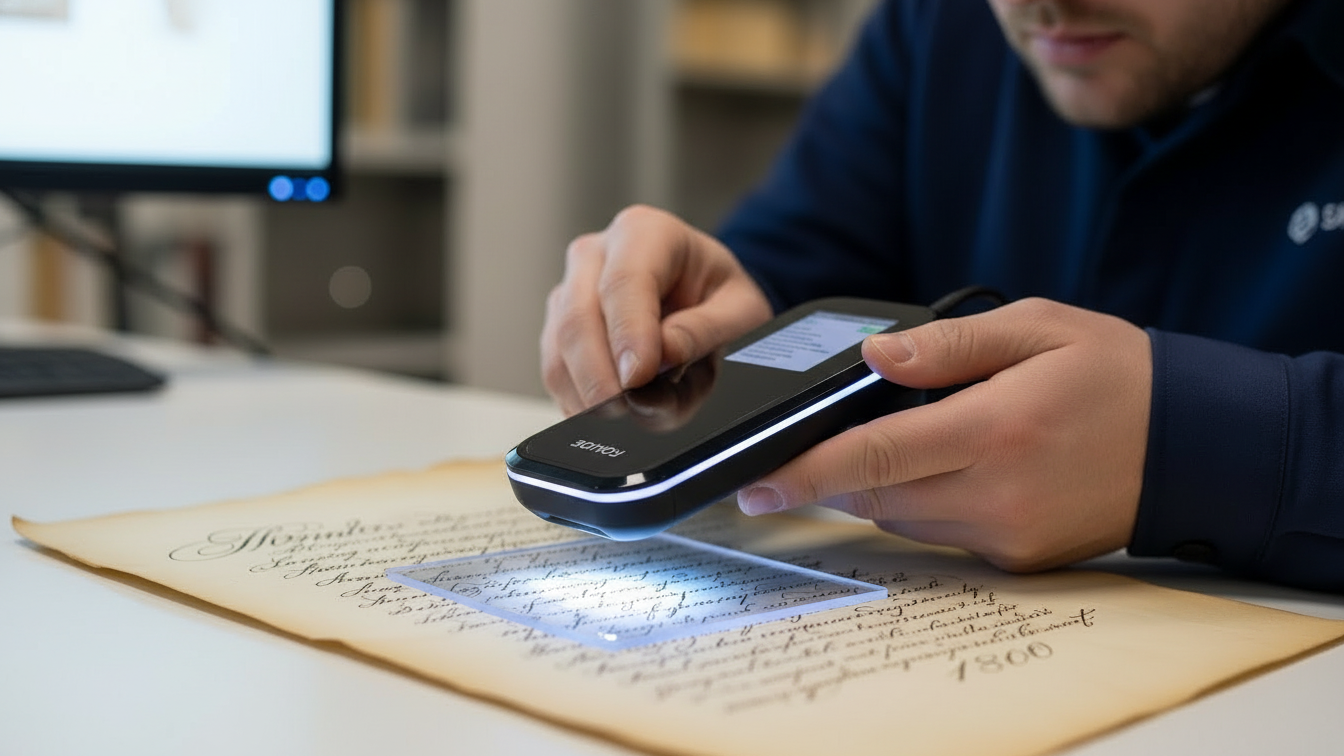
- Gemini 3 Pro’s ability to visually recognize handwriting from any period
But first:
Google’s Gemini 3 Deep Think mode now available
Google AI Ultra subscribers can now access Gemini 3 Deep Think, designed to solve advanced problems in mathematics, science, and logic. The special compute-intensive mode scored 41.0 percent on Humanity’s Last Exam without tools and 45.1 percent on ARC-AGI-2 with code execution, using parallel reasoning to explore multiple hypotheses at once. The technology builds on Gemini 2.5 Deep Think variants that achieved gold-medal performance at the International Mathematical Olympiad and International Collegiate Programming Contest World Finals. (Google)
Axiom proves two longstanding mathematical problems
AI mathematics startup Axiom produced formalized proofs for two open conjectures in the mathematical language Lean. Erdös problem #481 has been open since 1980 and problem #124 has been open for about 30 years. Prolific mathematician Paul Erdős formulated roughly 1,100 problems, but only 266 have ever been proved. The solutions come weeks after OpenAI claimed GPT-5 solved Erdős problems, only for mathematicians to observe the model had retrieved existing solutions rather than having discovered new proofs. (X and TechCrunch)
Trump plans executive order to block state-level AI regulations
U.S. President Donald Trump announced he will sign an executive order this week establishing a single federal rule for artificial intelligence, preempting state regulations the administration calls burdensome. A circulating draft of the order would allow the Department of Justice to sue states over AI regulations deemed unconstitutional and threaten funding cuts to states with laws considered too restrictive. The move marks a victory for AI industry leaders who have criticized state-by-state regulatory approaches, though it has drawn opposition from some Republican governors including Ron DeSantis of Florida and Sarah Huckabee Sanders of Arkansas. The order is part of a broader administration effort to ensure U.S. dominance in AI development and follows previous executive actions aimed at easing AI infrastructure development, data center construction, and export processes. (Bloomberg)
Essential 8B model’s agentic coding rivals larger models
Essential AI released Rnj-1, an open-weights language model available in base and instruction-tuned versions with 32,000-token context windows. The model outperforms similarly sized open-weight models on coding benchmarks like HumanEval+ and MBPP+ and mathematics benchmarks like AIME 2025, and achieves performance on SWE-bench Verified that approaches much larger models. Essential AI focused on pre-training rather than post-training reinforcement learning, incorporating research on data mixture optimization, the Muon optimizer, and modeling program execution. The model supports quantization from BF16 to FP8 to NVFP4 while maintaining quality and improving throughput on prompt-heavy workloads. (Essential AI)
New York Times, others sue Perplexity for copyright infringement
The New York Times filed a lawsuit against Perplexity AI, alleging the search engine startup scraped and republished millions of the newspaper’s copyrighted articles, videos, and podcasts without authorization. The complaint includes five counts: copyright infringement, trademark infringement, and trademark dilution. The Times claims Perplexity continued scraping content even after receiving cease-and-desist letters, and that the AI system generates false information, including a fabricated review of a recalled infant product that Wirecutter never covered. The Chicago Tribune filed a similar lawsuit the same day, joining existing copyright suits against Perplexity from Dow Jones, the New York Post, Encyclopaedia Britannica, and Merriam-Webster. Perplexity dismissed the lawsuits as similar to past cases against new technologies. (Courthouse News)
Gemini 3 Pro beats human baseline on document benchmark
Google published new benchmark results for Gemini 3 Pro showing state-of-the-art performance across vision tasks. The model scored 80.5 percent on the CharXiv Reasoning benchmark, surpassing the human baseline for complex multi-step reasoning across tables and charts in long documents. Test cases show the model’s ability to cross-reference data across a 62-page U.S. Census report, accurately derender an 18th-century handwritten merchant log into structured tables, convert mathematical notation from images to precise LaTeX code, and analyze video at 10 frames per second to capture rapid motion details like golf swing mechanics. The model also achieved state-of-the-art scores on MedXpertQA-MM for expert-level medical reasoning, VQA-RAD for radiology imagery, and MicroVQA for microscopy-based biological research. (Google)
Want to know more about what matters in AI right now?
Read the latest issue of The Batch for in-depth analysis of news and research.
Last week, Andrew Ng talked about the widespread distrust of AI in the U.S. and Europe, the need for the AI community to address public concerns and avoid hype, and the importance of building trust by making AI beneficial for everyone.
“To be clear, all of us working in AI should look carefully at both the benefits and harmful effects of AI (such as deepfakes polluting social media and biased or inaccurate AI outputs misleading users), speak truthfully about both benefits and harms, and work to ameliorate problems even as we work to grow the benefits.”
Read Andrew’s letter here.
Other top AI news and research stories we covered in depth:
- Meta’s SAM 3 image segmentation models analyzed and created bodies and other objects through an open 3D generation pipeline.
- World Labs made its Marble world model public and added the Chisel editing tool for generating and editing virtual spaces.
- Baidu’s Ernie 5 model natively generated multiple media, with Ernie-4.5-VL-28B-A3B-Thinking topping Vision-Language metrics.
- Google DeepMind’s RoboBallet project blended GNNs with RL to coordinate teams of 8-armed robots.
A special offer for our community
DeepLearning.AI recently launched the first-ever subscription plan for our entire course catalog! As a Pro Member, you’ll immediately enjoy access to:
- Over 150 AI courses and specializations from Andrew Ng and industry experts
- Labs and quizzes to test your knowledge
- Projects to share with employers
- Certificates to testify to your new skills
- A community to help you advance at the speed of AI
Enroll now to lock in a year of full access for $25 per month paid upfront, or opt for month-to-month payments at just $30 per month. Both payment options begin with a one week free trial. Explore Pro’s benefits and start building today!