From AI Experiments to AI Products: Experiemental projects can reveal AI powered-opportunities, but building AI-powered products often requires redesigning workflows.
How can businesses go beyond using AI for incremental efficiency gains to create transformative impact?
Dear friends,
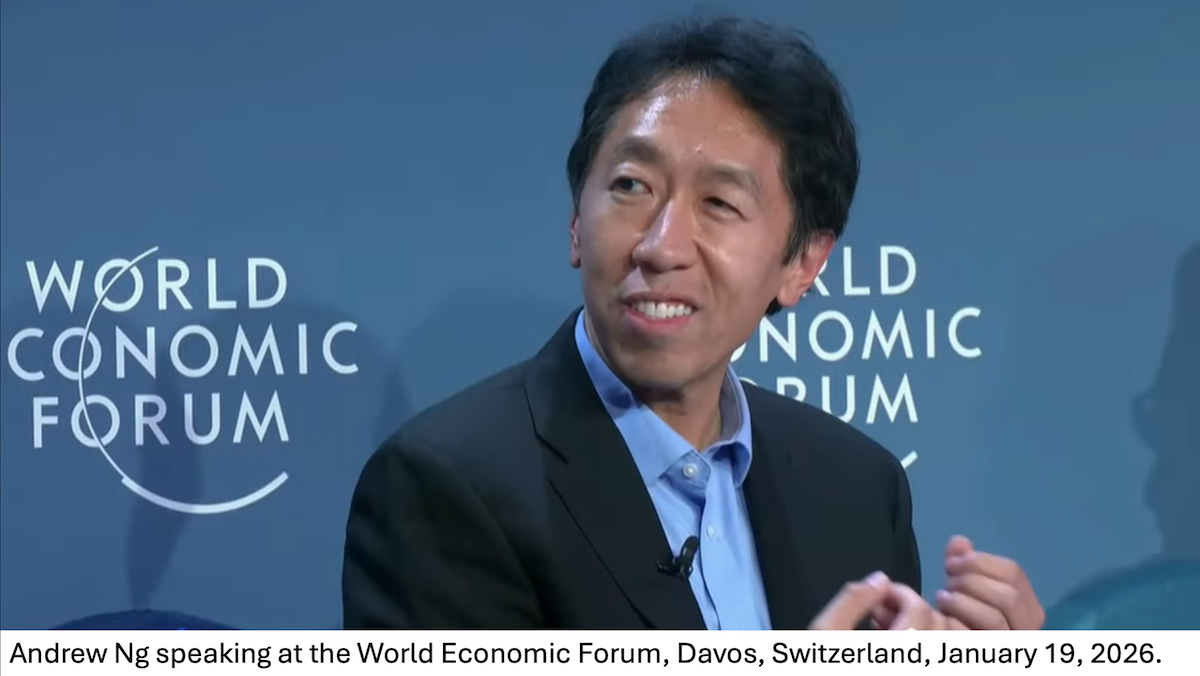
How can businesses go beyond using AI for incremental efficiency gains to create transformative impact? I’m writing this letter from the World Economic Forum (WEF) in Davos, Switzerland, where I’ve been speaking with many CEOs about how to use AI for growth. A recurring theme of these conversations is that running many experimental, bottom-up AI projects — letting a thousand flowers bloom — has failed to lead to significant payoffs. Instead, bigger gains require workflow redesign: taking a broader, perhaps top-down view of the multiple steps in a process and changing how they work together from end to end.
Consider a bank issuing loans. The workflow consists of several discrete stages: Marketing -> Application -> Preliminary Approval -> Final Review -> Execution
Suppose each step used to be manual. Preliminary Approval used to require an hour-long human review, but a new agentic system can do this automatically in 10 minutes. Swapping human review for AI review — but keeping everything else the same — gives a minor efficiency gain but isn’t transformative.
Here’s what would be transformative: Instead of applicants waiting a week for a human to review their application, they can get a decision in 10 minutes. When that happens, the loan becomes a more compelling product, and that better customer experience allows lenders to attract more applications and ultimately issue more loans.
However, making this change requires taking a broader business or product perspective, not just a technology perspective. Further, it changes the workflow of loan processing. Switching to offering a “10-minute loan” product would require changing how it is marketed. Applications would need to be digitized and routed more efficiently, and final review and execution would need to be redesigned to handle a larger volume.
Even though AI is applied only to one step, Preliminary Approval, we end up implementing not just a point solution but a broader workflow redesign that transforms the product offering.
At AI Aspire (an advisory firm I co-lead), here’s what we see: Bottom-up innovation matters because the people closest to problems often see solutions first. But scaling such ideas to create transformative impact often requires seeing how AI can transform entire workflows end to end, not just individual steps, and this is where top-down strategic direction and innovation can help.
This year's WEF meeting, as in previous years, has been an energizing event. Among technologists, frequent topics of discussion include Agentic AI (when I coined this term, I was not expecting to see it plastered on billboards and buildings!), Sovereign AI (how nations can control their own access to AI), Talent (the challenging job market for recent graduates, and how to upskill nations), and data-center infrastructure (how to address bottlenecks in energy, talent, GPU chips, and memory). I will address some of these topics in future letters.
Against the backdrop of growing geopolitical uncertainty, I hope all of us in AI will keep building bridges that connect nations, sharing through open source, and building to benefit all nations and all people.
Keep building!
Andrew