Carbon, Hydrogen, Neon, Oh My!: Google Gemini’s Updated Models Combine in Orchestrator
Google introduced two faster, less expensive Gemini 4 models and a way for its coding agent to hand work back and forth between models mid-task.
Google introduced two faster, less expensive Gemini 4 models and a way for its coding agent to hand work back and forth between models mid-task.
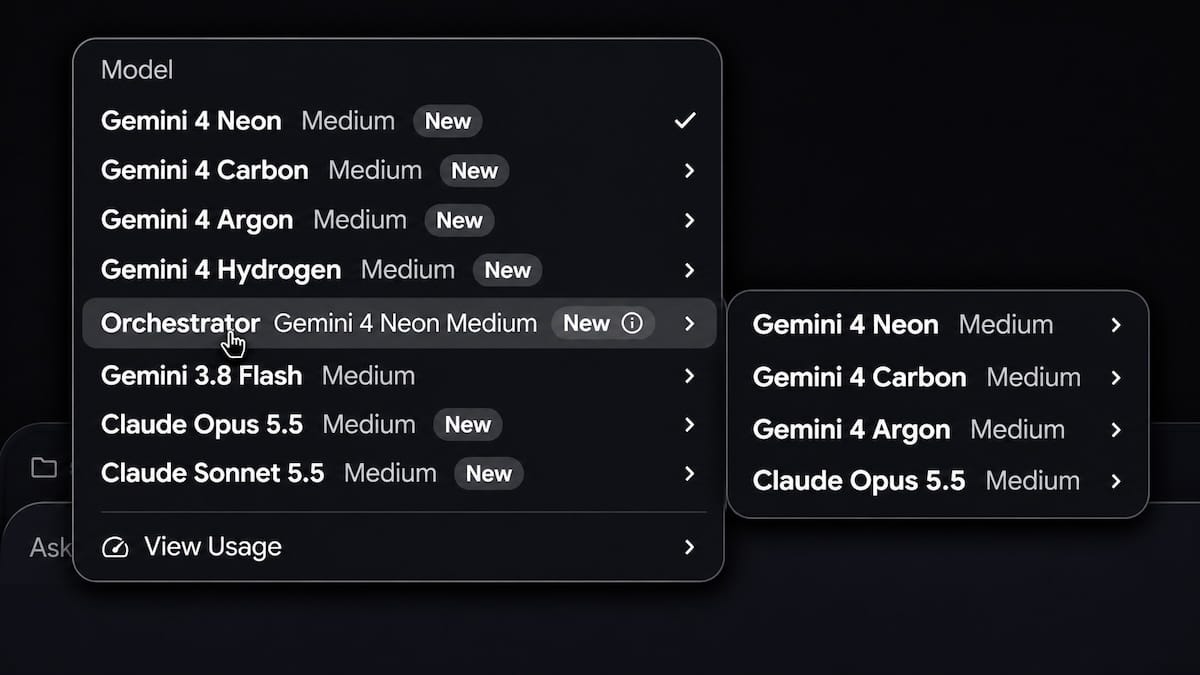
What's new: On November 12, Google released Gemini 4 Hydrogen, a model built to carry out coding and other agentic tasks quickly and at lower cost than Gemini 4 Carbon. On November 18, the company added Gemini 4 Neon, a model that rivals Carbon’s performance at an intermediate speed and cost. In addition, Antigravity, Google’s counterpart to OpenAI's Codex and Anthropic’s Claude Code, gained Orchestrator, an option that allows larger models like Carbon or Neon to plan a task and have smaller models like Hydrogen carry it out.
- Input/output: Text, images, audio, and video in, text out (up to 1 million tokens of input and output combined; up to 64,000 output token by default
- Speed: Hydrogen, 173 tokens per second at its highest setting; Neon, 99 tokens per second, both according to Artificial Analysis
- Architecture: Adapted from Gemini 4 Carbon
- Price: Hydrogen $1.50/$7.50 per million input/output tokens via API; Neon $3.00/$15.00 per million input/tokens
- Weights/license: Proprietary
- Undisclosed: Parameter count, architecture details, how Google adapted Hydrogen or Neon from Carbon, training data and methods
How it works: Orchestrator divides each task between a planner and an executor instead of running one model for everything, according to Antigravity’s documentation. Unlike setups that split a task between different agents, Orchestrator keeps a single agent within a single context window (conversation) and switches the model behind it.
- First, the planner (either Carbon, Neon, or Argon) studies the code without changing anything. Then it writes a plan that spells out what the actor model should do.
- Hydrogen carries out the plan: It changes the code, builds and tests it, and confirms that the results match what the plan called for.
- Hydrogen hands control back to the planner when it runs into trouble, such as a check that fails twice or an interface that behaves differently than expected. The planner rewrites the plan according to Hydrogen's feedback, then passes the work back.
Performance: Hydrogen trades some of Carbon’s capability for speed and lower cost, according to independent tests. Using Carbon as a planning model and Hydrogen as an actor inside Orchestrator nearly matches using Carbon alone, according to Google. Neon, meanwhile, outperforms Carbon on overall intelligence while costing less per task.
- Hydrogen set to high reasoning scored 51 on Artificial Analysis’ Intelligence Index, roughly matching Gemini 4 Argon (50). Set to xhigh, Hydrogen scored 54, took 14.9 minutes, and cost $3.16 per task. Neon at xhigh scored 61, costing $6.44 per task and taking 25.8 minutes per task. Carbon set to high scored 60, took 32 minutes, and cost $5.48 per task at its introductory price.
- Google says that on Terminal-Bench, which tests an agent’s ability to complete tasks in a computer terminal, using Carbon and Hydrogen together in Orchestrator came close to Carbon’s success rate while finishing 19 percent faster and consuming 24 percent less of its token quota on average.
- Hydrogen’s lower price doesn’t always mean fewer tokens. Set to extra-high, Hydrogen generated 304 million output tokens over the Intelligence Index’s tests, compared with Carbon’s 205 million.
Behind the news: Google made Gemini 4 Carbon widely available on November 10, following Argon in September. The power and cost of Gemini’s models roughly correspond with the weight of their element names: Hydrogen is light and fast, while Carbon is relatively heavier and more substantial. But the elementally heavier Neon is faster than Carbon, and Argon, now the least capable of Gemini’s “element” models, is heaviest of all.
Why it matters: Pairing a cheaper model with a costlier one isn’t new. Anthropic’s Claude Code offers a related “advisor” option, in which a cheaper model does the work and consults a stronger one at key moments, such as before committing to a plan or when it gets stuck. OpenAI’s Codex lets developers assign different models to subagents, but it delegates work to them only when instructed. Sakana’s Fugu takes this logic one step further, using a dedicated orchestrator model that can call models from Google, OpenAI, or Anthropic at each step. All these efforts show that the best model for a coding task may turn out to be two or more models working together.
We’re thinking: Google has made three very capable new models available within the last month. We can all be thankful for this rapid pace of progress.