Anthropic’s claims for Claude Mythos raise questions: 40 percent of U.S. data-center projects may be delayed
OpenAI’s big bet on an alternative to Nvidia. Meta’s plan to build a virtual CEO. Financial risks of lending money to companies affected by AI. Luma’s AI-driven film production studio.
Welcome back! In today’s edition of Data Points, you’ll learn more about:
- OpenAI’s big bet on an alternative to Nvidia
- Meta’s plan to build a virtual CEO
- Financial risks of lending money to companies affected by AI
- Luma’s AI-driven film production studio
But first:
Skepticism grows around Anthropic’s claims of Mythos cybersecurity breakthroughs
Anthropic’s claim that its next-generation Claude Mythos model discovered “thousands” of severe zero-day vulnerabilities is overstated and based on limited evidence, according to an analysis by the tech-news outlet Tom’s Hardware. Anthropic’s claims rely on 198 manually reviewed cases, many of which involve older or impractical-to-exploit software issues rather than newly discovered, high-risk vulnerabilities. Questions surrounding the capabilities of Claude Mythos highlight the role of selective evaluation in marketing AI systems as well as the need for rigorous validation by the developer community. (Tom’s Hardware)
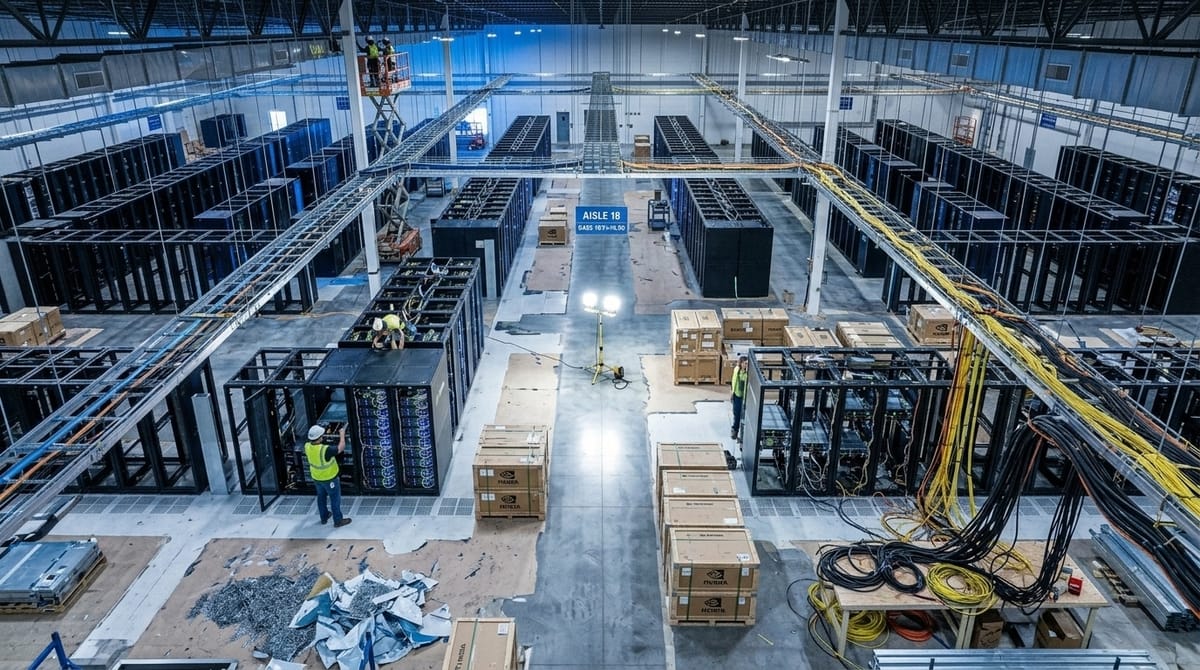
Satellite data suggests widespread delays in AI data center buildout
Satellite imagery shows that roughly 40 percent of U.S. AI data-center construction projects may be behind schedule, according to an analysis by SynMax, a company that interprets geospatial data. The analysis, which is based on tracking construction progress like land clearing and foundations, highlights issues such as permitting, labor shortages, supply constraints, and insufficient power infrastructure for GPU-heavy facilities. Delays in data-center capacity could slow the pace of AI deployment and scaling, shifting the industry’s bottleneck from model development to physical infrastructure. (Financial Times)
OpenAI makes massive deal with Cerebras as alternative to Nvidia
OpenAI agreed to spend more than $20 billion over three years on Cerebras AI processors in a deal that also grants it a potential equity stake in the chip designer. The agreement may include up to 750 megawatts of capacity, additional funding to build data centers, and warrants that could translate into a roughly 10 percent ownership stake depending on spending levels. The deal highlights the strategic importance of processing infrastructure, as leading AI labs move to secure supplies, diversify suppliers beyond AI chip kingpin Nvidia, and integrate their software and hardware strategies. (The Information)
Meta experiments with AI CEO avatar for internal communication
Meta is developing an AI version of CEO Mark Zuckerberg that employees can interact with directly as a way to improve access to leadership. The system is being trained on Zuckerberg’s voice, mannerisms, and past statements so it can answer questions and communicate company strategy across a workforce of tens of thousands. Meta’s move reflects growing use of AI agents in corporate settings and raises new questions about management structure, authority, and authenticity within AI-driven organizations. (The Guardian)
Moody’s flags early stress among lenders exposed to AI disruption
The credit-rating firm Moody’s identified early warning signs of credit deterioration among lenders that have made loans to companies that are affected by artificial intelligence. The firm highlighted rising risks in sectors like software, where AI-driven disruption is making it harder for companies to pay off their debts. Moody’s report suggests that the economic impact of AI is beginning to ripple through financial systems, giving developers and industry observers an early signal that it could have second-order effects on capital supplies and startup ecosystems. (Bloomberg)
Luma moves into AI-driven film production with new studio
Luma AI, maker of the video generator of the same name, launched an AI-powered production company called Innovative Dreams. The studio uses agentic technology based on the company’s multimodal Uni-1 model to combine virtual sets, lighting, and motion-captured actor performances into a real-time, AI-assisted workflow. Innovative Dreams’ approach signals a shift from AI-assisted video production using isolated tools to an end-to-end pipeline, showing how generative AI could reshape film production workflows, costs, and team structures. Its debut production, which depicts a Bible story, will stream on Amazon Prime Video this spring. (TechCrunch)
Want to know more about what matters in AI right now?
Read the latest issue of The Batch for in-depth analysis of news and research.
Last week, Andrew Ng talked about how AI-native software engineering teams operate differently by using coding agents to speed up product development, the importance of engineers and PMs expanding their roles to overcome project-management bottlenecks, and the need to minimize communication bottlenecks in small, co-located teams.
“AI-native software engineering teams operate very differently than traditional teams. The obvious difference is that AI-native teams use coding agents to build products much faster, but this leads to many other changes in how we operate. For example, some great engineers now play broader roles than just writing code. They are partly product managers, designers, sometimes marketers.”
Read Andrew’s letter here.
Other top AI news and research stories covered in depth:
- Meta pivoted away from its open-weights Llama strategy with Muse Spark, which signaled a shift in its approach to AI development.
- Pharmaceutical giant Eli Lilly committed to investing up to $2.75 billion in Insilico for AI-driven drug development, which marked a significant bet on AI’s potential to transform the industry.
- Despite opposition from President Trump, most US states moved forward with AI regulations, highlighting a growing trend towards state-level governance of AI technologies.
- Researchers advanced AI’s ability to simulate human diversity with persona generation, which enabled the creation of characters across a wide range of perspectives.
Last chance!
A special event for our community
Andrew Ng and DeepLearning.AI are hosting AI Dev 26 × San Francisco, a two-day conference for AI developers taking place April 28-29 at Pier 48.
Join 3,000+ engineers, researchers, and builders working on modern AI systems.
The program includes top speakers, developer relations experts, and engineers from companies including Google, AMD, Oracle, Neo4j, and Snowflake (and of course DeepLearning.AI), all sharing their latest technologies and explaining how they’re building and deploying AI systems today.
At AI Dev 26, you’ll find:
- Technical talks from engineers building AI systems in production
- Hands-on workshops exploring new tools and techniques
- Live demos from startups and AI builders
- Opportunities to meet other developers and companies in the space
Get your ticket with a special discount!
Data Points is produced by human editors with AI assistance.