AI Rewards Generalists Who Can Build New Skills: With AI assistance, full-stack engineers are joined by full-stack recruiters, full-cycle marketers, and more.
As AI increasingly automates coding, it frees up developers to spend time on high-level software development tasks traditionally reserved for senior engineers, like deciding on technical architecture and participating in scoping product requirements.
Dear friends,
As AI increasingly automates coding, it frees up developers to spend time on high-level software development tasks traditionally reserved for senior engineers, like deciding on technical architecture and participating in scoping product requirements. Demand for this type of work is growing, since it is an economic complement to coding, which is becoming cheaper. This is why I’m confident there will be rising demand for broad AI engineering skills. I see a similar pattern starting to emerge in other AI-influenced fields as well, and am cautiously optimistic — contrary to predictions of a “jobpocalypse” — that AI will generally increase demand for people with the right skills.
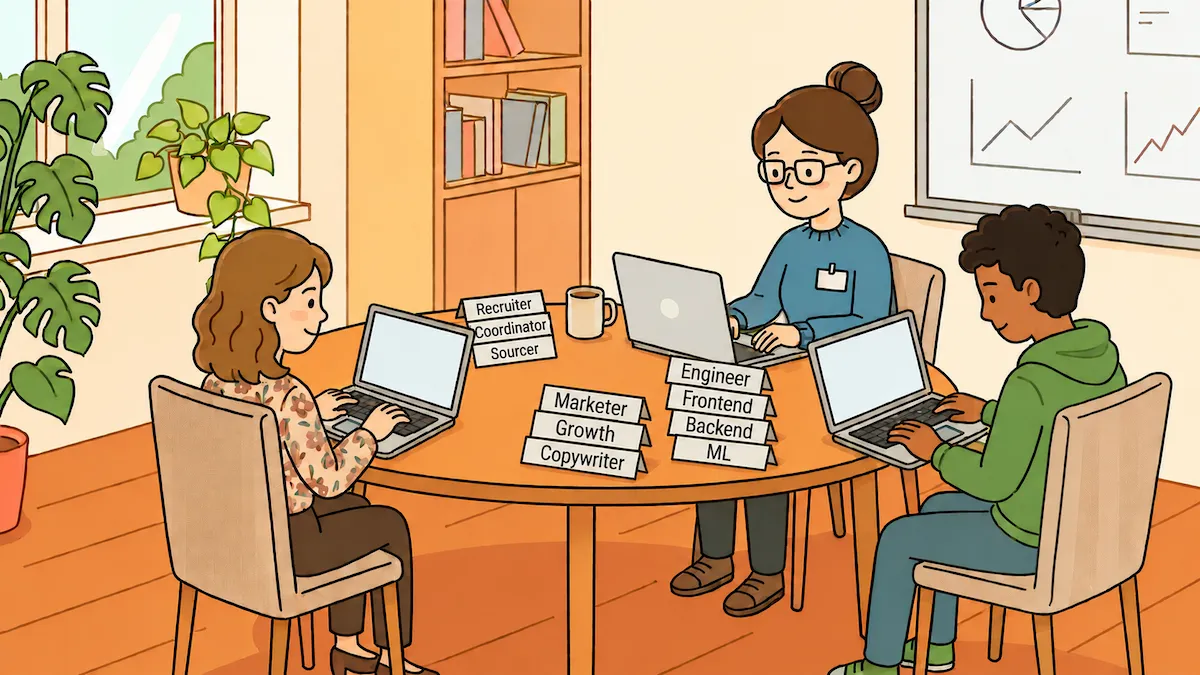
Take marketing. AI is helpful for drafting and editing marketing copy, gathering market data, and performing very basic data analysis. (In my experience, analyses by even frontier models are frequently wrong. So do use AI to help with your data-science tasks, but don’t blindly trust its confidently stated conclusions!) This frees up marketers to spend more time on higher-level tasks. I’m seeing that rather than specializing in narrow marketing roles like social media marketer or copy editor, AI-native marketers are rising up to help coordinate broader marketing campaigns end-to-end, from conception to multi-threaded execution to analyzing lessons learned.
Just as AI is turning many specialized developers (like frontend, backend, mobile, etc.) into full-stack developers, I am seeing early signs that it is turning many more marketers into full-stack marketers.
Or take recruiting. Some companies have separate roles for sourcer (who finds candidates online), coordinator (who handles scheduling) and recruiter (who runs the hiring process). But sourcing is increasingly automated, and coordination also partially automated. As a consequence, I’m seeing more AI-native recruiters run the full-cycle themselves, doing all of the above.
As AI enters more fields, I expect more people to start to play “full-stack” or “full-cycle” roles within their disciplines, meaning they will play broader roles that integrate traditionally separate roles. This lets individuals do more, and I believe it will ultimately lead to increased demand for skills as well as higher pay.
The broader pattern is this: In many job roles, as you rise in seniority, you become better at managing integration complexity — weaving together many disparate work streams like frontend, backend and data engineering to form a greater whole. As AI automates certain parts of one’s work — usually the more verifiable parts — it creates more room for individuals to play broader roles.
This pattern is not applicable to all job roles. In some, rising in seniority means increasing specialization. This corresponds loosely to people progressing in the IC (individual contributor) career track rather than the managerial/tech lead track. For example, a machine learning engineer acquiring extremely deep understanding of a technical niche, a financial expert growing from a generalist finance analyst to a specialist in an important sector (such as auditing cross-border deals), or a medical doctor developing deep expertise in just one medical condition. In many, but not all, such areas, I expect the demand for human skill to grow, but AI’s impact on any specialty will depend on how rapidly AI’s jagged frontier advances along that dimension. I’ll share more on this in a future letter.
Until then, I invite you to consider: Back in 2022, what tasks would your teammates have done? Those were likely complements to what you are doing. So if you are able to use AI to do more of those tasks yourself — which might require learning new skills — it could be one path to you becoming more effective with AI.
Keep building!
Andrew